

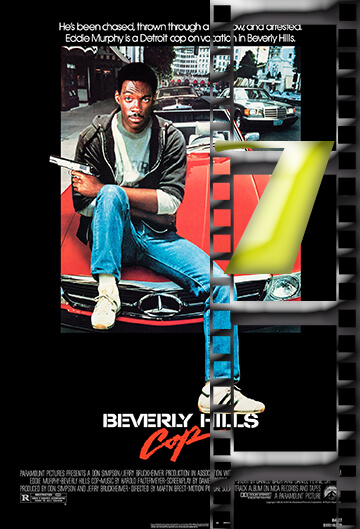
WHAT’S IT ABOUT
After his childhood buddy is murdered while visiting Detroit, rebellious cop Axel Foley (Eddie Murphy) follows the leads to Beverly Hills, Calif., under the auspices of a vacation. He checks in with old friend Jenny Summers (Lisa Eilbacher) and starts to believe her boss, art dealer Victor Maitland (Steven Berkoff), might somehow be involved in the murder. However, Lt. Bogomil (Ronny Cox) of the Beverly Hills Police Department does not trust Foley, and hinders his search for evidence.

MOVIESinMO REVIEW
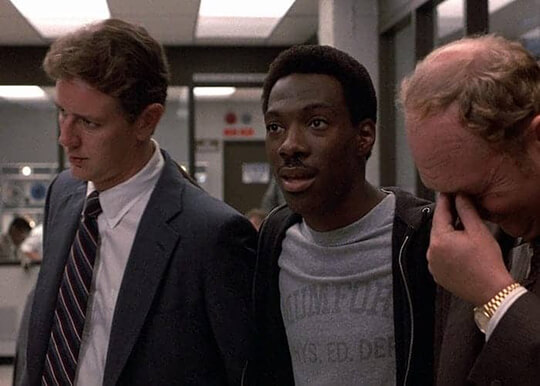
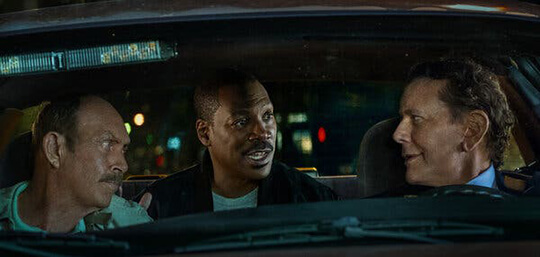
Forty-one years after its release, “Beverly Hills Cop” remains a fascinating cultural artifact that reveals as much about American racial dynamics as it does about 1980s action-comedy filmmaking. Eddie Murphy’s breakout vehicle, which grossed over $230 million domestically and spawned multiple sequels, deserves examination through both the lens of its initial reception and contemporary sensibilities. When “Beverly Hills Cop” hit theaters in December 1984, it was genuinely groundbreaking. The fresh “Saturday Night Live” star Eddie Murphy was the first African-American lead in a major studio action-comedy that wasn’t advertised as a “Black film.” Director Martin Brest made a movie that allowed Murphy’s comedic genius to shine while fulfilling the action thrills that an audience of a Jerry Bruckheimer movie would expect. Contemporary critics were almost uniform in their praise. Roger Ebert praised Murphy’s “street-smart intelligence” and the film’s ability to blend comedy and action. Janet Maslin of The New York Times observed Murphy’s “spectacular comic timing.” Black critics at the time, though fewer in mainstream publications, were inclined to look at the film as a positive evolution – here was a Black hero who was able, intelligent, and successful if he operated outside of traditional law enforcement chain-of-command. The box office hit was revolutionary in sentiment because Axel Foley was not just defined by his Blackness. He was a talented detective whose Blackness informed his character without stereotyping him. In 1984, this sort of representation felt like progress. Murphy’s Axel Foley remains one of the most fascinating protagonists of the film. He’s street-smart without being criminalized, funny without being emasculated, and able without being superhuman. The Detroit roots are not incidental. They are fundamental to defining the intersection of class, regional identity, and race in America. The interactions with the (mostly) white, upper-middle-class elite of Beverly Hills set up Foley as the point of tension for the film. His methodology, charming access to trendy clubs, impersonating authority figures, and using humor over guns, breaks the action hero mold but serves as a platform for Murphy to showcase his comedic talent. The classic “Banana in the Tailpipe” scene remains a lesson in timing and character comedy. Foley’s achievement, however, is often based on code-switching and performance, having to change his personality to navigate white spaces for the first time. Although this shows us his cleverness and adaptability, it also reinforces the exhausting reality of Black Americans – one has to water down one’s authentic self to be accepted and succeed. The film’s racial politics were complicated in 1984 and are so now. Foley experiences overt racism (the club scenes) and microaggressions (ongoing challenges to his credentials), but the film addresses these scenes in varying degrees of nuance. Certain scenes are dated and cringe-inducing by today’s standards. Foley’s Blackness is deployed to produce easy laughs at times in the movie, particularly when his appearance in Beverly Hills settings of the upscale kind causes humor through others’ unease. What was maybe transgressive in 1984 – a Black man asserting himself in white elite space – can today feel like it’s asking viewers to find humor in racial unease rather than to probe it. The minor characters bring additional shades of complications. Judge Reinhold’s Billy Rosewood and John Ashton’s John Taggart represent two shades of white supporters but are too frequently created to exist for Foley’s benefit rather than as legitimate characters. The way in which the film treats its few female characters, most notably Lisa Eilbacher’s Jenny Summers, is similarly disturbingly old-fashioned. In other ways, with the exception of its racism, “Beverly Hills Cop” works as entertainment. Brest’s direction is tremendous pacing, blending action sequences with character development. The iconic Harold Faltermeyer theme, particularly the synthesizer-heavy “Axel F” theme, suits the film’s cheerful tone as well as the decadence of the 1980s. The action sequences, while not very original, are serviceable in the context of the movie. The film wisely plays on Murphy’s comedic timing and improv skills rather than trying to make him an ordinary action hero. This is effective by letting his natural charm propel the film. The Beverly Hills setting is more than a location. It’s a character representing American privilege, wealth, and the cultural divide between suburban and urban America. The design for “Beverly Hills Cop” effectively contrasts the rough-around-the-edges grit of Detroit with Beverly Hills’ gilded surfaces, highlighting the cultural and economic messages. Is “Beverly Hills Cop” suitable for today? The answer is complex. The major premise of the film – a capable Black hero who thrives through intellect and cleverness – is sound. However, several things would be called into question in today’s debate. The style of police work in the film appears particularly antiquated in the context of current controversies about law enforcement and responsibility. Foley’s maverick approach, although enjoyable, involves numerous legal transgressions that the movie uses as harmless humor. In our recent debates over police reform, this frivolous disregard for procedure might provoke other reactions. Some of the humor also relies on racial and cultural stereotypes that no longer have as free a pass in contemporary society. The film’s occasional LGBTQ+ jokes are particularly embarrassing by modern standards. Despite all these fears, “Beverly Hills Cop” would remain popular today, though for reasons other than in 1984. Murphy’s comedy acting remains genuinely amusing, and the pace and tension of the movie remain infectious. B Walls modern audiences might appreciate the movie’s relative restraint – it achieves its R-rating by way of obscenity and not through gratuitous violence or carnality. Younger audiences might be unsettled by the 1980s sensibilities and pace of the film, and the pace is slow compared to contemporary action comedies. But Murphy’s charm transcends time, and the issues of class and cultural difference remain today. The film could also benefit from greater media literacy on racial representation among modern audiences. Audiences today may be more able to appreciate the depth of Foley’s character and the nuance of Murphy’s acting, even as they acknowledge the limitations of the movie. “Beverly Hills Cop” is an influential film that should be recognized for its influence on American culture. It’s also an important moment in Hollywood’s gradual efforts to improve Black representation, even as it is also a depiction of the incomplete nature of those efforts. The film works as a vehicle for Eddie Murphy’s amazing talent and as a 1980s time capsule of American society. Its shortcomings – the period humor, police stereotypes, and lack of women on the screen – don’t take away from its historical significance or Murphy’s success. For contemporary audiences, “Beverly Hills Cop” is enjoyable, and it is also educational about the way that racial representation in Hollywood movies has progressed. It’s not the liberal classic that some remember, nor the period piece others would expect, but rather a densely textured film that rewards close analysis. The film’s classic status and continued cultural references suggest that viewers still find Axel Foley’s iconoclastic wit and Murphy’s engaging on-screen presence appealing. While not the pinnacle of racial success in front of the camera, it is a significant benchmark deserving of revisiting – in its rightful place in historical context and critically. A culturally sensitive action-comedy that serves up superior comedic performances alongside capturing the successes and failings of 1980s Hollywood inclusivity.
OUR RATING – A BEVERLY HILLS 7