

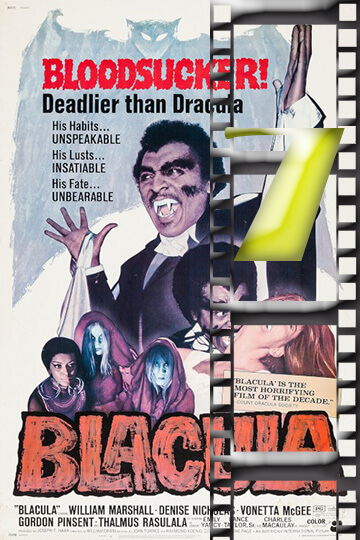
WHAT’S IT ABOUT
During a visit to Transylvania, an African prince (William Marshall) gets turned into a vampire by Count Dracula (Charles Macaulay). Sealed in a coffin for several lifetimes, “Blacula” reawakens in 1970s Los Angeles. Leaving a trail of bloodless victims in his wake, he pursues Lina (Vonetta McGee), a woman who bears a striking resemblance to his dead wife. Meanwhile, Dr. Gordon Thomas (Thalmus Rasulala) and top cop Lt. Peters (Gordon Pinsent) are hot on the bloodsucker’s trail.
MOVIESinMO REVIEW
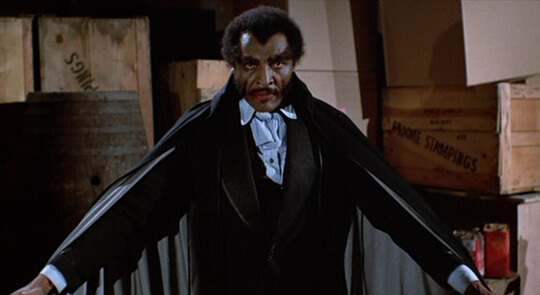
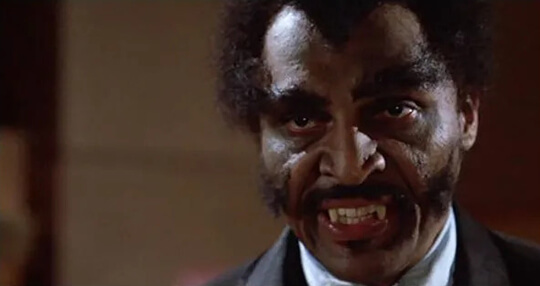
William Crain’s “Blacula” stands as one of the most fascinating and contradictory entries in the blaxploitation canon of the 1970s. Starring William Marshall in a performance that elevates the entire production, this vampire film attempts to blend Gothic horror with contemporary urban drama, creating something that was both groundbreaking and problematic for its time—and remains equally complex when viewed through today’s lens. “Blacula” tells the story of Mamuwalde, an 18th-century African prince who seeks Count Dracula’s help in ending the slave trade, only to be cursed as a vampire and sealed in a coffin for two centuries. When antique dealers accidentally resurrect him in 1970s Los Angeles, he embarks on a quest for both blood and his reincarnated love, Tina (Vonetta McGee). The film’s opening scene, which occurs in Dracula’s Transylvanian castle, quickly indicates the film’s intentions are serious. Marshall’s Mamuwalde is no cliched monster, but rather a nobleman in exile who, in a sense, is both literally and metaphorically the recipient of colonial violence when he is turned into Blacula. There is no overstating the stature of William Marshall’s performance. Standing at 6’5″ with a classically trained theatrical background, Marshall brings Shakespearean gravitas to what could have been a purely exploitative role. His Mamuwalde is simultaneously regal and tragic, a character who commands respect even as he terrorizes Los Angeles. Marshall insisted on rewriting much of his dialogue, removing what he considered demeaning language, and his advocacy shows in every scene. This is not the bumbling, comic relief Black character that dominated much of 1970s cinema, but a complex antihero whose very existence critiques the horror genre’s traditional power structures. When “Blacula” premiered in 1972, mainstream critics largely dismissed it as cheap exploitation fare. The New York Times review was perfunctory, focusing more on the film’s obvious budget constraints than its thematic ambitions. White critics seemed uncomfortable with the film’s racial politics, often reducing it to a novelty act—”Dracula, but Black.” However, Black audiences and critics recognized something different. The film became an important box office hit, particularly in urban markets, because it offered something rarely seen: a Black protagonist who was powerful, articulate, and uncompromising. Contemporary criticism of “Blacula” was also split along racial lines regarding the blaxploitation genre itself. While some Black intellectuals criticized these films for perpetuating negative stereotypes, others argued they provided rare opportunities for Black performers and addressed urban experiences ignored by mainstream Hollywood. “Blacula” occupied a unique space in this debate because Marshall’s dignified performance and the film’s anti-colonial subtext elevated it above typical exploitation fare. Today’s critical reassessment has been far more generous and nuanced. Modern critics recognize “Blacula” as a significant work that used horror conventions to explore themes of cultural displacement, historical trauma, and Black masculinity. The film’s representation of Mamuwalde as an object of white supremacist violence who metamorphoses into a monster speaks to the larger issues regarding systemic racism and its mental repercussions. Academic film scholars have found the film’s subversive elements particularly compelling, discussing how it effectively constructs a narrative through the lens of the vampire canon that is characteristically white and European, to one more relevant to the Black American experience. The film is most effective at a base level by taking its premise seriously. Unlike many of its blaxploitation counterparts, “Blacula” refuses to utilize camp and irony to commodify its Gothic image to a humorous effect. “Blacula” leans into its Gothic aesthetic, and there is visual continuity from past to present in the costumes, especially Marshall’s period-specific garments reflecting African royalty. The datedness of the makeup effects do a deliberate service to Marshall’s transformation into a genuinely creepy creature. In contrast, “Blacula” remains a product of its time and budget limitations, routinely stifling the film’s pace, notably in its midsection; several of these scenes undercut what the viewer would otherwise view as essential to the narrative and character development. Likewise, some of the supporting performances are underdeveloped compared to Marshall’s central performance, and the film at times falls into clichéd exploitation that it has otherwise overcome. The romantic plot, while necessary for the film, felt neglected in some places, which could have benefitted from a more serious examination of Tina’s agency, the effect of violence on her character and perspective of the narrative. There is again complexity to the way women are handled in this film. While Vonetta McGee’s Tina is portrayed as intelligent and independent, she ultimately becomes a prize to be won rather than a fully realized character. This reflects broader issues within both the horror genre and blaxploitation films, where women often served primarily as motivation for male protagonists rather than as subjects in their own right. “Blacula” is still very much watchable and relevant by today’s standards. The way the film engages with historical trauma can be seen in the ideas of generational trauma today and the continued traumatic legacy of slavery. Mamuwalde’s battle with his monstrosity can be understood as a representation of the psychological violence of racism and colonialization. Modern audiences might find some elements dated—the 1970s urban setting, certain dialogue choices, and some technical aspects—but the core themes remain powerful. The film’s unapologetic Blackness still feels radical in a horror genre that continues to struggle with meaningful diversity. Recent films like “Get Out” and “Candyman” owe a debt to “Blacula’s” pioneering work in using horror to explore racial dynamics. The question of acceptability for contemporary viewing is complex. While the film contains some problematic elements typical of its era—occasional stereotypical characterizations and the male gaze’s treatment of women—these issues are largely overshadowed by its progressive elements. “Blacula” would likely find appreciation among modern audiences interested in horror history, Black cinema, and films that use genre conventions to explore serious themes. “Blacula” functions as both a period piece and a sustained epistolary subtext about power, identity, and historical violence. It is by no means a flawless film, but it is an important moment in cultural history, as it marks the moment when Black filmmakers and performers began to take control of their stories as the protagonists, antagonists, and supporting roles in popular genres at the time. Just the dynamic performance of William Marshall is reason enough to watch “Blacula,” but also because it is an interesting way to engage with more serious ideas. Ultimately, “Blacula” provides entertainment and education for audiences today. It demonstrates how genre films can serve as vehicles for social commentary while providing insight into how Black artists navigated and subverted exploitative industry practices. The film’s influence on subsequent horror films and its role in expanding representation in genre cinema cannot be understated. Would people today like “Blacula”? Audiences interested in horror history, Black cinema, or films that challenge genre conventions would likely find much to appreciate. While it may not satisfy viewers seeking modern production values or contemporary sensibilities, viewers wanting to engage with the film on its own terms will discover a work that remains surprisingly relevant and powerful more than five decades after its release.
OUR RATING – AN AMBITIOUS 7