

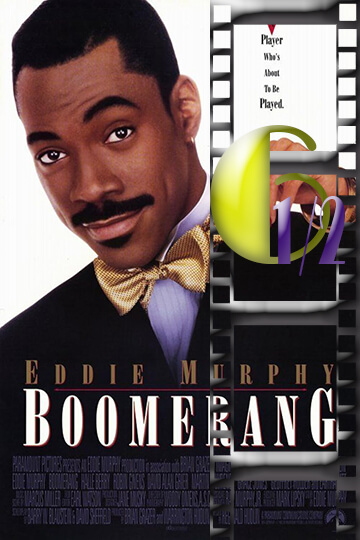
WHAT’S IT ABOUT
A cocky ad executive, Marcus (Eddie Murphy) has a reputation as a ladies’ man. However, Marcus gets a taste of his own medicine when a merger finds him working under the beautiful Jacqueline (Robin Givens), who has a similarly cavalier attitude about romance. Marcus and Jacqueline become involved, but he is put off by her noncommittal approach to their relationship. Meanwhile, Marcus also begins to develop feelings for the pretty Angela (Halle Berry), who is more thoughtful than Jacqueline.
MOVIESinMO REVIEW
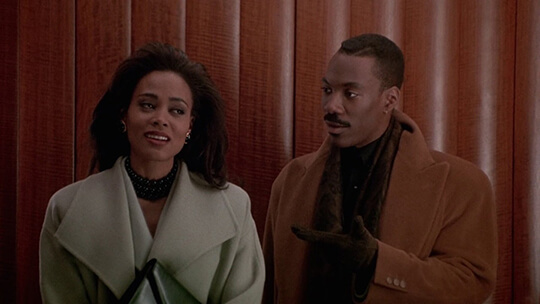
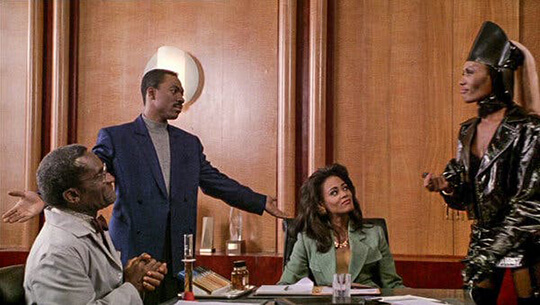
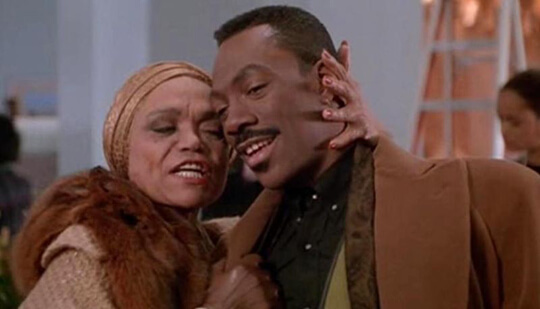
Thirty-three years after it came out, Reginald Hudlin’s “Boomerang” is a compelling site for Black film—a film that was forward-thinking and flawed when it first released, and so too when viewed in the context of now. This romantic comedy featuring Eddie Murphy is due for scrutiny not only as entertainment but as a cultural product that indicates just how far we’ve come and how far we still need to travel. When “Boomerang” opened in July of 1992, it followed the heels of a revolutionary period for Black cinema. Spike Lee already shook Hollywood with “Do the Right Thing” and “Malcolm X” opened just a few months later. John Singleton’s “Boyz n the Hood” was up for Oscars the previous year. Against the background of serious, socially aware Black filmmaking, “Boomerang” was something else. It was a gripping, mainstream romantic comedy that had the nerve to focus on successful Black professionals in corporate America. Reviewers of 1992 were generally favorable, acknowledging the film’s depiction of wealthy Black life. Roger Ebert gave it three stars, commenting on how great it was to see Black actors in roles typically played by white actors. The film was applauded for its stunning cinematography, Black cast, and crew in front and behind the camera, and unapologetic portrayal of Black excellence in corporate settings. But even that, some writers noted, had the problems of gender dynamics in the film. Murphy’s Marcus Graham was the typical player—a man who sleeps with women but keeps them at arm’s length, only to be shown a lesson when he encounters Robin Givens’ Jacqueline Broyer, a woman who treats him the same way that he does her. What was groundbreaking about “Boomerang” back in 1992 was its visual language. There were Black people in power, living in nice apartments, wearing bespoke suits, and holding corporate boardrooms hostage. The film’s production design, directed by Charles Bennett, created a universe where Blackness and success existed together in perfect harmony—no explanations required, no struggle motifs necessary. The character actors are a roll call of Black stars: Halle Berry, Robin Givens, David Alan Grier, Martin Lawrence, Tisha Campbell, and Grace Jones all performed well. There was wonderful music, too, from artists like Boyz II Men, Toni Braxton, and Kenneth “Babyface” Edmonds, and the soundtrack became as much a part of pop culture as the film itself. From the perspective of 2025, “Boomerang’s” treatment of women and sex looks extremely questionable. Marcus Graham is not merely a player—he’s emotionally manipulative and treats women like throwaway objects for his gratification. The film makes this kind of treatment normal, even endearing, until the time when he is treated the same way by Jacqueline. The so-called “comeuppance” plot doesn’t hold up under modern scrutiny. Marcus doesn’t actually learn respect for women; he just becomes attracted to someone who makes him weak. His character development is selective empathy rather than genuine growth—Marcus only feels for women when he’s directly affected by the same actions. Robin Givens’ Jacqueline is icy and manipulative, embodying the old stereotype of the successful woman as emotionless by definition. While the film attempts to make her Marcus’s equal, the film ultimately punishes her for having the same sexual agency that it rewards him. Most disturbing is the way in which the film treats Halle Berry’s Angela Boisterous. She is the typical “good girl”—patient, tolerant, and willing to wait around for Marcus to recognize her worth. The film suggests that Angela’s niceness and willingness to wait render her more lovable than Jacqueline’s confidence and sexual autonomy. This dichotomy between the “good” woman who waits and the “bad” woman who takes what she wants reinforces negative stereotypes about female sexuality and agency. Angela’s character lacks the complexity that makes her an actual person rather than a prize to be uncovered. Imperfect as it is, “Boomerang” left a lasting impact on Black cinema and popular culture. It demonstrated that Black romance and comedy movies could thrive financially independent of the urban strife genre. The movie grossed more than $131 million at the worldwide box office, illustrating there was a demand for diverse material in the marketplace. The movie also kick-started or enhanced several careers. It was one of Berry’s major starring roles, making her one of the main ladies. Martin Lawrence’s performance as Tyler showed him to be more than a stand-up comic. The commercial success of the movie set the stage for future black romantic comedies in the 1990s. The plain truth is multifaceted. “Boomerang’s” subtext, a womanizing male learns to love, may be true in 2025 but would require re-doing. Modern audiences, particularly younger ones who have grown up with more enlightened tales of consent and emotional competence, would judge Marcus’s behavior as abhorrent rather than charming. A remake would require actually grappling with the harm that he causes and providing actual character development. The females in his life would need agency more than the sake of advancing his character arc. The film would need to acknowledge that emotional manipulation and playing people for sex are not whimsical personality quirks but patterns of behavior that cause real damage. What remains most robust about “Boomerang” is its visual presentation. The look of the film, from the stunning cinematography to the fashion to the production design, is still aspirational and beautiful. Observing successful Blacks traverse corporate America, reside in beautiful places, and exist without explanation or justification continues to leave its mark. The soundtrack of the movie also remains a classic of early 1990s R&B. Such hits as Boyz II Men’s “End of the Road” and Toni Braxton’s “Love Shoulda Brought You Home” became classics that overshadow the movie itself.”Boomerang” is a relic of its time that also has positive portrayals and disturbing messages. Although its Black success image and Black talent celebration remain admirable, its treatment of women and relationships is now dated and problematic. For contemporary viewers, the film is best understood as a cultural artifact—a portal into how we used to speak of love, sex, and relationships and how our discourse has evolved. It’s a well-made film with great performances that are ultimately undermined by its retro-gender politics. The film would likely find an audience today with viewers nostalgic for 1990s culture and film buffs interested in Black film history. But it would probably not register with younger audiences who are used to freer and more liberal examinations of sex and relationships. “Boomerang” remains a worthwhile film in the history of Black cinema, but one that must be viewed critically, not uncritically celebrated. It’s a reminder that representation is necessary, but it is not enough. The narratives that we present and how we present them are as significant as to whom we permit to present them.
OUR RATING – A MURPHY ASSESSED 6.5