

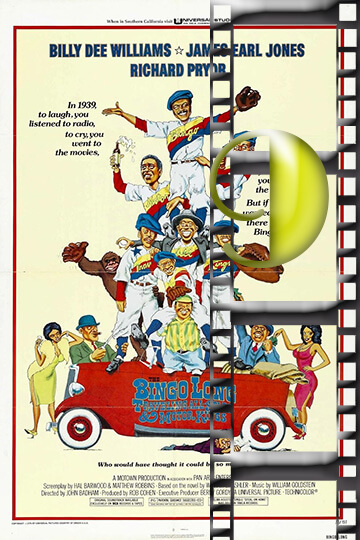
WHAT’S IT ABOUT
Top baseball pitcher Bingo Long (Billy Dee Williams) is fed up with how his Negro League team owner treats him, so he forms his own lineup, recruiting big-hitting Leon Carter (James Earl Jones) and Charlie Snow (Richard Pryor), who dreams of playing in the majors. Boycotted by black teams, Long’s outfit play minor league white teams, earning more attention as entertainers than as players. However, their success wins them a chance to play again in the Negro League, this time as equals.
MOVIESinMO REVIEW
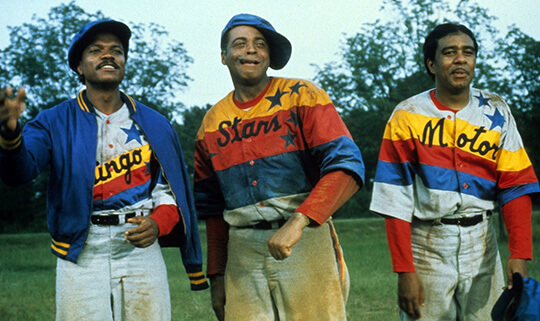
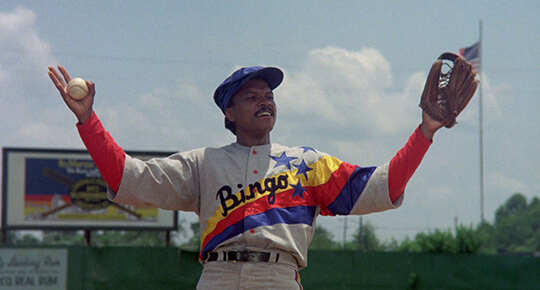
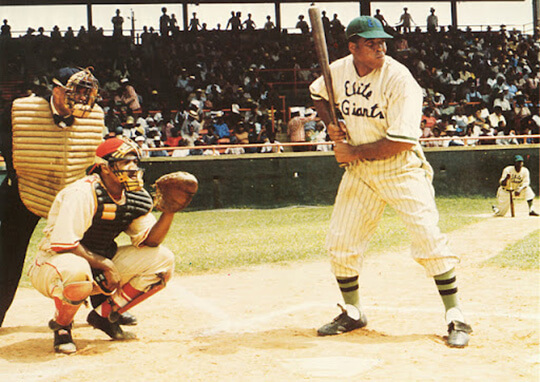
When “The Bingo Long Traveling All-Stars & Motor Kings” came out in 1976, it was a shock: a big Hollywood movie all about the Negro Baseball Leagues of the 1930s. Featuring Billy Dee Williams, James Earl Jones, and Richard Pryor at the top of their game, the film brought audiences along on a road trip through America’s segregated past with an unlikely mix of comedy, drama, and historical perspective. As a Black film critic watching this film almost fifty years after it was produced, the most obvious to me is how the film holds a singular place in history – revolutionary during its era and yet limited by the filmmaking conventions of the 1970s. The tale is of Bingo Long (Williams), a charismatic pitcher who rebels against the greedy Negro League owners by creating his own independent barnstorming team. He is accompanied by power-hitter Leon Carter (Jones) and slapstick comedian Charlie Snow (Pryor), barnstorming the Midwest playing exhibition games and flashy “Clown Ball” to attract white fans while keeping one step ahead of the vindictive league owner trying to crush their independence. Upon release, the film’s performances and its delicate touch with challenging subject matter were well received by most critics. Whereas the majority of white critics concentrated on the movie’s value as entertainment, Roger Ebert described it as “a good-natured movie, not so rough as it might have been, not so angry as you might have expected.” Black critics tended to remark on something more profound: here was a Hollywood movie that portrayed Black business ownership, mutual aid, and opposition to economic exploitation – subjects not usually treated in movies in the 1970s. By today’s standards, “Bingo Long” is a film ahead of its time in some ways but very dated in others. The film’s greatest strength remains its incredible cast. Williams imbues Bingo with charisma and dignity, avoiding stereotypes in his portrayal of a man fighting for autonomy in a system designed to deny it. Jones brings gravitas as the team conscience, and Pryor – less bombastic here than in his stand-up persona – offers comic relief that usually conceals ulterior motives. However, modern audiences may find the tone of the movie inconsistent according to today’s standards. Director John Badham (who went on to direct “Saturday Night Fever”) uses a light hand that sometimes undermines the serious topic of racism and exploitation. The movie veers between broad comedy, melodrama, and social commentary in a way that can seem choppy to modern sensibilities used for more targeted messaging. Historically, the film deserves a lot of credit for bringing focus to the Negro Leagues at a time when their story was still little told in the mainstream media. Even though the Baseball Hall of Fame had only begun inducting Negro Leagues players around the time the film was made, “Bingo Long” helped popularize these forgotten stories, albeit in fictionalized forms. Contemporary audiences would be surprised at the way the movie deals with race issues. Unlike the typical 1970s films, “Bingo Long” does not have white savior figures and racial tension as the predominant theme. Rather, it depicts a universe of Black characters with interior lives, aspirations, and complicated motivations. The villains are all other Black characters – especially the team owners who exploit them – so this is a tale of intra-community relations instead of Black-white relationships. The movie is not afraid to lay bare the realities of Jim Crow America. It depicts white audiences both as exploitative and entertained by Black sporting greatness. A chilling scene depicts the team bus being pulled over by racist police, showing the day-to-day threats that Black Americans faced while navigating hostile territory. Where “Bingo Long” doesn’t hold up for modern audiences is in its handling of women. Women are secondary characters and are seen as little more than love interests with precious little agency of their own. This is a reflection of both the male-dominated world of sports being depicted and 1970s Hollywood storytelling in general. The film’s production values continue to be stunning. The period detail – from the beautiful old uniforms to the Depression-era rural landscapes – is evocative and convincing. John Williams’ score incorporates jazz instrumentation into his usual orchestral approach to evoke the period without pastiche. Would today’s audiences appreciate “Bingo Long”? I believe they would, particularly those with an interest in sports history and Black cultural stories. The overall messages of economic self-determination and resistance to exploitation remain timely. The acting continues to sparkle with charisma and nuance, particularly from Williams and Jones. Contemporary audiences may long for a darker, less sentimentalized depiction of the period’s racism or a more profound examination of the Negro Leagues’ place in history. The movie occasionally prioritizes entertainment over historical accuracy. Yet what continues to make “Bingo Long” succeed is its celebration of Black joy, ingenuity, and perseverance amidst systemic racism – attributes that supersede era-specific filmmaking sensibilities. With changing cultural attitudes, certain aspects of comedy may be interpreted differently today. The “clowning” acts the team performs to entertain whites – although historically accurate – are perilously close to depicting and possibly reinforcing stereotypes. But, the film situates these acts as deliberate business stratagems by the characters and not as essential characteristics, which makes these scenes more nuanced. “Bingo Long” continues to be important as Hollywood’s one of the few efforts to dramatize this crucial chunk of Black American history. Its commercial success opened doors for subsequent sports films focusing on Black life, and its shortcomings are emblematic of the limitations of its time. For audiences today, it is both an entertainment and cultural artifact – a window into how Hollywood was starting to address Black stories in the mid-1970s. In returning to this film today, I am struck by how it is a significant waymark in the evolution of Black cinema – imperfect but pioneering, entertaining as well as educational. For audiences today wanting to know more about Negro League history as well as Black image in American film, “Bingo Long and the Traveling All-Stars & Motor Kings” is still a must-view, imperfections and all.
OUR RATING – A STATISTICAL 9