

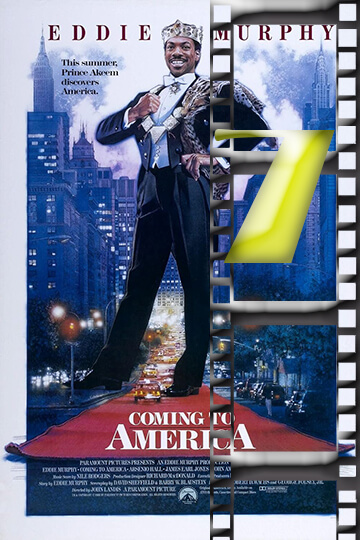
WHAT’S IT ABOUT
Prince Akeem (Eddie Murphy) is the prince of a wealthy African country and wants for nothing, except a wife who will love him in spite of his title. To escape an arranged marriage, Akeem flees to America accompanied by his persnickety sidekick, Semmi (Arsenio Hall), to find his queen. Disguised as a foreign student working in fast food, he romances Lisa (Shari Headley), but struggles with revealing his true identity to her and his marital intentions to his king father (James Earl Jones).
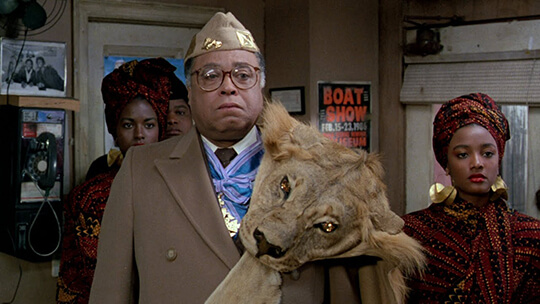
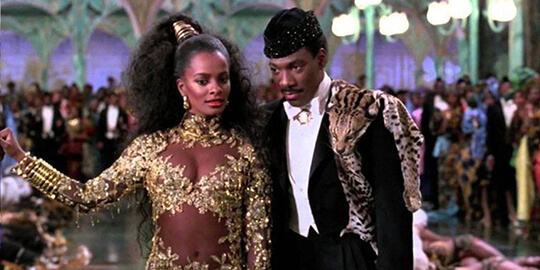
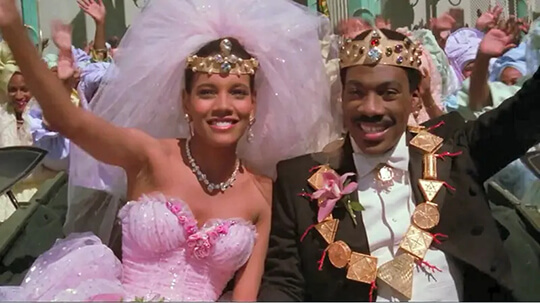
MOVIESinMO REVIEW
When John Landis’s “Coming to America” came out in the summer of 1988, Eddie Murphy’s box office dominance was at its peak. Basking in the blockbuster “Beverly Hills Cop” and “Trading Places,” Murphy’s turn as African Prince Akeem searching for romance in Queens cemented his status as Hollywood royalty. As a film that has remained culturally significant for over three decades, it’s worth considering how this comedy classic is interpreted differently through contemporary lenses. When it opened, critics were split. Some complimented Murphy’s charm and the film’s fish-out-of-water humor, but others called it formulaic and faulted its use of stereotypes. The Washington Post branded it “hollow and wearying,” while Roger Ebert enjoyed its “charm and comic invention.” What most critics conceded was Murphy’s magnetic star power and his rapport with Arsenio Hall, whose several character makeovers with Murphy were a showstopper. As a Black filmgoer in 1988, “Coming to America” was groundbreaking simply for existing. Here was a major studio comedy with nearly all-Black casting that didn’t involve crime, poverty, or racial tensions. Instead, it presented a fantasy realm of African royalty and Black American life that, while sometimes cartoonish, had genuine affection for its characters and places. The imaginary Zamunda could have been a Hollywood construct of African stereotypes (over-the-top palaces, exotic beasts, too much servitude), but it was portrayed on a scale reserved for white characters. Queens, meanwhile, was not portrayed as a crime-infested ghetto but as a people with ambition, pride, and heart. For Hollywood of the 1980s, this was a breath of fresh air. Audiences today, however, bring different sensibilities to the screening. The film’s gender politics date particularly poorly. Female characters exist primarily as romance objects or bodies to be objectified. That infamous nude women bathing scene with women attending to Prince Akeem in the nude would never make it into a serious comedy today. Lisa McDowell (Shari Headley) is otherwise strong but otherwise only gets to choose between competing suitors. The movie’s central romantic conceit—that Akeem lies to Lisa about his identity in order to gain her affection—would likely be subject to more scrutiny in our post #MeToo world. Africa itself, as well, receives a reprise. Played for farces, Zamunda is a collection of colonial-era stereotypes about royalty in Africa. The fictional nation has no roots in real African politics or history but is instead an exotic backdrop for Murphy’s journey to America. Contemporary audiences might ask why African prosperity had to be portrayed through such a Westernized, fairy-tale lens. But for all its old-fashioned flourishes, “Coming to America” possesses virtues that are still relevant today. First, its multiracial cast was groundbreaking in its time. Apart from Murphy and Hall, the film featured Black actors like James Earl Jones, Madge Sinclair, John Amos, and up-and-coming star Cuba Gooding Jr. The barbershop scenes featuring Murphy and Hall in multiple roles (as old Jewish and Black men who get into acrimonious arguments) remain masterclasses in character comedy and cultural observation. The movie also presents real insights into class divisions in Black communities. Akeem’s transition from privilege to working-class life provides social distinctions infrequently visited in mainstream comedies of the period. The irony between the McDowells’ aspirational capitalism (with Cleo McDowell’s overt emulation of McDonald’s) and Akeem’s royal lineage creates humor while addressing economic diversity within Black America. Above all, “Coming to America” succeeds because it balances its more distressing moments with genuine heart. Murphy acts Akeem with surprising delicacy, and his relationship with Lisa is genuinely tender. The film affirms Black excellence, desire, and unity without reference to the trauma stories that marked a lot of Black films of the period. Would contemporary audiences enjoy “Coming to America”? Absolutely, but perhaps more critically detached. The film’s quotable catchphrases (“The royal penis is clean, your Highness”), hallmarks (Sexual Chocolate!), and Murphy’s charming performance ensure it remains popular. The box office performance of the 2021 sequel only goes to testify to how deep-rooted an effect the original has had, with deference to changing sensibilities. Is it “acceptable” viewing? This is a measure of our evolving sensitivity to representation. “Coming to America” contains stereotypes and antiquated gender politics that are worth examining, not canceling. Rather than canceling troublesome classics, contemporary audiences can appreciate these works while acknowledging their shortcomings—perceiving both their position in history and how our common cultural awareness has expanded. To Black viewers in general, “Coming to America” remains significant for its positive portrayal of Black life. When Black screen characters were usually relegated to sidekicks or stereotypes, the movie created a universe in which Black people operated throughout the social strata—monarchs, entrepreneurs, barbers, and neighbors—with humaneness and dignity still in place. The technical achievements of the film also stand up. Oscar-nominated costume design by Deborah Nadoolman Landis, makeup effects by Rick Baker that allow Murphy and Hall to play several different roles, and a score by Nile Rodgers all gel with Landis’s confident direction to create a slick, fun package. “Coming to America” remains a cultural touchstone because of how it was able to balance commercial success with cultural specificity. Its Soul Glo jokes, McDowell restaurant jokes, and Black barbershop jokes are all resonant with lived experiences that are poorly represented in mainstream Hollywood. The failures of the film are due to its time, but its Black joy, Black romance, and Black community are timeless. Thirty-five years later, “Coming to America” is still a time capsule and a still-witty comedy. Its legacy is not just its comedic lines but how it helped expand Hollywood’s definition of what a Black-starring blockbuster could be—a lesson the industry continues to learn today.
OUR RATING – A ROYAL REASSESSMENT 7