

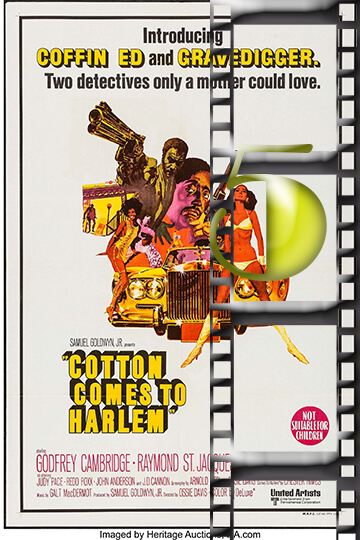
WHAT’S IT ABOUT
Harlem’s African-American population is being ripped off by the Rev. Deke O’Malley (Calvin Lockhart), who dishonestly claims that small donations will secure parcels of land in Africa. When New York City police officers Gravedigger Jones (Godfrey Cambridge) and Coffin Ed Johnson (Raymond St. Jacques) look into O’Malley’s scam, they learn that the cash is being smuggled inside a bale of cotton. But the police, O’Malley and lots of others find themselves scrambling when the money goes missing.
MOVIESinMO REVIEW
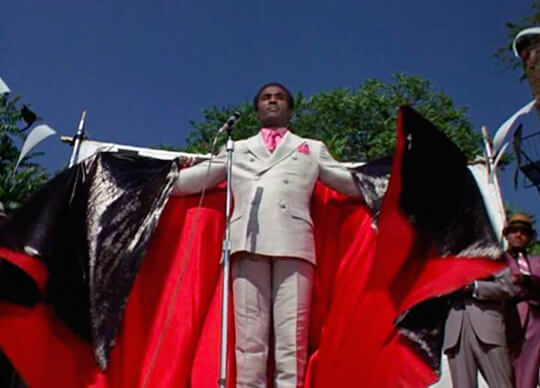
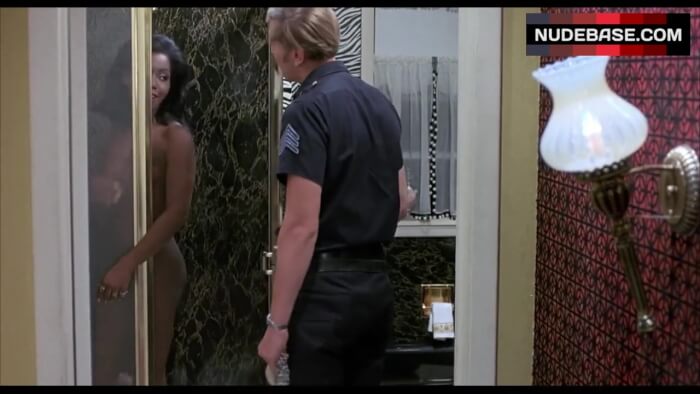
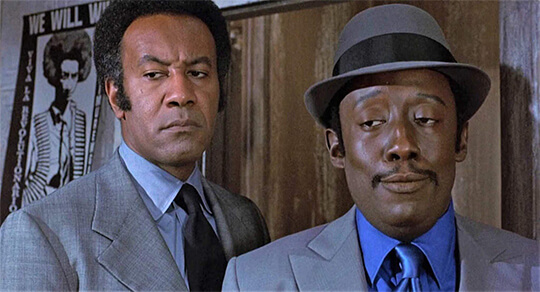
America was still reeling from the civil rights movement, the assassinations of Martin Luther King Jr. and Malcolm X, and the Black Power movement in 1970. Hollywood had traditionally offered Black actors stereotypical yet respectful parts, and very few Black directors were included in mainstream films. It is against this background that the movie “Cotton Comes to Harlem” unfolds with two Black detectives, Grave Digger Jones (Godfrey Cambridge) and Coffin Ed Johnson (Raymond St. Jacques). The detectives are on the trail of a bogus preacher who has conned the Harlem community out of $87,000 with a “Back to Africa” movement. A bale of cotton in which the money is hidden is the center of a suspenseful chase. Critics at the time disagreed about the film. White mainstream critics tended to discuss the film’s “blaxploitation” elements—such as its violence, sex, and stereotypes—without perceiving its greater significance. Black critics, however, perceived something greater: a film that represented Harlem in an unapologetically Black manner, with Black heroes outwitting both white authority figures and Black hustlers. Vincent Canby of The New York Times in 1970 wrote that the film was “crude in construction, but very funny in an explosively vulgar way.” This two-edged compliment showed how often critics simply did not understand what Davis was trying to do. What many critics did not see at the time (and which is clear now) is Davis’s good work as a director. The movie employs vibrant and colorful visuals to present Harlem in all its specificity. It presents the neighborhood as an actual, vibrant community rather than merely as a crime-ridden area as in films produced by white directors. The street scenes pulse with genuine energy, and the music, featuring excellent songs by Melba Moore, keeps pace with the rhythms of Black urban life. Godfrey Cambridge and Raymond St. Jacques deliver performances that shatter the two-dimensional, stereotypical representations of Black men common in film during this era. Their detectives are hard-boiled, intelligent, morally complex, and—most significantly—in control of their narrative. They are not straight men or sidekicks but the moral compass in an unethical world. The film’s humor, too often discounted in serious examinations, is politically biting. Davis uses satire to ridicule everything from white power structures to Black religious hustles preying on their own kind. The satire is biting and purposeful, using laughter as both a weapon and a balm. Reading “Cotton Comes to Harlem” today is to see both its groundbreaking nature and its shortcomings. Some of it undoubtedly is a product of its time—especially in its treatment of women. The female characters, like Judy Pace’s Iris and the different sex workers shown, are often seen only for their sexuality. This way of treating them, which was common in movies from the 1970s no matter the race, feels old-fashioned and is a problem by today’s standards. The film’s easy way of showing police violence—even when done by our main characters—feels different in America after Ferguson and George Floyd. Grave Digger and Coffin Ed use vicious interrogation methods that were funny or hip in 1970 but now remind us of police brutality, which was not what the film meant to imply. Still, a lot of the movie feels new and timely. Its condemnation of fake religious leaders cashing in on racial suffering could apply to numerous people today. It depicts how Black folks come together as a community despite being disregarded by the institutions. It is also a celebration of Black intellect, capability, and leadership that remains a singular phenomenon to this day. Modern audiences who watch “Cotton Comes to Harlem” would probably find plenty to appreciate, but context is hugely important. For those interested in the history of Black films, this is an important book. It serves to bridge the gap from the Sidney Poitier era to the more controversial blaxploitation films that came afterward. It initiated the Black action film without exploring some of the more troublesome elements of later films in this category. Black viewers today may enjoy watching Harlem depicted with genuine love and honesty by a Black filmmaker who obviously cared about the community he was portraying. The comedy in the movie remains humorous, the action sequences remain exciting, and its overall story of the resilience of the community resonates with people even after decades. Viewers accustomed to contemporary speed and quality may have to be a bit patient. The plot construction of the movie can be relaxed by today’s standards and some of the cultural references naturally date. Beneath all these surface distinctions, however, lies a film of genuine soul and purpose. “Cotton Comes to Harlem” deserves to be celebrated not just as entertainment but as a cultural milestone. It assisted in making Black directors commercially viable in Hollywood. It provided Black heroes and Black problems to resolve without white savior tropes. And it did so while providing actual entertainment. The film had a sequel, “Come Back, Charleston Blue,” and influenced a legion of Black directors in its wake. One can see its impact in everything from the buddy-cop conceits of “48 Hrs.” to the neighborhood-centric mysteries on modern shows like “True Detective: Night Country.” Would the film be “acceptable” today? That’s a complicated question. Some of the details would probably be changed in a modern remake, especially the way it treats women and ordinary violence. But the general ideas of the film—honoring Black intelligence, denouncing those who use racial unity for selfish ends, and showing Harlem with love—are still pertinent and applicable. “Cotton Comes to Harlem” is a lively portrait of a time when Black film was finding a sense of confidence. It is not perfect now, perhaps, but it’s a valuable, provocative, and historically insightful film. It is worth watching, offering a glimpse into the past, with themes that are just as pertinent in our own world of injustices.
OUR RATING – A RETROSPECTIVE 5