

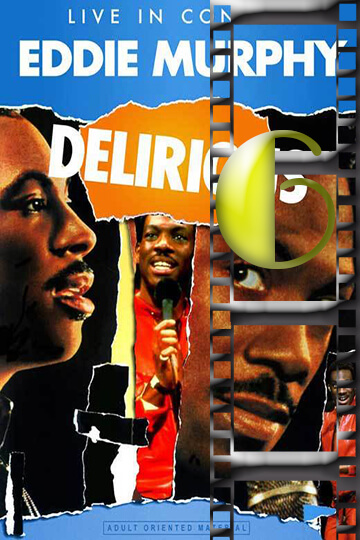
WHAT’S IT ABOUT
Comedian Eddie Murphy brings his proudly raunchy comedy act to a sold-out stadium and pontificates in his own vulgarly hilarious fashion on such subjects as sexual orientation, puberty, dating, disciplinarian mothers, ice cream trucks, and the personality traits of certain singers.
MOVIESinMO REVIEW
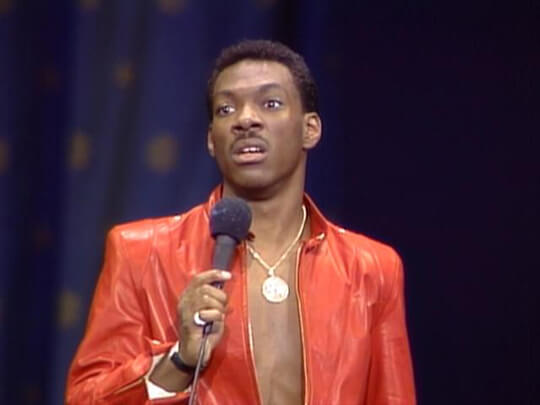
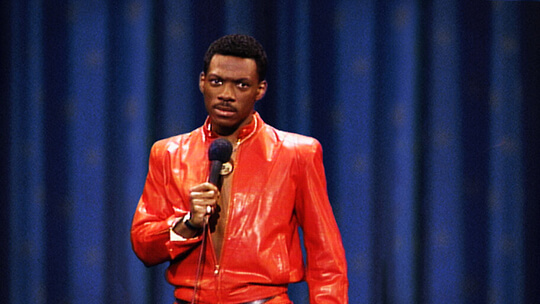
Eddie Murphy’s “Delirious,” recorded at his August 1983 performance at Washington D.C.’s Constitution Hall, is both a peak moment in 1980s stand-up comedy and a fascinating artifact that bears witness to how far our cultural horizon has shifted. To watch this special now is to walk the fine line between appreciating comedic excellence and confronting material that would be, in large part, unacceptable today. When “Delirious” debuted, it was a full-fledged cultural phenomenon. Murphy, just 22 at the time and basking in the glow of his “Saturday Night Live” stardom, performed what many considered the decade’s most charged stand-up routine. In 1983, critics were nearly unanimous in praise, with premier publications saluting Murphy’s unflinching attitude toward taboo subjects and his unsettling ability to bring to voice and body several characters without dialogue. Mainstream critics and the entertainment establishment mostly brushed over or skirted the uncomfortable aspects of Murphy’s work, while still praising his innate charisma and skill. Fans were called his “raw honesty,” “fearless comedy,” and ability to be provocative – all elements the special was heralded as innovative TV, as it brought black comedy club to the mainstream, partly for the first time! Murphy’s stand-up artistry in “Delirious” cannot be denied. His impersonations are flawless—watching him impersonate family members, celebrities, and stereotypical figures shows a performer in peak form. His physical comedy is not less impressive; Murphy’s entire body is a comedic instrument, from his exaggerated facial expressions to his dead-on imitation of anyone from his mom to Mr. T. The show’s premise brings Murphy on a string of observational jokes about home life, love, celebrity politics, and social interactions. His account of his upbringing in Roosevelt, Long Island, and his family life does have some genuinely insightful observations as far as Black family life and the generation gap go. His memories of his mother and grandmother are saturated with authenticity and affection and provide some sense of the kind of subtle cultural critique that would feature in his later work at its best. While much of what he uses relies heavily on homophobic slurs and stereotypes, far too common in 1980s comedy but far too objectionable these days. Murphy’s extended gay-bashing monologues, using language hate speech for today, constitute much of the special. These are not careless instances of bad judgment. They are central to much of his material. Seeing “Delirious” through the lens of the present is an uncomfortable case of cognitive dissonance. Murphy’s technical skill remains impressive, but much of the special is actually painful to watch. As a Black critic, I’m left struggling with the complexity of disliking an artist who was undoubtedly dismantling barriers while simultaneously reinforcing harmful stereotypes about marginalized groups. The homophobic content isn’t just dated—it’s actively harmful. Murphy’s frequent use of slurs and reduction of LGBTQ+ individuals to lowbrow stereotypes would rightly conclude careers today. What is particularly unsettling is how pervasive this content is in the special’s structure. You can’t simply skip over “problematic moments” because they’re woven throughout the performance. Murphy himself has attested to this. He apologized for the homophobic material in a 2019 interview, stating that he would not make those jokes today and that he’s “horrified” by some of what he’s done. That admission is valuable, but it doesn’t reverse the content or its legacy. “Delirious” necessarily opened the way for later Black comedians to be able to present their authentic voices on mainstream platforms. Murphy’s success opened doors and demonstrated that unapologetic Black comedy could appeal to massive crowds. Chris Rock, Dave Chappelle, and Kevin Hart owe a debt to Murphy’s trailblazing. The special is also a specific time in the history of comedy when shock and boundary-pushing were often mistaken for being innovative. The 1980s decade of comedy was dominated by comedians who used to speak the “unspeakable,” frequently without concern for how what they said in life impacted marginalized communities. The simple solution is no—”Delirious” never would be alright for release today, and it shouldn’t be. The homophobic content alone would prevent any of the big platforms from releasing it. Other than the offending material, much of Murphy’s relationship humor relies on dated gender expectations that are awkward rather than transgressive. Much of the rest of Murphy’s other observational humor about life with his family, his impressions of celebrities, and his take on life as a Black person in America are still genuinely funny and clever. These are the parts that explain why Murphy was such a vital presence in comedy—he had something particular to communicate and the charisma to communicate it convincingly. To contemporary audiences, “Delirious” is a difficult watch. Younger audiences, and particularly those who are LGBTQ+, would find a lot of it genuinely offensive rather than being provocative. Even those who are able to look beyond Murphy’s technical skill will take issue with the moral implications of laughing at something that is actually hurtful. The special is best described as a historical record—a snapshot of what American comedy was like in 1983, both in terms of what it could do and where it fell short. It reminds us how far we’ve come culturally while also flagging some long-standing blind spots around how marginalized communities are represented in entertainment. “Delirious” is significant due to its historical value and Murphy’s unquestionable genius, but it’s a badly flawed film that has not aged well. Murphy’s star power and technical ability are evident, showing why he became such an enormous movie star. But the homophobic content pervades to the point where it spoils the genuinely brilliant moments. As entertainment, it can’t meet the test of time. As a work of history of American comedy and cultural norms of the 1980s, it remains worthwhile to read, although it is disturbing. Murphy’s later acknowledgment of flaws in the material is commendable, but the material itself remains harmful. Today’s audiences looking for Murphy’s comedic genius would be better served by reading his later work. “Delirious” is best appreciated by comedy historians and those who are interested in learning how much the art has evolved, and not as outright entertainment. It is worth it for its historical value and Murphy’s unmistakably great talent, but the lengthy, flawed material is not something that can truly be enjoyed or supported by today’s standards.
OUR RATING – A CRITICALLY REASSESSED 6