

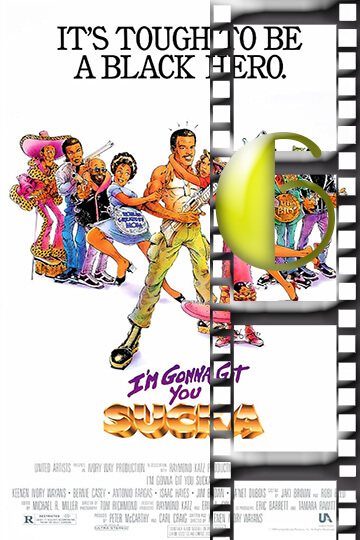
What’s It About
Jack Spade (Keenen Ivory Wayans) comes home to the ghetto and finds his brother dead from a gold chain overdose. With the help of his hero, John Slade (Bernie Casey), and a team of washed-up crime fighters, Spade declares vengeance on Mr. Big (John Vernon), the white crime leader responsible for selling gold chains on the streets. But Spade realizes that he must take matters into his own hands to finish the job in this zany spoof of 1970s blaxploitation films.
MOVIESinMO REVIEW
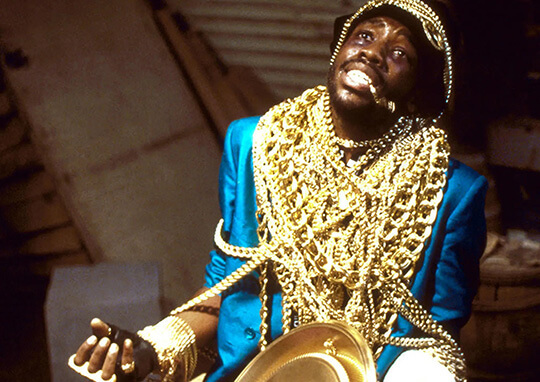
When Keenen Ivory Wayans’ “I’m Gonna Git You Sucka” debuted in 1988, it came with the subtlety of a gold chain-wearing hero bursting through a window. As a parody of blaxploitation that celebrated and mocked the genre, it occupied a unique position in Black cinema – respectful of its influences and the brutal mocking of their excesses. Looking back after 37 years, this film is a fascinating time capsule that works as satire and social commentary. The film follows Jack Spade (Wayans), who returns home after the death of his brother from an “OG” – over-gold chain-wearing – to revenge himself against the criminal organization responsible for it. He hires a team of blaxploitation heroes in their later years, including John Slade (Bernie Casey) and Hammer (Isaac Hayes). When “Sucka” initially released, critics were divided. Most mainstream (largely white) critics struggled with the film’s specific cultural references and in-jokes. Some labeled it bottom-barrel comedy, and others recognized its satirical brilliance but questioned whether it would find an audience beyond Black viewers. Black critics, however, largely embraced Wayans’ loving spoof of films that, as imperfect as they were, had provided Black audiences with scarce representation at the cinema. The movie arrived at a time of transition. The blaxploitation category had disappeared but its afterglow still lingered in the popular memory of the culture. “Sucka” was both an obituary and a denunciation, recognizing the value of Black heroic characters on screen and denouncing the genre for resorting to formulas and simplifying black characters into stereotypes. It was also prophetic – arriving a dozen years before the tidal wave of parody movies like “Scary Movie” (later directed by Keenan himself). Watching “I’m Gonna Git You Sucka” in 2025 is a more informed experience. The comedy of the movie still lands – scenes like the diner patron ordering “one rib” or Antonio Fargas’ character wearing so much ice that he has to be assisted along are still genuinely funny. The dedication to absurdity never wavers, and the cast delivers their lines with sheer deadpan seriousness that elevates the material. But modern viewers can be shocked by things that have not aged well. The women being cast by the film practically solely as sex objects, although parodic negative critique of blaxploitation conventions, grates now. All or all the gay panic humor – specifically as it concerns the character Flyguy upon having spent time in prison – clangs out-of-key in an age when there is increased awareness regarding LGBTQ+ representation. But to completely abandon the film would be unfair. “Sucka” is significant for several reasons. One, it was a singular instance of an African American filmmaker gaining the backing of a studio to produce unapologetically Black comedy for African Americans. Wayans was not diluting or modifying his vision to gain white acceptance – he was creating something honest to his people’s sensibilities and realities. Second, the movie was groundbreaking in its meta-commentary. Prior to “meta” being a standard practice, Wayans was deconstructing a whole genre while also offering homage to it. The movie is aware of the issues of blaxploitation but is celebrating its cultural relevance – the brashness of movies that focused on Black experiences when Hollywood was ignoring Black audiences for the most part. The cast itself merits a special mention. Old pros like Jim Brown, Isaac Hayes, and Bernie Casey – who themselves had spearheaded blaxploitation movies – join ranks with newcomers Chris Rock and the Wayans brothers. The meeting of these two generations further lends strength to the movie as an homage and development. Would modern-day audiences enjoy “I’m Gonna Git You Sucka”? It is a qualified yes. Audiences willing to put the film in its context will find much to appreciate. The overall physical comedy and sight gags remain effective, and the particularity of its references is authentic rather than pandering. For Black audiences familiar with the films being spoofed, there is a bonus level of enjoyment – watching how Wayans lovingly exaggerates tropes while exposing their illogic. Yet, audiences anticipating the movie to fit modern sensibilities around gender and sexuality might flinch at times. The women characters’ handling in the film, as much as it parodies blaxploitation’s shortcomings, does not get beyond those shortcomings sufficiently to seem progressive now. “I’m Gonna Git You Sucka” occupies that challenging space of being a comedy that was ahead of its time but never fully left its time behind. It remains a milestone of Black cinema – a film that helped break ground for the Wayans dynasty and influence generations of Black comedians who made films later. The strongest feature of the movie might be the unapologetic Blackness. From solo cultural references to the nuanced understanding of what about blaxploitation was objectionable but also important, Wayans produced a film that was not concerned about whitewashing Black existence for white audiences. That frankness remains pertinent despite some of the humor’s being dated. For contemporary viewers, “I’m Gonna Git You Sucka” can most effectively be seen as entertainment and cultural document – a representation of a particular moment in Black cinema when filmmakers were beginning to reclaim and redefine their storytelling possibilities. It’s a film that must be respected for what it accomplished, even as we acknowledge the ways in which our cultural conversations have evolved. In 2025, “I’m Gonna Git You Sucka” remains a major accomplishment of Black comedy film – flawed but worthwhile, outdated in some spots, but refreshingly new in others. For those viewers who are willing to accept both its brilliance and its flaws, it is an entertaining but informative viewing experience regarding how far we’ve come and how far still we have yet to go.
OUR RATING – A RETROSPECTIVE 6