

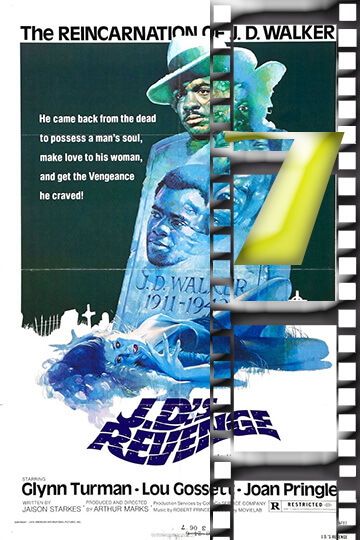
WHAT’S IT ABOUT
Although notorious New Orleans gangster J.D. Walker (David McKnight) is shot and killed in the 1940s, his spirit remains restless for three decades until a hypnotist’s supernatural nightclub act allows him to take over the body of Isaac (Glynn Turman), a mild-mannered law student. After inhabiting Isaac, Walker decides to hunt down the Rev. Elija Bliss (Louis Gossett Jr.), a former criminal who helped the authorities find and assassinate the mobster years ago.
MOVIESinMO REVIEW
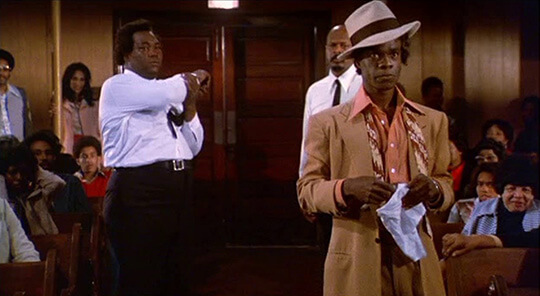
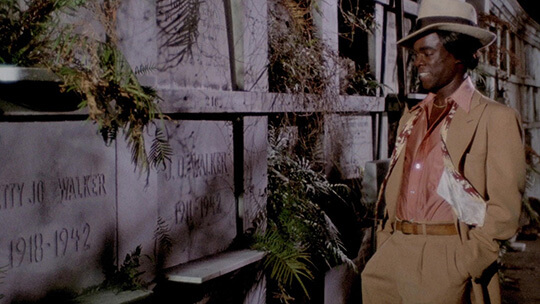
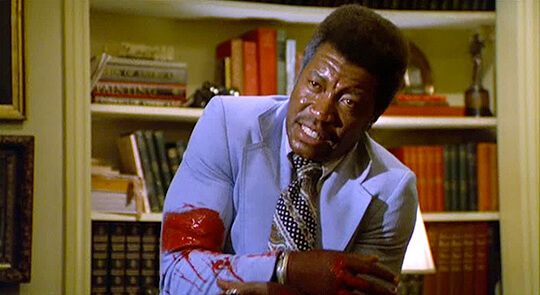
Examining 1976’s “J.D.’s Revenge” from a present day lens is an intriguing study of how Black cinema has developed and changed throughout the course of almost five decades. As a blaxploitation horror film with direction by Arthur Marks, this supernatural thriller captured an important moment for Black filmmakers and performers who began pushing towards establishing own space in a genre (particularly horror) that had socially and culturally excluded them for such a long time. The film follows Glynn Turman as Isaac, a law student who becomes possessed by the spirit of 1940s gangster J.D. Walker while under hypnosis at a nightclub. What begins as strange behavioral changes escalates as Isaac’s personality is gradually overtaken by J.D., who seeks revenge for his murder and his sister’s death. Turman’s performance is the foundation of the movie, as he displays an incredible range while transforming from an unassumed student into a cold-blooded, blue-steel-wearing gang leader. “J.D.’s Revenge” opened to critics shrieking exploitation film– an all too convenient cash-in on blaxploitation and horror. The film was determined to be so-called exploitation fare by critics reduced to sensational elements: violence, supernatural conceit, and sexuality. White critics particularly did not acknowledge social commentary attached to the surface nor to the importance of Black complexity in a horror film. However, Black spectators engaged the film pleasurably on multiple wavelengths. Beneath the revenge plot, “J.D.’s Revenge” engages in themes central to Black life: the weight of historical trauma, negotiating assimilation and cultural identity, and the psychological toll of oppression. Isaac’s possession can be read as a rumination on how historical pain resonates with contemporary experience – as a metaphor of generational trauma, the film was simply ahead of its time. The New Orleans location adds depth to this subtext, for the city has historical focus on the intersection of African spirituality and the supernatural. The voodoo undertones—though somewhat stereotypical—acknowledge spiritual traditions often erased from mainstream American horror. Using the cultural context of the city, Director Arthur Marks manages to create an environment in the film that feels not just possible but plausible, given the supernatural elements of the film. Louis Gossett Jr.’s performance of Reverend Elija Bliss complicates the situation further. The Reverend is symbolic of both the church as an important institution for the Black community and potentially a hypocritical one. To showcase religion in a more conflicted way within Black communities was rarely if ever, done in the cinema of the time. By today’s standards, “J.D.’s Revenge” deserves recognition as more than just a genre exercise. The horror genre in the present day has finally started to incorporate Black stories and perspectives in works that have achieved both critical recognition and box office performance, like Get Out, Us, and Candyman (2021). These works build on the legacy of films that attempted to center Black characters, such as J.D.’s Revenge, at the height of dwindling Black representation in supernatural storytelling. But the film has its problems of things that are obviously problematic in today’s time. The film’s treatment of women, especially those who experience violence, is very much a product of its time and that time’s gender politics. The sexual dynamics between Isaac/J.D. and his girlfriend Christella often treads into uncomfortable territory, especially concerning consent and the troubling connotations in a contemporary reading. These aspects simply cannot and should not be ignored in a contemporary reading of the the film. In a reasonable surprise, the crafts of the film hold up well. The cinematography creates a sense of disorientation, as Isaac is at once possessed, with great camera angles and the lighting providing cues of Isaac’s multiple personalities. The musical score, which blends 1970s funk with the horror musical tropes, blends musically into an experience that enhances the narrative and is never overbearing. “J.D.’s Revenge” also deserves recognition for its portrayal of Black masculinity in crisis. Isaac’s battle with J.D. explores the conflict between two models of Black masculinity: the educated, upwardly-moving professional, and the aggressive, street-savvy hustler, which feels particularly prescient given our current discussions about code-switching and the mental toll of moving through white-centric professional enclaves as a Black man. The movie preserves a particular type of Black urban life from the 1970s, from a cultural preservation perspective. The clothing, language, soundtrack, and even social dynamic preserve a time stamp of culturally expressive Black culture that can claim cultural significance beyond entertainment. In reviewing “J.D.’s Revenge,” it must be acknowledged that the film was an achievement, considering the systemic challenges facing Black filmmakers. The film has historical value on a cultural level, primarily produced on a small budget and sometimes relegated to the exploitation side of American film-making. Filmmakers such as Arthur Marks (the director) exploited the possibilities of horror to provide representational cinema that was a momentous feat at that time. Now for the viewer who may be thinking about watching “J.D.’s Revenge” (or is thinking about watching it) for the first or even a second time, we see in the film both a moment in America’s past and present relevancy to present issues. The film argues that the ranks of historical violence are carried forth in each generational moment, its offerings of a supernatural horror purposefully centered around Black experiences, and for its complex assortment of character development, it is more than due for some critical revaluation. Modern horror, in the manner in which it treats issues of race, gender, and violence, has progressed in many ways. However, J.D.’s Revenge is one of the landmark films that has contributed to the historiography and journey towards more diverse and complex storytelling within the genre. J.D.’s Revenge reminds us that Black horror cinema didn’t begin with this current renaissance that Black horror has a history of exploration and celebration that’s worth discovering in a deeper way. Because of its historical impact, compelling central performance, and thematic aspirations, J.D.’s Revenge requires more recognition than simply being another oddity of the blaxploitation genre: it is a valuable piece of Black horror cinema that influenced and continues to impact and activate the genre in significant, albeit unanticipated, ways.
OUR RATING – A GHOSTLY 6