

WHAT’S IT ABOUT
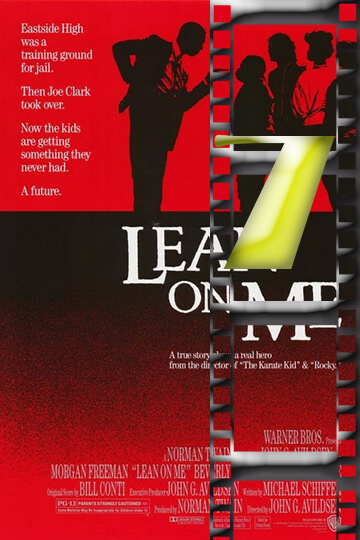
In this fact-based film, a New Jersey superintendent, Dr. Frank Napier (Robert Guillaume), watches helplessly as East Side High becomes the lowest-ranked school in the state. With nowhere else to turn, Dr. Napier enlists maverick ex-teacher Joe Clark (Morgan Freeman) to take over as principal of the declining school. Unfortunately for Clark, before he can focus on improving the student body’s state exam scores, he has to somehow rid the school of its gang and narcotics problems
MOVIESinMO REVIEW
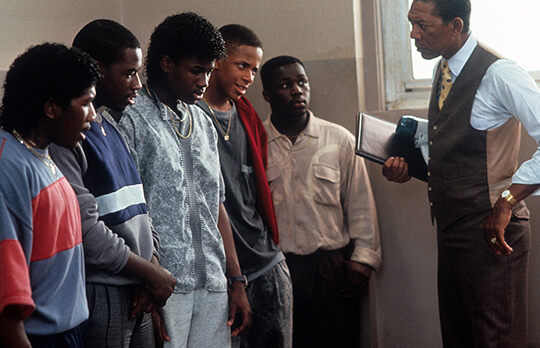
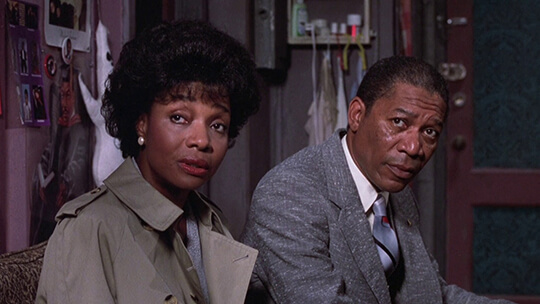
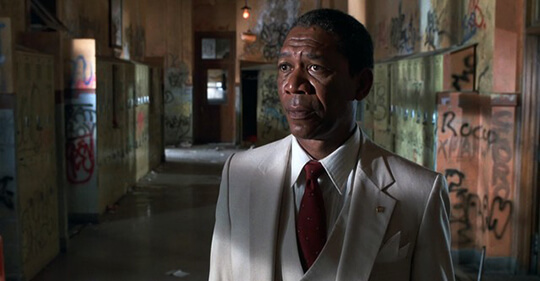
When “Lean on Me” burst onto screens in 1989, it was billed as an inner-city education success story that was received by many as inspirational. Coming back to the film 36 years later highlights both its lasting strengths and problematics that might benefit from critical examination from a contemporary vantage. The film’s unapologetic strength remains Morgan Freeman’s portrayal of Joe Clark, the bat-wielding, chain-padlocking principal of Paterson, New Jersey’s Eastside High School. Freeman’s Clark is so convincingly realized that even when his methods enter troubling realms, his charisma keeps the viewer riveted. The film, based loosely on Clark’s actual tenure at Eastside, shows a school plagued by drugs, violence, and abysmal test scores—a portrait that resonated with film audiences at the height of America’s “war on drugs” era. When “Lean on Me” came out, mainstream critics gave split opinions, largely isolating Freeman’s acting as they debated the merit of the film as a school drama. White critics tended to make the story straightforward, about discipline rescuing an inner-city school through tough love. The majority of Black critics identified more complicated dimensions within the film’s representation of a mostly Black and Latino school community. The film was a commercial success, finding an audience that reacted positively to its bootstrapping message during a period when “by any means necessary” education reform was gaining currency among urban communities. The fictionalization of students’ transformation from “hoodlums” to scholars via strict discipline reflected Reagan-era educational ideologies centered on individual responsibility over systemic analysis. Seeing “Lean on Me” in 2025 is an intriguing task in terms of both what has changed and hasn’t changed in American cinema and education. The movie’s most blatant shortcoming by today’s standards is its naivety in terms of educational reform. Joe Clark’s methods, expelling 300+ students who are “troublemakers,” screaming at students and teachers, and ruling by fear, are portrayed as a bitter medicine that must be taken instead of problematic practices that need to be interrogated. Contemporary education discourse recognizes that excluding low-achieving students does not eliminate issues—but only displaces them. The fate of such students who have been pushed out is never considered in the film, as though they are disposable collateral damage in the drive for higher test scores. Contemporary pedagogical frameworks emphasize restorative justice, trauma-informed practice, and addressing systemic injustices rather than simply pushing out “problem students.” The gender politics of the film also reveal its age. Female characters—most prominently the embattled superintendent Dr. Napier (Robin Bartlett)—are one-dimensional, serving primarily as foils to Clark’s heroism or obstacles to his crusade. The few teachers of the female persuasion we do meet are either incompetent or require Clark’s assistance to achieve success. In spite of this, “Lean on Me” contains something within it that does not age. Its depiction of a predominantly Black and Latino high school fighting for resources and respect still resonates in an era of persistent educational inequality. Freeman’s Clark genuinely believes in his students, informing them over and over that they are “somebody” in ways that feel earnest rather than patronizing. Contemporary audiences would likely find “Lean on Me” both moving and enraging. The technicalities of the movie remain solid. Its editing, Freeman’s amazing performance, and sentimental scenes like the students singing the theme song continue to stand. Contemporary audiences might cringe at the reduction of education issues and the lionizing of authoritarian leadership. The film’s depiction of urban youth culture now feels antiquated, if not offensively so. The hip-hop cliches and teenage slang are faithful to the era but not as sophisticated as newer movies that dare to enter similar environments. The “before and after” characterization of Eastside High seems particularly naive in 2025 when audiences expect more complex narratives about institutional change. With that said, “Lean on Me” would likely find an audience among those nostalgic for films that showcase simplistic moral lessons and educational “victories” that are measurable through standardized tests. For viewers who have grown up on more nuanced educational dramas like “The Wire” (season 4) or documentaries that explore the issues of urban education in complexity, the film might seem like a well-intentioned but outdated artifact. “Lean on Me” is still suitable for viewing, but preferably as a catalyst for critical conversation instead of as a pedagogical roadmap. Freeman’s performance makes it worth watching, but the movie’s message needs to be put into perspective. Teachers and parents could utilize the film to explore how our knowledge of effective school leadership has developed. Joe Clark’s signature line—”They used to call me Crazy Joe. Now they call me Batman.”—underlines the film’s framing of education reform as requiring a superhero rather than systemic change, something that educational discourse has largely moved beyond today. Grading “Lean on Me” as a cultural artifact that gives a snapshot of a specific moment in American educational history and that has a transcendent performance from Morgan Freeman, I give it 3.5 out of 5 stars. As a model of education, however, it deserves a much more critical appraisal. Its heart is in the right place—having faith in students others have lost faith in—but its practice deserves suspicion. The film’s most enduring message—that students need adults who believe in them—is equally powerful in 2025 as it was in 1989. Joe Clark’s insistence that his students are “somebody” continues to resonate, even as we recognize that his methods of getting them to believe this were frequently flawed. “Lean on Me” is a period piece with timeless truths and dated methods. It’s worth revisiting as both an entertaining drama and a conversation starter about how our understanding of educational equity has evolved over three decades. Its greatest value today may be as a starting point for discussions about how we’ve progressed in our approaches to urban education—and how much further we still need to go.
OUR RATING – A PERSPECTIVE 7