


What’s It About
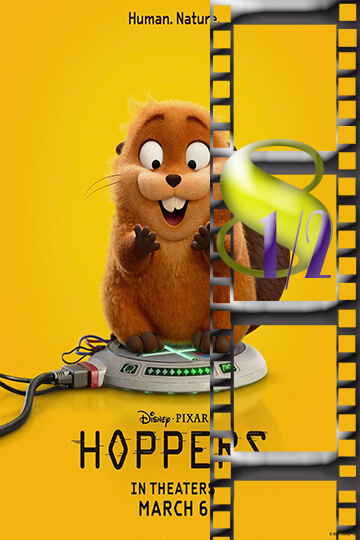
Mabel, an animal lover, uses a newly developed technology to transfer her consciousness into a robotic beaver. She enters the animal world to uncover mysteries and befriends a regal beaver named King George. Together, they must unite the animals and stop a real estate developer from destroying their home.
MOVIESinMO REVIEW
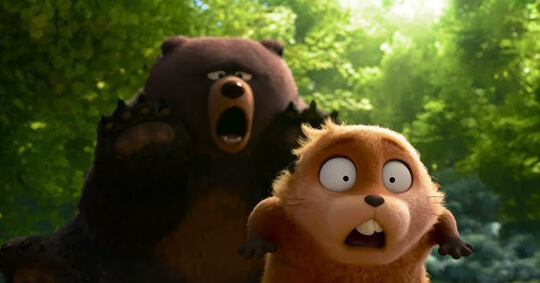
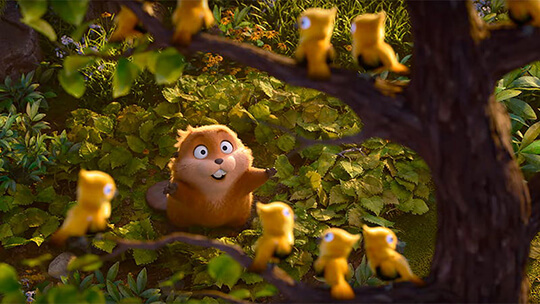
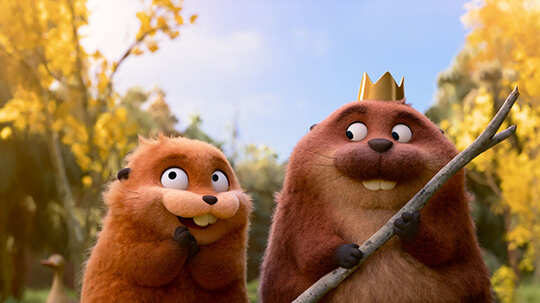
There is a moment early in Pixar’s thirtieth film, Hoppers, where a teenage girl sits beside her grandmother on a rock overlooking a quiet clearing in the woods. No cars. No noise. Just wind moving through the trees and water finding its own path downstream. The granddaughter gets a powerful message from her grandmother: “When we feel like we belong to something greater than ourselves, we find it difficult to feel anger.” This single statement is what this film is all about, and somehow, it works. Director Daniel Chong, best known for creating the animated series We Bare Bears, makes his feature film debut with Hoppers, and he arrives not just ready but fully loaded. This is not a safe, play-it-down-the-middle animated movie. Chong came to shake the table — and he does exactly that. The story centers on Mabel Tanaka (voiced by Piper Curda), a nineteen-year-old college student whose love for nature borders on obsession. She has been fighting to protect the environment since she was a child. When Mayor Jerry Generazzo (Jon Hamm) announces plans to build a highway extension through a local glade — the same one Mabel used to visit with her late grandmother — she refuses to sit still. The mayor has quietly driven the animals away from the area to clear the path for his construction, so Mabel takes matters into her own hands. She discovers that her biology professor, Dr. Samantha Fairfax (Kathy Najimy), has built a technology called the “Hoppers” program, which transfers a human’s consciousness into a lifelike robotic animal body. Think Avatar — Chong knows it too, and the film winks at the comparison more than once. Mabel steals access to the technology, uploads her mind into a robotic beaver, and walks straight into the animal kingdom. What Mabel discovers in the place she found is quite astounding. The animals displaced from their homes, forced into a small area, have created their own community. King George, a benign beaver with a calm and wise personality, leads a council of different species who have determined they will remain peaceful with each other rather than fight. Mabel comes to this community with the intention of getting the animals to help them get their homes back. Mabel is right and wrong about this, and that conflict provides the most venturesome portion of the movie. What makes Hoppers rise above other animated films that take on environmental themes is the intelligence behind its screenplay. Chong and co-writer Jesse Andrews refuse to build this story around a simple hero-versus-villain structure. Jerry the Mayor appears to be the main bad guy right off the bat, but you soon see how he evolves. He never becomes a ‘good guy’ but instead grows into being a complete person, which ultimately forces the audience to do some further introspection. Mabel herself doesn’t get everything right; her passion can lead her to moments where she loses her wisdom. The film holds her accountable for seeking understanding through growth, change, and listening. Most importantly, this has become something of immeasurable value for young viewers because there are so few stories that provide character development attributes in this way; Hoppers gives us that as viewers. King George is an underappreciated character in this film who provides comic relief by being bumbling, naïve, and impressed by everything he sees; however, voice actor Moynihan also brings layers of complexity that unfold through the course of the film and culminate with a heavy impact. While George has a fundamental belief that no matter how bad someone is behaving at any given time, you should give that person the benefit of doubt (patience and understanding), his philosophy is an exact opposite of Mabel’s frustration. Watching the way both characters deal with their differing views provides an emotional foundation for the film. Their friendship is the beating heart of Hoppers, and it earns every moment it asks you to feel. The supporting cast fills in the world beautifully. Dave Franco voices Titus, a young insect prince with an appetite for power, and delivers what may be the most entertaining vocal performance of his career. Dr. Sam, portrayed by Kathy Najimy, is both warmhearted and disorderly: she truly desires to care for Mabel, despite the fact that Mabel clearly does not listen to anything Dr. Sam tells her to do! Meryl Streep appears as the Insect Queen and embodies the seriousness that the title implies. Melissa Villaseñor plays Ellen, a friendly grizzly bear who surprises all the other characters by being so nice! All three of these characters help to enhance the setting without overstaying their welcome. Visually, Hoppers is doing something worth studying. For years, Pixar animation has pushed the envelope in respect to realism, meaning they have been working hard to improve different aspects of realism, including, among other things, the sharpness of the surface textures used for the models; the level of detail found in the lighting on the models’ surfaces; and how much detail can be put into a surface that can look like it can actually be touched. Chong takes that energy and directs it to expressing emotion through the animation. Although the animation continues to be very precise and very detailed, there is a different kind of breathing that occurs in the animation itself. The animation will shift its tone based on which character’s point of view the viewer is experiencing. A clever visual cue has been implemented by the creative team- when looking at animals from a human’s point of view, the animal will look to be very realistic, but when looking at animals from an animal’s point of view, the animal will look much more expressive, with open faces and big, warm eyes. It is a small choice with a large impact, and it reflects exactly the kind of creative thinking Chong brings to every corner of this film. The sound design matches that ambition. In the opening scenes around the grandmother’s glade, every natural sound is mixed with such precision that the environment becomes a character of its own. The hum of wind, the movement of water, the shuffle of leaves — these are not background details. They are intentional, and they work to pull you into the world the same way they pull Mabel in. You understand why she fights so hard to protect something this alive. The film’s second half shifts into a bigger, louder gear. The action sequences grow in scale and intensity, and Chong commits to some genuinely wild choices — a flying shark, a caterpillar with political ambitions, a climax that belongs on the largest screen possible. Some of these sequences run a little long, and younger viewers may find certain moments intense. But the energy never feels empty. Every wild swing connects back to the characters and the stakes they are fighting for. Hoppers is also, without question, Pixar’s funniest film in years. The humor is well-timed and earns its laughs rather than chasing them. The film is also aware of itself in the best way — it knows it is asking big questions, and it never lets that weight crush the joy underneath it. Stay for the post-credits scene. Trust that instruction. Pixar has spent the last several years leaning heavily on sequels and familiar properties. Hoppers is a reminder of what the studio looks like when it takes a genuine risk. It is messy in places, ambitious in all the right ways, and quietly one of the most important animated films of the decade. It asks children to think carefully about the world they are inheriting. It asks adults to remember what it felt like to believe that protecting something beautiful was worth every effort it required. Mabel Tanaka will not save nature all by herself. Neither will any of us. But Hoppers makes a strong case that the work is still worth doing — and that paying attention to the world around you, really stopping to feel like part of something bigger than yourself, might be exactly where that work begins.
OUR RATING – AN ENVIRONMENTALLY SOUND 8.5
MEDIA
- Genre – Family
Street date
- Digital – April 28, 2026
- 4K/Blu-Ray/DVD – June 2, 2026
- Video – 1080p
- Screen size 1.85:1
- Sound – English: DTS-HD Master Audio 7.1, English: DTS-HD HR 5.1, English: Dolby Digital 2.0, French (Canada): Dolby Digital 5.1, Spanish: Dolby Digital 5.1, Audio descriptive
- Subtitles – English, English SDH, Spanish, French
Extras
- The Critter Diaries (HD 10:17)
- Hopping In: The Making of Hoppers (HD 11:46)
- “Meet King George” Scene Breakdown (HD 6:34)
- Beaverton Revealed (HD 4:12)
- Dam Good Bloopers (HD 2:04)
- Deleted Scenes (HD 19:34)