

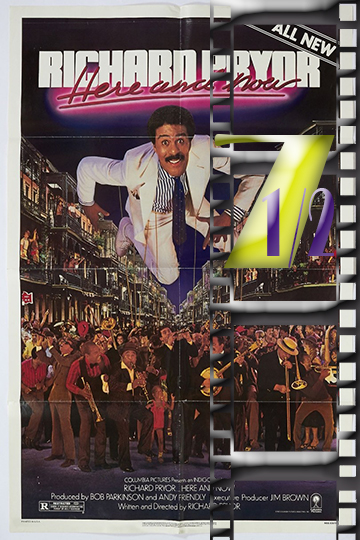
WHAT’S IT ABOUT
Part live stand-up performance, part documentary, this film is one of comedian Richard Pryor’s later stand-up performances. As foul-mouthed as ever, Pryor touches on most of the same topics as in his previous live shows.
MOVIESinMO REVIEW
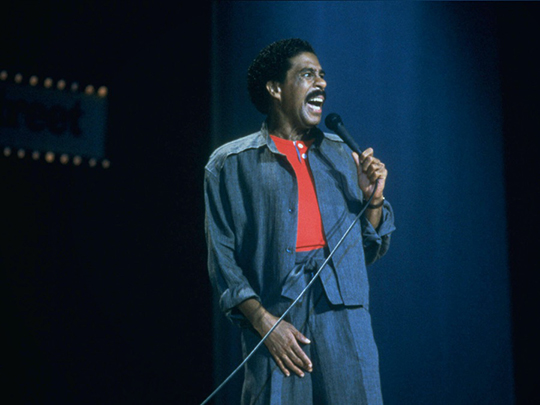
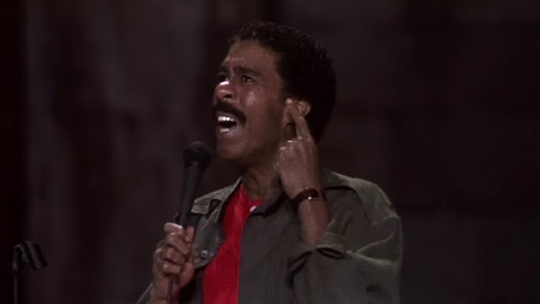
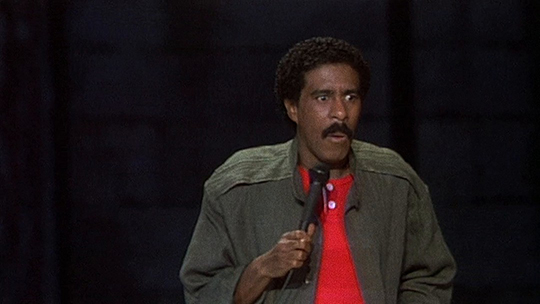
Richard Pryor’s “Here and Now” arrives at a crossroads in both the comedian and American comedy history. Filmed at the Saenger Theatre in New Orleans and released in 1983, this concert movie captures Pryor at one of his most vulnerable but artistically strong moments, two years since his nearly fatal accident with freebasing, which resulted in third-degree burns across half his body. What emerges is not only a comedy special but an unsparing exploration of mortality, addiction, race, and the human condition offered in the unvarnished honesty that made Pryor a revolutionary force in American popular entertainment. The moment Pryor takes the stage, there is an electric tension in the air, part anticipation, part anxiety. His physical injuries from his accident are obvious, but more disconcerting is the manner in which he monetizes his tragedy. His opening commentary on the hospital experience is both hilarious and heartbreaking, as he satirizes the worried voices of medical personnel with his most impressive impressionistic skill while acknowledging the gravity of what nearly killed him. Pryor’s range as a comic in “Here and Now” is what made him an influence on the likes of Eddie Murphy through Dave Chappelle. His talent to become different characters—from his grandmother’s disapproving tone to the beady-eyed terror of a guy on fire—becomes a one-man theatrical spectacle beyond the limits of stand-up. The notorious “freebasing” sequence, where he’s interviewed as cocaine speaking to him, is harrowing and purging, depicting a raw glimpse into addiction that’s truer to life than most drug movies are capable of. Since “Here and Now” was released in 1983, critics have generally been favorable toward Pryor’s uninhibited candor, but sometimes, they have taken exception to his explicit material and drug mention. The New York Times’s Vincent Canby described it as “brilliant” but questioned Pryor’s stability and health. Rolling Stone admired his “unflinching self-examination,” but some mainstream media were worried about celebrating drug use during the height of the “Just Say No” era. Racially, 1983 reviewers, who were predominantly white, would disregard the sociological subtext of Pryor’s humor. His comments regarding police encounters, corporate racism, and Black life in America were sometimes dismissed as “angry” or “confrontational” rather than as trenchant social commentary. The white critical establishment wasn’t always eager to fully understand how Pryp was tearing down racial stereotypes, even as it seemed he was calling them up. By today’s standards, “Here and Now” needs to be reexamined. Pryor’s frequent invocation of racial epithets, including the n-word, which he eventually dropped, would be deeply inadvisable from most comedians today. But Pryor’s invocations stem from a particular moment and frame of personal history: that of a Black artist taking over and analyzing the language used to subjugate his people. His 1979 abandonment of the n-word makes his use here feel like reporting on his artistic development rather than senseless goading. What’s truly amazing about “Here and Now” is how Pryor takes real trauma and makes it into crowd-pleasing humor without minimizing the pain. His story of the freebasing accident isn’t being hyperventilated into gross-out chuckles—it’s a masterclass on how comedies can navigate trauma. The laughter when he describes running down the street on fire is soft, purging, and completely human. This approach to suffering and art-making seems eerily true now that we are more aware of trauma and mental illness. Pryor’s honesty regarding addiction appears remarkably contemporary. Unlike the metaphors of the “war on drugs” obscuring 1983, Pryor portrays addiction as a dirty, complicated human fight rather than a moral deficiency. His characterization of cocaine as a master manipulator strikes true for anyone who’s watched addiction destroy lives, making the special more relevant today than it was when it first aired. Director Richard Pryor (he also acts in it) keeps the filmmaking simple and effective. The single-camera use gives Pryor’s physicality a chance to shine without excessive ornamentation. Lighting both charisma and vulnerability, the sound design makes sure each vocal tic, whisper, and scream is clear and crisp. The rhythm demonstrates Pryor’s masterful understanding of dramatic structure. He builds tension through increasingly intimate disclosures, uses bodily humor to cut it, then dives deeper into emotional terrain. The 94-minute running time is both concise and epic, the ability to share a night with someone intensely intelligent, profoundly imperfect. Would “Here and Now” pass as television today? The response is multifaceted. To older viewers who know something about historical context, yes. Pryor’s comedy challenges viewers to question race, addiction, domestic life, and social hypocrisy—conversations we so badly need today. Comedic musings about his dealings with police officers resonate as hauntingly prophetic amidst today’s controversies around police brutality. But, some material and the language would require extensive contextualization for younger viewers. Societies and schools would have to show the screenings in context, explaining the manner in which Pryor’s use of disturbing language served specific aesthetic and social purposes in his era. Contemporary comedy fans who are used to highly edited, instant-consumption content might initially experience Pryor’s unapologetic approach as disturbing. But for those who are willing to receive the material as it is offered, it will prove enlightening. Pryor’s influence on comedians today, like Dave Chappelle, Chris Rock, and Kevin Hart, becomes immeasurable when one views “Here and Now.” Emotional honesty of the special resonates particularly with audiences today who value the realness and vulnerability from their entertainment. Pryor’s frankness about addressing mental illness, addiction, and trauma appears remarkably current, even prescient. “Here and Now” is both documentation of history and lasting art. Where aspects in some cases rely on contextual familiarity, Prypr’s success in transposing personal pain into shared laughter continues to shine through. The special catches a master artist at a defining moment and creates something that is both of its time and timelessly enduring. For Black audiences, the special is a richly textured legacy, one that pays tribute to a pioneering artist while acknowledging how his art subverted and, at times, reinforced negative stereotypes. Pryor’s later evolution away from some of those language and techniques makes “Here and Now” a definition-of-the-times chapter of a larger book of artistic and personal growth. This is not just comedy; this is American art in its purest, most naked form. Consider the moments of gratuitous sexual behavior, but ice those: “Here and Now” still deserves to be seen for its value to understand the history of comedy and the larger American conversation on race, trauma, and redemption.
OUR RATING – A RAW GENIUS 7.5