



What’s It About
In an afterlife where souls have one week to decide where to spend eternity, Joan is faced with the impossible choice between the man she spent her life with and her first love, who died young and has waited decades for her to arrive.

MOVIESinMO REVIEW
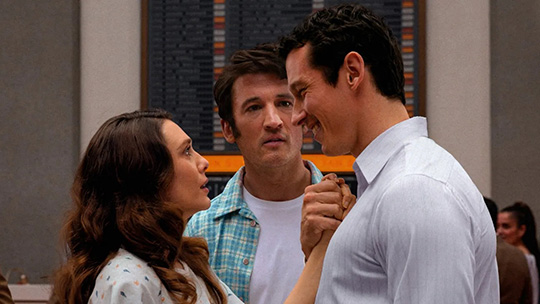
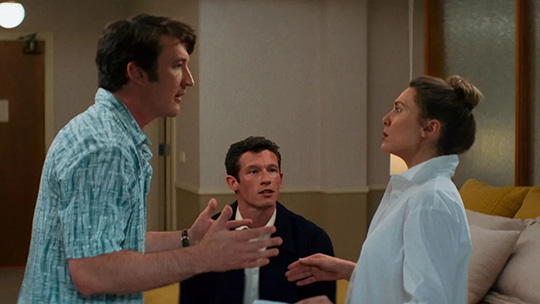
I’m going to be straight with you. When I first heard about “Eternity”, I wasn’t really interested in seeing it. Just another indie dramedy about white people making dumb decisions? No thanks! However, once I found out that Da’Vine Joy Randolph was in the film, everything changed for me. I am a Black male in 2025 who has become increasingly frustrated with trying to find someone who looks like me in film. The only other person of color in this entire film is Da’Vine Joy Randolph, and without her amazing energy and comedic timing, this would have been just another forgettable indie dramedy, and I would have simply ignored it. While Hollywood claims that they care about ‘representation’ of people of color, I believe that until they show me something different, I won’t believe them! Regardless of this frustration, I was surprised by how much I enjoyed “Eternity”! Director David Freyne and writer Pat Cunnane created something that feels fresh even though it borrows heavily from movies like “Defending Your Life.” The story follows Joan Cutler, who dies after a long marriage and ends up in a weird afterlife waiting room called The Junction. Here’s the twist—she has to pick which dead husband she wants to spend forever with. Yeah, you read that right. Her first husband, Luke, died young in the Korean War, and her second husband, Larry, just choked on a pretzel at a family party after sixty-five years together. Both dudes are waiting for her in this cosmic DMV, and Joan has one week to decide. The movie opens with old Joan and old Larry, played by Betty Buckley and Barry Primus, driving to their great-grandkid’s gender reveal party. They’re bickering about vacation spots—Larry wants the beach, Joan wants the mountains—and you can tell these two are worn down by decades of marriage. Joan’s got cancer, they’re about to tell the family, but then Larry dies first in the most random way possible. Suddenly, he’s at The Junction looking like Miles Teller, confused as hell about why he’s young again and stuck in what looks like a retro airport terminal from the sixties. This is where the movie gets fun. The Junction isn’t clouds and harps. It’s a bright, kitschy place with laminated maps and salespeople trying to sell you on different eternal worlds. Want to spend forever at the beach? There’s Beach World. Prefer nightclubs? They got that too. The production design nails this weird mix of whimsy and sadness, like a hotel lobby that makes you think about all your life choices. Each dead person shows up looking however old they were when they felt happiest, which explains all the ten-year-olds running around and why teenagers are basically nonexistent. Larry’s afterlife coordinator is Anna, played by Randolph, with the kind of warmth and humor that makes you wish she had way more screen time. She explains the rules—once you pick your eternity, you’re stuck there forever, no takebacks. Change your mind, and you end up in something called The Void, which sounds exactly as terrible as it seems. Larry decides to wait for Joan because obviously he wants to spend forever with his wife. Makes sense, right? Wrong. While Larry’s chilling at The Junction’s bar, he meets the bartender, who turns out to be Luke, Joan’s first husband. Callum Turner plays Luke, like he stepped out of an old romantic movie, all soft-spoken charm and tragic hero vibes. Luke’s been waiting at The Junction for decades, hoping Joan would show up so they could finally have the life together that war stole from them. His coordinator is Ryan, played hilariously by John Early as this sarcastic, flamboyant guy who also happens to be Anna’s ex-boyfriend. The movie tries to convince us that these two used to date, but honestly, they seem more like frenemies who roast each other for fun. When Joan finally dies and shows up looking like Elizabeth Olsen in her twenties, the real drama starts. Ryan becomes her coordinator too, and he’s team Luke all the way. Anna’s pushing for Larry because she thinks their sixty-five-year marriage means more. Joan is caught in a difficult situation and does not know which one to choose, if she is to keep her first love for as long as she can and that Joan never had a chance to fully live. Joan has a long-term relationship with Larry, however, he is the most complicate part of Joan’s no longer behaving in the proper manner by placing all the importance on the other two characters (Larry and Luke). Both characters have what is needed for Joan; Larry is the reality in Joan’s life and reality is everything in Joan’s relationship with Larry. Olsen carries this whole thing on her back. She plays Joan with this mix of youth and old-soul wisdom that makes you believe she lived eighty-six years, even though she looks twenty-something. In a memorable scene, she and Larry realize that they are once again able to squat down and jump without any discomfort to their knees, and it is a beautiful moment to see them both laughing together joyfully as a child would. Teller plays an excellent role as Larry and he shows us a true struggle as the perennial underdog, while never making you feel sorry for him. He’s just a normal guy who thought he would be with his wife for the rest of his life, but now he finds himself in the same arena as a war hero. Turner’s Luke is a bit less developed, he’s almost too perfect, too dreamy, but the movie kind of acknowledges that by making it part of the point. Luke is memory and nostalgia. Larry is life as it actually happened. The supporting cast helps keep things moving when the main plot starts dragging. Randolph and Early steal every scene as the bickering coordinators doing cosmic HR work. There’s also Karen, an older lady played by Olga Merediz, who tells Joan she chose to look seventy-two in the afterlife because that’s when she finally lived as her true lesbian self during a three-month vacation. These smaller moments give the movie depth beyond just the love triangle. Here’s where “Eternity” stumbles a bit. The middle section loses some energy as Joan drags out her decision with flashbacks and soul-searching. The rules of this afterlife don’t totally make sense if you think about them too hard—why can’t you change your mind? What about spending eternity with your kids? Despite the confusion at the end of the movie about time and the decisions that have to be made, it’s an effective ending. In fact, I’d say that Joan feels like a real person making her final decision, which is something that most romantic comedies don’t portray very well or at all. She doesn’t just pick the better man; she picks the version of herself she wants to be forever. Many romantic comedies do not take this type of story seriously, and although “Eternity” has a concept that does not present anything particularly original, it does bring some heart to that bizarre idea. A film is sweet without being cloying, sad without feeling depressing. The dialogue was witty and the performances worked well, and even as the film had to revisit its own story, viewers remained engaged in Joan’s ultimate decision. It does not overstay its welcome given its almost 2-hour length. Would I recommend it? Yes. The film does lack diversity, but it does present its audience with some thought-provoking issues surrounding love, choice, and what we really need as opposed to what we might think we want. It is a film that will resonate best with people who can put away their doubts and just experience the many feelings that come when watching it. Just wish Hollywood would remember that representation matters as much as clever concepts and charming performances.
OUR RATING – AN AFTERLIFE 7