

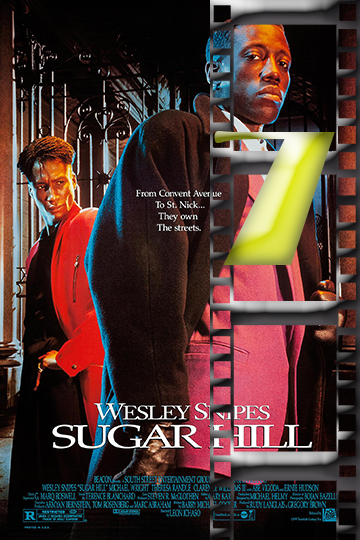
WHAT’S IT ABOUT
Roemello Skuggs (Wesley Snipes) and his brother, Raynathan (Michael Wright), grew up surrounded by crime. As an adult, Roemello becomes a high-ranking drug dealer. Roemello’s girlfriend, Melissa (Theresa Randle), however, does not approve of his lifestyle, and, after some violent altercations, Roemello begins questioning his choices also. Roemello and Melissa decide to start over in North Carolina, but Raynathan does everything he can to keep his brother from leaving.
MOVIESinMO REVIEW
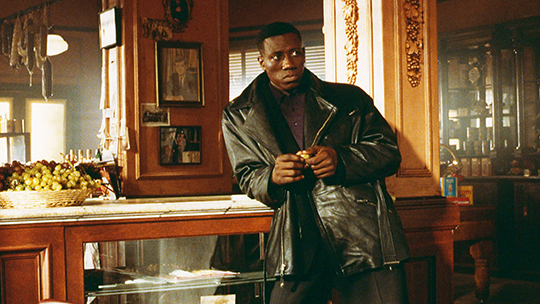
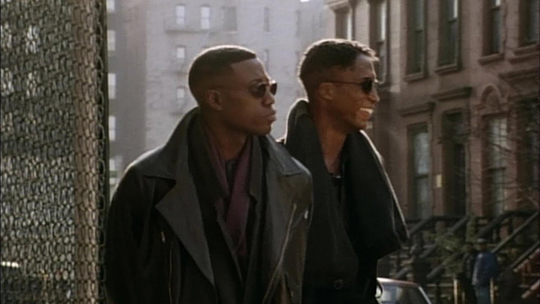
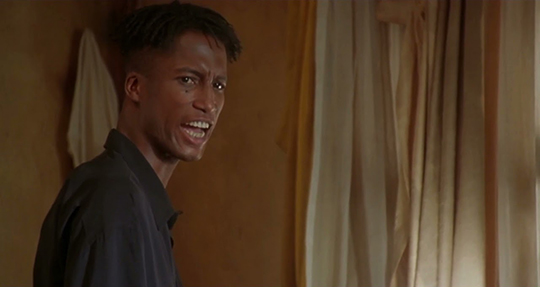
Leon Ichaso’s “Sugar Hill” arrived in 1994 at a crossroads moment for Black cinema, wedged between the innovative success of Spike Lee’s initial forays and the just-over-the-horizon wave of hood movies that would overwhelm so much of the decade. Starring Wesley Snipes as Roemello Skuggs, a Harlem street dealer who desires to escape the game that is killing his neighborhood and family, the movie presents itself both as an urban grittiness drama and a morality tale. Nearly three decades later, “Sugar Hill” needs an enlightened reconsideration that is sensitive to both its strengths and limitations in the context of Black film criticism in the present day. When “Sugar Hill” played in theaters, critics divided primarily along the lines of mainstream critics dismissing it as another in the “hood film” subgenre without acknowledging its attempts at psychological sophistication. “Sugar Hill” earned box office takings to neither here nor there and was consistently unfavorably compared with “New Jack City” (1991), which had set the bar for a stylish, socially conscious crime drama with Black protagonists. Most of these critics subsequently focused their criticisms on the movie’s violence and drug trade plot without so much as fully honoring its more substantial themes of family loyalty, institutionalized oppression, and cyclical dynamics of urban poverty. The 1990s critical intelligentsia, which was still white and frequently uncomfortable with the complexities of Black urban life, had a tendency to reduce films such as “Sugar Hill” to a simplistic moral framework. They cheered or condemned based on whether or not these films were “positive” or “negative” representations of Black lives, ignoring the subtlety that allows for the best drama. Their reductionism did not recognize the artfulness with which “Sugar Hill” walked the line between commercial success and authentic storytelling. Watching “Sugar Hill” today, some elements are actually compelling. Wesley Snipes delivers a committed performance as Roemello, bringing a depth of feeling to a character that otherwise could have been a one-dimensional antihero. His performance documents the internal struggle of an intelligent person who can recognize his circumstances for what they are but who is restrained by allegiance, circumstance, and the absence of alternatives. Snipes avoids glamorizing the drug-dealing existence and all too simplistically reduces Roemello to a cautionary example. The film’s exploration of family dynamics in the context of poverty is relevant today. The relationship between Roemello and his younger brother Raynathan (Michael Imperioli) is the affective center of the movie, depicting the ways criminal behavior destroys and unites families. The script, by Barry Michael Cooper, who also wrote “New Jack City,” is attuned to the manner in which economic despair and restricted opportunity breed the conditions that give rise to criminal enterprise. Visually, cinematographer Bojan Bazelli constructs a lived-in Harlem, not just atmospheric. The film avoids the over-styled presentation that will reduce violence into a cartoonish spectacle, instead construing the neighborhood as a dirty space in which beauty and brutality coexist. This visual realism is used to ground the more melodramatic parts of the plot. However, viewing “Sugar Hill” with contemporary eyes reveals deeply rooted issues that limit its impact and relevance. The biggest issue with the film is the way it portrays women. Women characters appear primarily as objects for men to lust after, agents of temptation, or symbols of what men stand to lose. Theresa Randle’s Melissa is there solely to serve as Roemello’s precipitating factor for escaping the life of selling drugs, with no agency or depth of her own. This reduction of women into devices is representative of broader problems within 1990s urban cinema that Black filmmakers of today have attempted to resist. The movie also struggles with the “tragic mulatto” trope, that of casting and characterization choices. Light-skinned actors complete the narrative, with dark-skinned actors confined to more stereotypical positions. This colorism issue, which was all but ignored in 1994 discourse, looks somewhat different when juxtaposed with recent discourse on representation and internalized racism in Black communities. Additionally, “Sugar Hill” at times falls into the trap of portraying crime as the only economic opportunity for intelligent Black men residing in cities. While this is a truth of actual systemic limits, the film does not entirely explore or explore other potential avenues, perhaps reinforcing restrictive Black urban life tropes. Would Black folks today embrace “Sugar Hill”? The answer isn’t easy. The economic disparity, loyalty to family, and institutional racism tropes of the film are uncomfortably relevant. The opioid crisis and long-term mass incarceration challenges make the film’s central conflicts prescient now. Young Black viewers would appreciate seeing Wesley Snipes in a meaty dramatic role that showcases his ability beyond action flicks. But today, Black viewers, particularly young people, are given much more nuanced and varied portrayals of Black life. Shows like “Atlanta,” “Snowfall,” and “The Wire” have shown us how to tackle the same themes with greater sophistication, better character work, and more authentic dialogue. “Sugar Hill” is old-fashioned in its approach to relationships, women, and community politics. “Sugar Hill” is both the promise and potential of Black film of the 1990s. It is to be credited with attempting to build a psychologically nuanced crime thriller that does not necessarily condone or condemn its subject’s behavior. The film’s examination of how systemic racism creates openings for criminal enterprise remains valid, and Snipes’s acting keeps the film on the ground. But the film’s treatment of women, its reinforcement of a few stereotypes, and its occasional lapse into sloppy focus keep it from being truly exceptional. Although truly revolutionary films of the era like “Boyz n the Hood” or “Menace II Society,” “Sugar Hill” is unable to ascend to a plane beyond genre expectations in order to speak more broadly about Black American existence. For contemporary viewers, “Sugar Hill” is perhaps best enjoyed as a period piece that shows both the expectations and limitations of 1990s Black cinema. It’s good, watchable, and worth it for entertainment value and some genuinely emotional moments, but it’s not worth making mandatory viewing. Black audiences in the present day would appreciate some things while observing areas in which the film fails to live up to today’s standards of accurate, multidimensional portrayal. Ultimately, Sugar Hill is an outright fun film with moments of genuine vision, but it remains a period piece that showcases both the progress made and the ground gained in Black film over the past thirty years.
Our rating – a demanding 7