

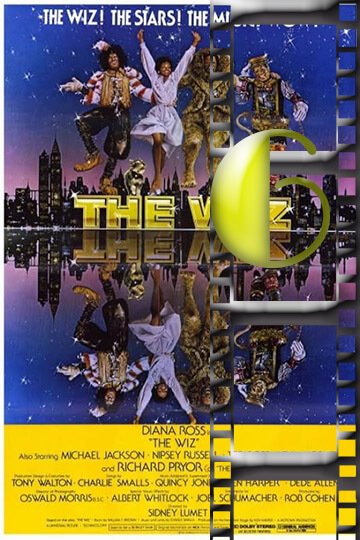
WHAT’S IT ABOUT
When Harlem schoolteacher Dorothy (Diana Ross) tries to save her dog from a storm, she’s miraculously whisked away to an urban fantasy land called Oz. After accidentally killing the Wicked Witch of the East upon her arrival, Dorothy is told about the Wiz (Richard Pryor), a wizard who can help her get back to Manhattan. As Dorothy goes in search of the Wiz, she’s joined by the Scarecrow (Michael Jackson), the Tin Man (Nipsey Russell), and the Cowardly Lion (Ted Ross).
MOVIESinMO REVIEW
When “The Wiz” was released to theaters in 1978, it came with a lot of expectation and a lot of pressure. As a Black film critic looking back on this seminal musical, I find myself with a foot in each camp of whether the initial critical response should have served as better evidence than its reception as an esteemed work of art – fascinated by the time like many things about art can shape our conception of it. Upon its release, “The Wiz” faced harsh criticism from predominantly white reviewers who seemed unable to grasp its vision. With a $24 million budget (enormous for its time), an all-star Black cast including Diana Ross, Michael Jackson, Nipsey Russell, and Richard Pryor, and direction by Sidney Lumet, it was expected to be a guaranteed hit. Instead, it was labeled a commercial disappointment and critically panned “The New York Times” critic Vincent Canby infamously dismissed it as “a nightmare of incompetence,” while others criticized Diana Ross (at 33) as too old to play Dorothy, traditionally portrayed as a teenager. These reviews omitted something fundamental: “The Wiz” was never attempting to be a literal adaptation of “The Wizard of Oz” but rather a reinterpretation from a very specifically Black cultural point of view. What these early reviews failed to notice was how revolutionary “The Wiz” really was. The film took L. Frank Baum’s classic American tale into a very urban African American environment. The yellow brick road became city streets in New York; the Emerald City was a metropolitan wonderland; and the tornado that swept Dorothy up was substituted by a snowstorm – all symbolism for the Black experience in America. From our vantage point today, “The Wiz” is a groundbreaking work of Black film. Its visual appearance – the reinvention of Oz as a surreal vision of New York City – constructed a world where Black characters could exist in a magical world of their own making. The elaborate production design by Tony Walton, with its surrealist interpretations of cityscapes, feels ahead of its time in terms of its audacity and imagination. Michael Jackson’s Scarecrow performance now stands with eerie pathos, exhibiting his groundbreaking genius on the eve of his debut solo album “Off the Wall.” His dance routines, particularly in “Ease on Down the Road,” opened up stardom that was soon to earn him the King of Pop mantle. While Diana Ross injected vulnerability and strength into Dorothy, and despite the age criticism that still lingers even in contemporary viewing, her performance has emotional depth that speaks beyond such objections. Contemporary audiences are aware of what many critics in 1978 were unable to perceive: “The Wiz” was not just entertainment – it was a statement of Black culture regarding Black identity, community, and resilience. The theme of self-reliance and power coming from one’s own kind in the movie strikes especially strongly now. As Dorothy discovers that “home” is taking her identity and community in Harlem, the film makes a powerful statement about Black belonging and self-determination. The soundtrack, composed by Quincy Jones with music by Charlie Smalls from the original Broadway production, deserves special note for cultural reasons. While at first overshadowed by the film’s disappointing box-office performance, the music of “The Wiz” has remained a cornerstone of Black musical tradition.Songs like “Ease on Down the Road” reimagined the journey down the yellow brick road with R&B sensibilities, while “Home” became a powerful anthem covered by countless artists, perhaps most notably by Whitney Houston. The score masterfully blended disco, soul, funk, and gospel – producing a musical tapestry that distills the spirit of Black music in the late 1970s, yet remains ageless. Quincy Jones’ production represents his genius years before he would ultimately redefine popular music with Michael Jackson. The Luther Vandross-arranged “Everybody Rejoice/A Brand New Day” stands as one of the most uplifting liberation anthems in cinema. In today’s context, “The Wiz” is recognized as part of a vital lineage of Black musicals and films that helped pave the way for future generations. Its influence can be seen in everything from Beyoncé’s visual albums to the Afrofuturistic aesthetics of “Black Panther.” The 2015 NBC live television production of “The Wiz Live!” demonstrated its enduring appeal to new generations. What makes “The Wiz” especially significant today is its unapologetic Blackness. It doesn’t explain or translate Black culture for white audiences but invites viewers of all backgrounds to step into its world. In a time when we’re beginning to see the significance of authentic representation in film, “The Wiz” is an early example of the possibilities of having Black people tell their own stories. The film has its flaws – pacing, special effects, and sometimes the story flows a little disjointed – but these imperfections are much less important when considering the cultural significance of the work overall. “The Wiz” wasn’t just adapting a classic American tale; it was claiming space for Black Americans within that mythologyIts critical reevaluation mirrors our broader cultural reckoning with how Black art has historically been evaluated through white critical lenses. The same critics who dismissed “The Wiz” often failed to appreciate other landmark works of Black cinema from that era. Today’s more diverse critical voices have helped reclaim these works and properly contextualize their importance. “The Wiz” reminds us that cultural significance often transcends initial critical reception. What was once dismissed as a failed adaptation has been reclaimed as a bold artistic statement that helped expand what was possible for Black cinema. Its journey from commercial disappointment to cultural touchstone speaks to how art – particularly art from marginalized communities – requires time and context to be fully appreciated. As we see a resurgence in Black Film, it is important to acknowledge “The Wiz” as a significant landmark along that way – a beautiful, imperfect, ambitious effort to reinterpret a classic American tale from a Black cultural perspective. It began to ease on down a road that many would venture down, allowing the Black imagination to take flight on screen in all its beauty and complexity.
OUR RATING – A DISMISSED 6