

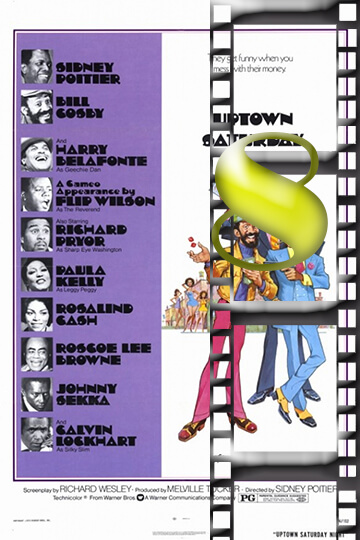
WHAT’S IT ABOUT
Blue-collar buddies (Sidney Poitier, Bill Cosby) search the underworld for a winning lottery ticket lost in a nightclub holdup.
MOVIESinMO REVIEW
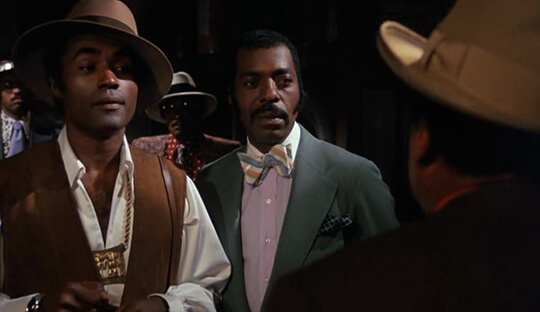
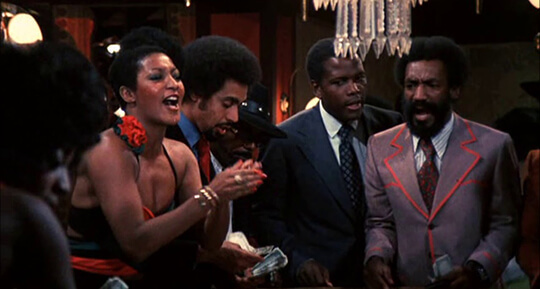
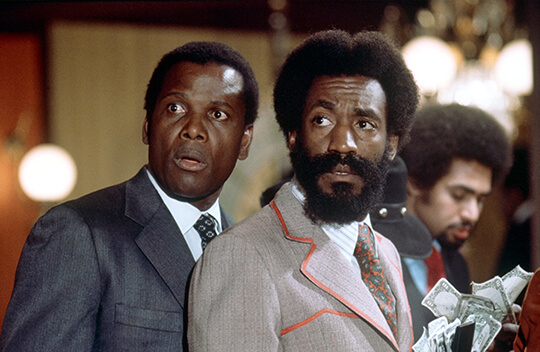
Among the collectives of Black film, few movies occupy such a unique position as 1974’s “Uptown Saturday Night.” The Sidney Poitier-directed film, headlined by the dynamic acting team of Poitier and Bill Cosby, is an important milestone within Black entertainment history that has been given a fresh close examination on a contemporary analytical platform. The release of “Uptown Saturday Night” in 1974 came at a key point in the portrayal of Black people on screen. It was the start of the period of what is popularly referred to as blaxploitation, and Black audiences were viewing characters who were more than sidekicks or domestic workers; they were leading the story. But where so many blaxploitation films went in on the violence and the hypersexual, “Uptown Saturday Night” went another way. This comedy caper allowed its Black stars to simply be funny, human, and lovable. The premise is surprisingly simple: two working-class friends, Steve Jackson (Poitier) and Wardell Franklin (Cosby), go into an underground after-hours spot where they’re subsequently robbed. When Steve discovers his wallet contained a winning lottery ticket worth $50,000 (more than $300,000 today), the duo embarks on a wild adventure through the underworld to reclaim it. Their journey puts them in the face of a colorful array of characters, including gangsters Silky Slim (Calvin Lockhart) and Geechie Dan (Harry Belafonte in a scene-stealing performance). Contemporary critics, for the most part, viewed “Uptown Saturday Night” as light fare – entertaining but not exactly heavy stuff. The New York Times called it “a comedy with more promise than delivery,” while others praised its star power but questioned whether it would be anything of lasting importance. What many were not noticing at the time was the revolutionary potential of Black characters in a comedy that was not necessarily about racial tension. Here were Black men grappling with universal ideas: friendship, potential, and working towards a greater world. Seeing the film now reveals both its enduring strengths as well as the ways in which cultural conversation has shifted. The film’s greatest service remains its cast, a veritable who’s who of Black excellence, with Flip Wilson, Richard Pryor, and Paula Kelly added to the leads. To see these gifts sharing the same screen remains a delight. Their timing and chemistry have not been damaged by the years. The film’s portrait of Black community existence – its social groups, community politics, and economic status – is a time capsule of urban life in the 1970s that is credible despite the comic environment. Poitier’s pacing keeps the activity moving at a fast pace, alternating slapstick with character scenes that place the zaniness under control. But contemporary audiences will view things that didn’t survive the test of time. Gender representation is rooted very much in its era, where women are largely relegated to background roles as wives or love interests who don’t have agency within the narrative proper. The politics of class ascension in the movie sometimes suggest individual luck (winning the lottery) rather than systemic change as the key to economic ascent. And some of the humor relies on stereotypes that would be more sharply examined in modern productions. Most jarring to viewers today is likely the unproblematic inclusion of Bill Cosby, whose own reputation has been irreparably tainted by several charges of sexual assault and subsequent conviction (later vacated on a technicality). His work playing Wardell cannot be separated from our current-day awareness, and so infusing an irrepressible tension while viewing the movie today. Would “Uptown Saturday Night” screen in 2025? Sure, but most likely with a more critical audience. Today’s audiences would appreciate the film as a historical document of Black beauty and talent thriving despite narrow chances. The comedy is still actually funny, and seeing Black stars overcome challenges through humor and cleverness rather than sheer force was state-of-the-art in its time and remains a welcome variation. Current viewers would connect with the central themes of the movie – friendship, economic aspiration, and getting by in systems that don’t benefit you – that continue to be relevant in America today. The film depicts connections of community and networks of support in Black enclaves, which may not place it in a specific time, but very much provides a warmth that exists in that time period. All that said, a contemporary remake (which has languished in development hell for decades) would need to update its gender politics, make its women more multidimensional, and perhaps investigate the structural barriers its characters face more explicitly rather than focusing on chance. “Uptown Saturday Night” has a unique place in Black cinematic history – one of transition away from the radical but occasionally disturbing blaxploitation genre towards the mature Black filmmaking that would exist in the future. It proved that Black storytelling could be economically viable without having to rely on violence or stereotypes, paving the way for future filmmakers like Spike Lee, John Singleton, and Ryan Coogler. The greatest legacy of the film may be the manner in which it made Black joy acceptable on screen. Most representations of Black life in the mainstream at the time dealt with hardship, whereas “Uptown Saturday Night” gave its characters real moments of fun, camaraderie, and adventure. It reminded us all that Black experience is part of the full range of human emotion and experience, from comedy to community and aspirational living, too. For viewers today, “Uptown Saturday Night” remains a watchable film, as a comedic engagement that still brings laughter and as a cultural artifact that could aid in helping to understand Black representation progression in American cinema. It may require some contextualizing, perhaps, but in essence, it still lives: a film about friendship, a community, and the pursuit of aspirations that reaches beyond its era and fits with a more universal human experience. In exploring how far we’ve traveled regarding Black cinematic representation, we must give credit where credit is due: the stepping stones that led us here, and “Uptown Saturday Night” most certainly was among them.
OUR RATING – A GROUNDBREAKING 8