

WHAT’S IT ABOUT
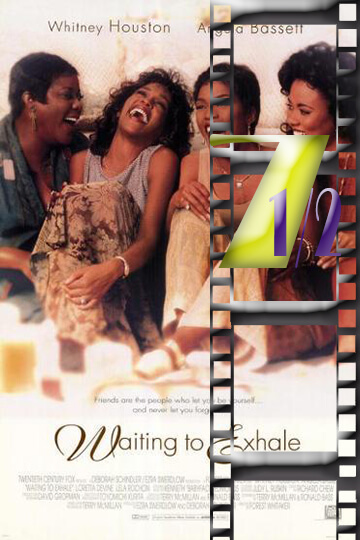
Navigating through careers, family, and romance, four friends bond over the shortcomings in their love lives — namely, the scarcity of good men. Both as the “other woman,” Savannah (Whitney Houston) and Robin (Lela Rochon) carry on relationships with married men, each believing their lovers will leave their wives for them. On the flip side, Bernadine (Angela Bassett) ends up alone when her husband divorces her for his mistress. Meanwhile, Gloria (Loretta Devine) finds love with a new neighbor.
MOVIESinMO REVIEW
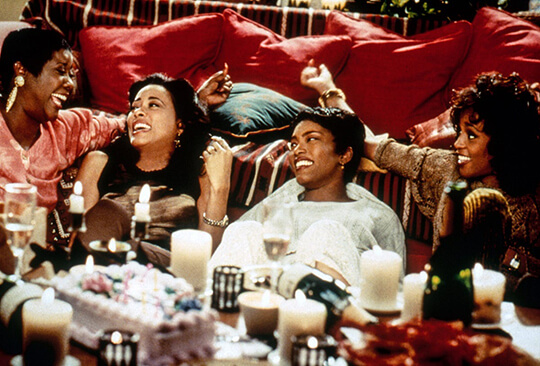
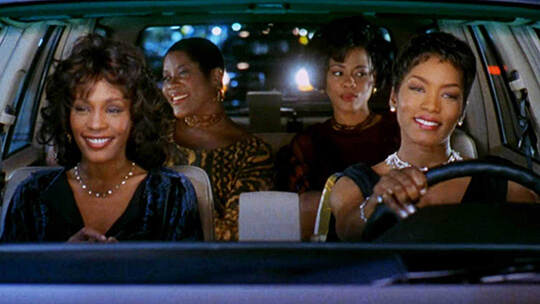
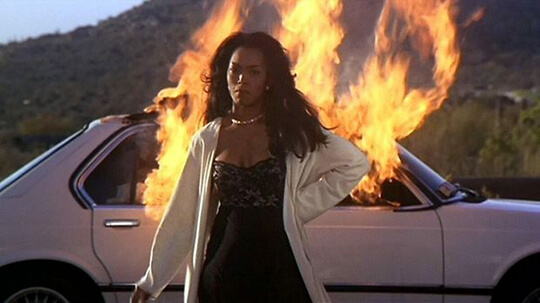
Nearly three decades after its release, Forest Whitaker’s directorial film “Waiting To Exhale” is an engrossing cultural artifact that is due for a reevaluation by contemporary standards. Adapted from Terry McMillan’s best-selling novel, this movie about four African American women finding their way through love, friendship, and work in Phoenix was revolutionary when released in 1995 and offensive by today’s standards in ways both encouraging and discouraging. When “Waiting To Exhale” opened in December 1995, it was nothing less than revolutionary. Here was a major studio film, backed by 20th Century Fox on a budget of $16 million, with four African American women as complex protagonists and not sidekicks or stereotypes. Whitney Houston as Savannah, Angela Bassett as Bernadine, Loretta Devine as Gloria, and Lela Rochon as Robin each experienced love letdowns but maintained their strong bonds as emotional supports. 1995 critics were universally positive, though many white critics seemed nearly shocked by the movie’s emotional finesse. Janet Maslin of The New York Times praised its “warmth and vitality,” and Roger Ebert liked its welcome focus on “women who are smart, successful, and funny.” Black audiences and critics were more uniformly ecstatic. Finally, these were Black women on the screen who were not maids, addicts, or victims but lawyers, television producers, and successful professionals with ownership of their own narratives. The film was a commercial success, grossing $81 million globally and spawning a soundtrack that ruled R&B charts for months. Most importantly, it proved that films about Black women could be successful, paving the way for subsequent endeavors. In 1995, this was a seeming tectonic plate shift in Hollywood representation. “Waiting To Exhale” is both powerful and dated-looking today when viewed in 2025. The central thesis of the film, that Black women deserve love, respect, and happiness, remains strong and necessary. The female friendships between these four women remain true and feel lived-in, particularly in those moments when they sit down and vent and celebrate and support each other through manifold catastrophes. But the film’s representation of masculinity and relationships today is infuriatingly one-dimensional. Nearly all of the Black men in the film are cheaters, mama’s boys, or emotionally unavailable ones. This was a true representation of the frustrations Black women actually had. Demonizing all Black men now proves to be problematic, especially with ongoing debates regarding how media representation affects community relations. The class politics of the film must also be critiqued. All four of the lead characters are solidly middle-to-upper-middle class, living in Phoenix suburbs with no acknowledgment of economic struggle or institutional racism. This “respectability politics” approach, which encourages successful Black women to counter negative stereotypes, was acceptable in 1995 but now feels limiting. Contemporary viewers, used to more nuanced portrayals of Black life, might find the constricted class exposure unsatisfying. Whitaker’s direction, while competent, lacks the visual imagination to lift the material beyond its TV-movie sheen. Phoenix, the location, is wasted, more than it must be, as a generic backdrop instead of a living, breathing world that shapes these lives. The film’s pace fails at times, particularly in the second segment, and some of the dramatic events feel contrived rather than unfolding naturally. The performances remain the film’s strongest asset. Bassett delivers a powerhouse performance as Bernadine, particularly in the legendary car-burning sequence that immediately became a cultural touchstone. Houston, debuting as an actress, is unexpectedly fragile in the role of Savannah, though her lack of experience periodically betrays her in tougher dramatic scenes. Devine and Rochon are solid supporting players, and they share a plausible supporting chemistry that serves to carry the film through its weaker moments. The Babyface-scored soundtrack deserves mention because it’s the movie’s most lasting contribution to pop culture. Songs such as “Exhale (Shoop Shoop)” and “Count on Me” were the essence of the mood of the film and demonstrated how music was incorporated into enriching and not compromising storytelling. Would “Waiting To Exhale” be a blockbuster today? The verdict is divided. The issues of the film remain relevant today—Black women still face unique issues in dating, career advancement, and social acceptance. The recent box office success of such films as “Insecure,” “Girls Trip,” and “The Woman King” demonstrates audiences’ hunger for narratives about Black women’s lives. However, contemporary viewers would likely expect more nuanced character arcs and less stereotyping of Black men. The heteronormative assumption and narrow intersectionality of the film might ring offensively to a younger viewer accustomed to more evolved identity politics as somehow dated. The depiction of women’s friendship and professional aspirations in the film is still so powerfully resonant. When more is being discussed about work-life balance and the importance of a chosen family, the friendship of these four women feels prophetic, not old-fashioned. “Waiting To Exhale” achieved its main objective: placing the stories of Black women at the forefront of mainstream cinema, while also demonstrating that those stories can be sold in the marketplace. “Waiting to Exhale” helped to pave the way for directors who followed, such as Gina Prince-Bythewood, Ava DuVernay, and Regina King, who expanded representation and addressed some of the limitations of this film. Its influence seeped into a larger cultural conversation about Black womanhood, friendship, and relationship standards. “Waiting to Exhale” made its way into ubiquitous contemporary discourse as a shorthand for the expectation of emotional fulfillment or sexual satisfaction. Its influence, however, must be viewed through the lens of potential loss. By playing it relatively safe as much as challenging broader social formations or exploring more nuanced character dynamics, the film did achieve mainstream acceptance at the cost of more nuanced artistic and political engagement. “Waiting To Exhale” is still an important cultural touchstone worth celebrating for its innovative depiction and box office success. Although certain aspects are tied to the time period and seem archaic by today’s standards, its overall affirmation of Black women’s friendship, drive, and strength still resonates. Today’s audiences would embrace the film’s spirit but also judge it. It is both inspiring in what we have achieved and reminding us of how much more we can achieve. In 2025, “Waiting To Exhale” is no longer the revolutionary statement it was in 1995 but is instead a crucial milestone on the way to the more subtle, sophisticated portrayals of Black life we now have. The film succeeds as both entertainment and history, providing a glimpse of a specific time within Black women’s cultural production and gesturing toward horizons its antecedents would later come to recognize. For that, it deserves both appreciation and open-minded critical evaluation.
OUR RATING – A RETROSPECTIVE 7.5