

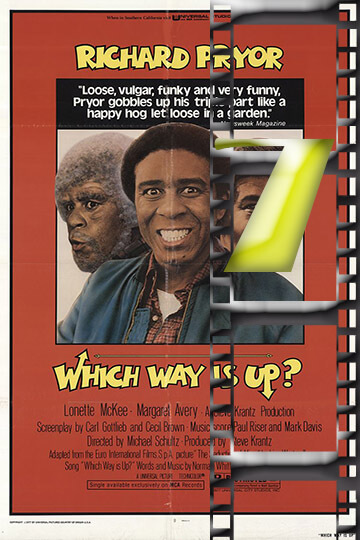
WHAT’S IT ABOUT
Orange picker Leroy Jones (Richard Pryor) inadvertently becomes a union leader and is forced out of town, leaving behind his sexually obsessed father, Rufus (also Pryor), and spouse, Annie Mae (Margaret Avery). He heads for Los Angeles, where he falls for union organizer Vanetta (Lonette McKee). Annie Mae seeks solace from the local preacher, Lenox Thomas (also Pryor), who eventually impregnates her. When Leroy catches wind of this, he heads home for a showdown with Lenox.
MOVIESinMO REVIEW
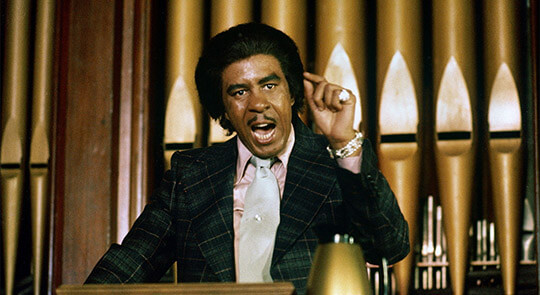
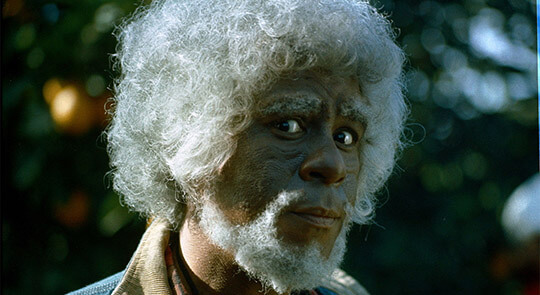
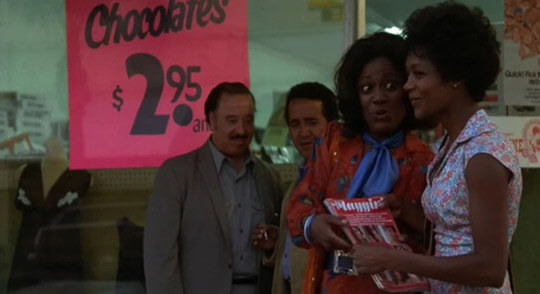
Richard Pryor’s comedic movie “Which Way Is Up?,” released in 1977, is both engaging and a look into a time just before Black cinema was about to shift. Looking back with today’s view, you can enjoy the warm laughter and embarrassing moments from the movie. A remake of Lina Wertmüller’s “The Seduction of Mimi,” the film transposes Italian class politics to California’s farm workers’ movement, with Pryor taking on three different roles – a tour-de-force that illustrates just how versatile a performer he was. When “Which Way Is Up?” premiered, some reviewers praised Pryor’s manic energy and physical comedy, and others decried it as vile and ramshackle. Black audiences generally welcomed the film for its uncompromising look at working-class Black life, though even then, there were some people who were put off by its sexual politics. What’s most striking about seeing this movie decades down the line is the manner in which it succeeds in feeling revolutionary and retrograde simultaneously. Pryor portrays Leroy Jones, a farm worker who accidentally stumbles into labor heroism after finding himself blacklisted for a protest and moving to the city to rebuild his life. The aspects of the organizing labor movement, the machinations of corporations and the economic stressors on Black workers are still relevant today. Director Michael Schultz makes the backbreaking quality of farm labor visceral with a realism not common in mainstream American cinema of the era. The film’s sexual frankness was unprecedented for the era, depicting Black desire as normal instead of sensational. Still, the women-as-conquests approach and offhand sexism present throughout the script make one wince today. Leroy’s relationships with his wife (Lonette McKee), mistress (Margaret Avery), and other women are typical of a male gaze that approaches female characters essentially as receptacles for male gratification or chastisement. Most remarkable, though, is Pryor himself, who delivers a masterclass in comedy. On top of portraying the hapless hero Leroy, Pryor also portrays Leroy’s father and a lascivious preacher. Pryor disappears into each character with different physicalities, vocal cadences, and energies. His work here is a testament to why he’s considered one of America’s greatest comic performers. The film’s handling of class struggle from a Black viewpoint was ahead of its time. Instead of focusing on the urban experience like the majority of blaxploitation films of the day, “Which Way Is Up?” examines rural and working-class Black life and shows how capitalism exploits vulnerable individuals wherever they are. Leroy’s journey from field hand to management stooge to disillusioned cynic is an arc that many workers can relate to. Cinematographically, the film has a raw, documentary-like grittiness to its field sequences that contrasts with more conventional studio setups. That visual shift follows Leroy’s trajectory between worlds and offers a subtle visual commentary on class divisions. Norman Gimbel and Charles Fox’s soundtrack effectively uses funk and soul to underscore the vitality of the era. Most troubling to watch the film today is its casual misogyny and homophobia. Jokes that probably got laughs in 1977 now fall with a clang or a wince. Women are objectified with regularity, and gay men are the butt of jokes. Such things were not out of the ordinary for comedies of the period, but they also make the movie hard to recommend without major reservations. Would people today like “Which Way Is Up?”? It’s complicated. Pryor’s comedic genius is timeless, and his physical comedy is still funny. The film’s teardown of predatory labor practices feels ahead of its time, given contemporary debates over workers’ rights. Contemporary viewers, however, will be alienated by the film’s treatment of women and its casual bigotry. For scholars of film and fans of comedy, “Which Way Is Up?” remains valuable both as a showcase for Pryor’s talents and as a work of Black cinema during a period of transition. The film followed the peak of blaxploitation’s popularity but preceded the more polished Black comedies of the 1980s. Its roughness and contradictions give it more substance as a cultural object than mere entertainment. Even at the time of its release, mainstream critics overlooked the film’s insidious engagement with class and labor politics in their condemnation of its profanity and sexuality. Black critics generally admired its more profound commentary on economic exploitation, even if some took issue with its depiction of Black women. Contemporary critics would likely laud its political content while more vociferously criticizing its troublesome gender politics. The film’s legacy lies in how it showcases Pryor at the height of his powers while also painting the limits of its era. “Thanks to its subject matter and the context of its release, “Which Way Is Up?” is progressive and problematic, forward-thinking and frustratingly retro. It’s a snapshot of an era when Black film was finding its footing in the mainstream and still had to carry the burdens of contemporary cultural attitudes. For students of Black film development or Richard Pryor’s career, “Which Way Is Up?” remains essential viewing in spite of its flaws. Modern audiences need to approach it as a historical artifact in need of contextualization rather than as entertainment. The film’s denunciation of labor exploitation has not dated, even if its sexual politics have. “Which Way Is Up?” overall stands in a complicated place in the history of Black cinema – too political to be seen as just entertainment, too problematic to be an unquestioned celebration. It expresses a notion that progress is rarely linear – and that works created with progressivity in mind will always have dimensions that are rightfully critiqued by future generations. It is this tension that makes the film not just a comedy but a significant cultural necessity that continues to provoke thought and discussion more than four decades after its release. The query is not so much whether “Which Way Is Up?” holds up today but what we can learn from its innovations and shortcomings. Within that tense space between praise and critique is a more honest grappling with our cultural history – one that does not discard flawed works out of hand nor make excuses for them. For those who are willing to engage the movie on these levels, “Which Way Is Up?” is still lots of fun.
OUR RATING – A CONFRONTATIONAL 7