

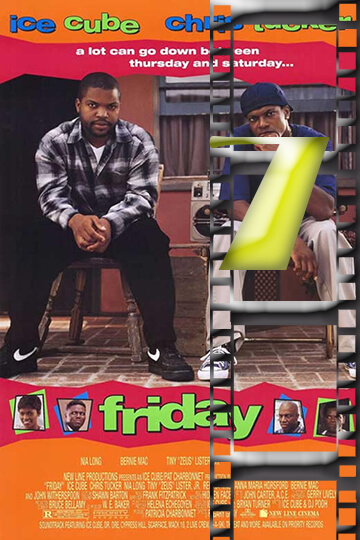
WHAT’S IT ABOUT
It’s Friday and Craig Jones (Ice Cube) has just gotten fired for stealing cardboard boxes. To make matters worse, rent is due, he hates his overbearing girlfriend, Joi (Paula Jai Parker), and his best friend, Smokey (Chris Tucker), owes the local drug dealer money — and that’s all before lunch. As the hours drag on, Jones and Smokey experience the gamut of urban life, complete with crackheads, shoot-outs and overly sexual pastors, concentrated into one single, unbelievable Friday.
MOVIESinMO REVIEW
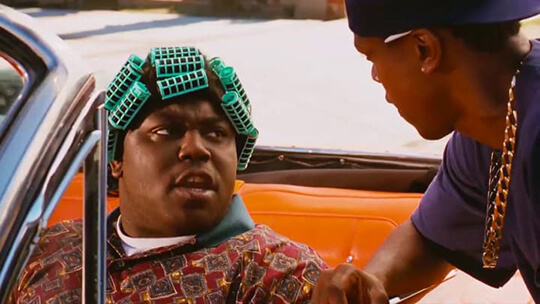
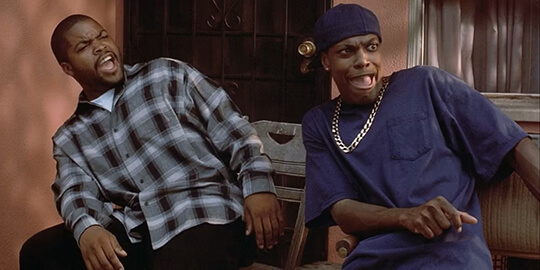
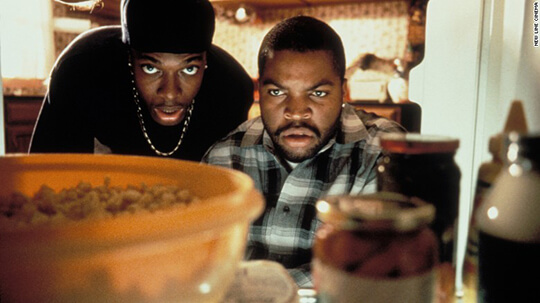
Looking back at “Friday” nearly thirty years after its release, I grapple with mixed feelings about a film that meant so much to many of us. As a Black film critic in 2025, I must be honest about what this film was, what it represented back then, and how it holds up today. When “Friday” hit theaters in 1995, it was groundbreaking in ways that are hard to explain to younger viewers. This was not just another comedy about Black people. This was our chance to tell our own stories, in our own voices, without holding back. Ice Cube wrote and produced this film after becoming frustrated with how Hollywood portrayed Black communities. Rather than the common themes of gang violence and destructive urban perspectives that defined Black narratives in cinema, Cube showed us something wholly different: the routine of a typical day in the neighborhood in which little happens, and that was the point. “Friday” is a comedy with a plot centering around Craig (Ice Cube), who loses his job, and hangs out with his best friend Smokey (Chris Tucker in his breakout role). They sat together on the porch of their house and watched their neighborhood, interacted with key neighborhood personalities, and figured out their small dramas that feel real to anyone who has lived in a neighborhood like that. The genius of “Friday” was the day-to-day nature of it. They were not drug dealers or gangsters or sad figures. They were just people living their normal lives, with normal problems and enjoying normal humor. Critics were mixed on “Friday” in 1995. Many mainstream white critics dismissed it as crude or convoluted, not recognizing that the film’s miracle is in being true to the Black working-class experience. However, many Black critics and audiences recognized its uniqueness. Roger Ebert gave it a favorable review, realizing that the film’s loose structure reflected real life in Black neighborhoods, where community happens on porches and street corners. The film earned $27 million on a $3.5 million budget, showing that there was a demand for these kinds of stories. What made ‘Friday’ also so special was how it expressed the cadence and vernacular of the Black community, without having to explain or otherwise translate any of it for white audiences. The film was meant for audiences to catch the jokes, recognize the references, and enjoy other audiences watching a cinema where we were truthfully represented. Smokey, Deebo, Mrs. Parker, and Felicia joined the ranks of classic characters because of their resemblance to people we had known. They lived in our neighborhoods and therefore felt authentic. Chris Tucker’s portrayal of Smokey was likewise extraordinary. His energy and comedic timing created a character who was equal parts funny and tragic. Smokey’s drug issues were never mocked for cheap laughs, and Tucker made him sympathetic every time he made bad decisions. Ice Cube’s Craig was a perfect “straight-man” character as the average guy simply sitting in a spot without getting involved in the madness engulfing him. The film’s portrayal of masculinity was also unique. Craig’s father, played by John Witherspoon, gives his son advice about fighting that touches on complex ideas about respect and Black manhood in neighborhoods where backing down might put you in danger. The movie does not shy away from these realities while questioning whether violence is always the answer. However, watching “Friday” today requires recognizing its shortcomings. The portrayal of women in the movie doesn’t feel good in the current context. Most women are present as love interests, antagonists, or comic relief characters. Homophobic jokes that felt normal in 1995 feel outdated and harmful today. Some of the language around mental health and addiction that was acceptable at the time is not today, and for good measure. So, it is complicated if “Friday” really works in today’s terms. The central story and characters are still compelling, but the film would need a complete revision in its handling of gender and sexuality if it were to sit well with today’s audience. The casual misogyny and homophobia in the dialogue would potentially face significant backlash today. I do think “Friday” will have an audience today. Its primary appeal- Black, authentic voices telling their own story with humor and heart- is still impactful. The chemistry between Ice Cube and Chris Tucker is obvious. Everything from the supporting cast to the visuals to the sound adds warmth and personality to every scene. The film’s celebration of Black community and culture still resonates. The true takeaway from Friday is how it informed all comedy and Black cinema that followed. It illustrated that Black stories do not have to be sad to matter to audiences, that comedy can be culturally specific and relatable as well, and that unique and authentic voices can create lasting art. In fact, every piece of cinema (or television) has followed in some way. All horror and even romantic comedies follow, to some extent, the “Friday” formula. In ways large and small, “Friday” has permeated films ranging from “Barbershop” and “Atlanta” to just about every meme or reference making the rounds on the internet today. The film also represents a particular instance in Black American culture, both timeless and limited. This was post-crack epidemic, pre-internet Black life, where neighborhood interactions and relationships dominated everyday realities in ways that we can see are almost nostalgic now. “Friday” is not perfect – it struggles in some parts and certain aspects of it have not aged well – but it is authentic. It was genuinely made with love for Black communities, from Black people, for Black audiences first. I think you can still feel that authenticity 30 years later. Would I recommend “Friday” to viewers today? Yes, absolutely, if we have the context of its time, and we can be critical of the things that are problematic. It is an artifact of a culture, presenting something authentic about Black American lived experiences, while entertaining audiences in various ways through humor and memorable characters. “Friday” certainly has achieved something worthy of celebrating, and we face the task of acknowledging its imperfections. As Black cinema moves into spaces of sophistication and progress, I see “Friday” as an important milestone in that journey. Certainly not the end of the line, it was an important part of the line on the way to more authentic, nuanced, and multifaceted Black stories. For that reason alone, it will earn its proper place in film history as well as my respect. I just hope we can continue to build upon its foundation and produce better and more inclusive stories for the future.
OUR RATING – A DAAAMN 7