

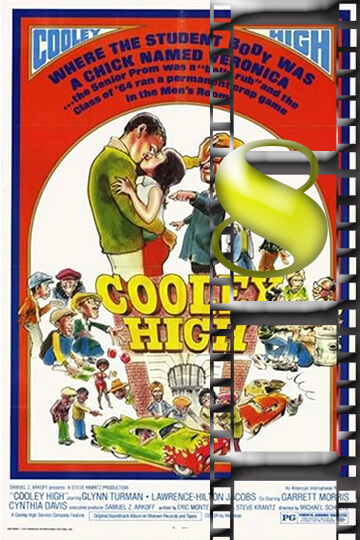
WHAT’S IT ABOUT
Richard “Cochise” Morris (Lawrence-Hilton Jacobs), a local basketball hero, and Leroy “Preach” Jackson (Glynn Turman), who dreams of a career in writing, are likable Chicago high school students in 1960s Chicago. They’re into hanging out with friends, pretty girls, and the Motown sounds so popular during the era. Each wants to make it big in his own way, but not everybody they meet is looking out for them, as they learn when a seemingly harmless outing goes awry.
MOVIESinMO REVIEW
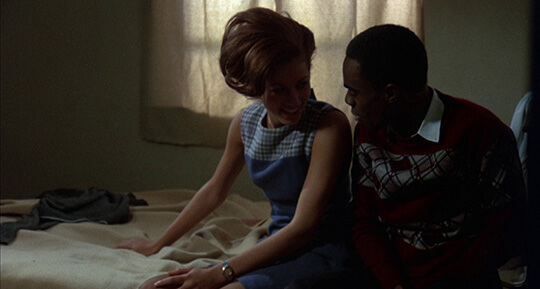
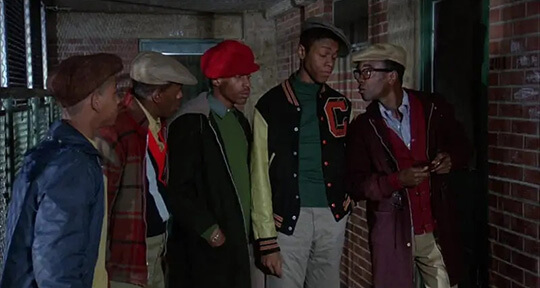
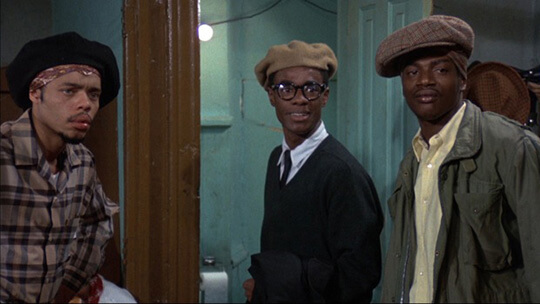
As a Black film critic who now looks back at Michael Schultz’s 1975 classic “Cooley High,” I can’t help but think about how this film, for the past five decades, has progressed in cultural value from just being a nostalgic artifact to being a reference point for sincere Black storytelling that spans generations. When “Cooley High” debuted, it came at an important time in Black cinema. Most critics thought the film was a breath of fresh air from the blaxploitation movies that were popular in the early 1970s. The film was praised for its authentic and heartfelt slice-of-life portrayal of Black teenagers in 1960s Chicago. Many critics recognized that instead of the hyper-stylized characterizations portrayed in films like “Shaft,” “Superfly,” etc., the audience was seeing young Black men who had aspirations, were social beings, and lived in a world with challenges and obstacles. The comedy in “Cooley High” was applauded for the moments of joy and levity that were present but never crossed the line into being caricatures, and the dramatic beats were earned and not forced. Mainstream white critics sometimes compared it to the coming-of-age nostalgia of “American Graffiti,” again limiting its cultural specificity. Many mainstream publications gave the film praise while betraying their limited grasp of the Black experience depicted on screen. Black critics, however, recognized something more profound – a rare glimpse of Black youth depicted with nuance, humor, and humanity during a time when such portrayals were exceedingly rare in American cinema. The soundtrack was revolutionary for its time and deserves special attention in any discussion of this film. When “Cooley High” hit theaters, its Motown-heavy soundtrack featuring The Supremes, Stevie Wonder, The Four Tops, and Martha and the Vandellas served multiple purposes that critics immediately recognized. Modern critics pointed out the way in which the music both signified a specific temporal period while also creating an emotional trajectory for the story. These are not just random music in the background, but rather, the songs are cultural shorthand that links people to a common cultural history rooted in Black music. In reviews, critics were particularly commendatory of how songs like “Reach Out, I’ll Be There” by the Four Tops and “My Girl” by The Temptations were not simply used for period decoration here and there but were meaningfully used in key moments in the film’s narrative. The music was so tightly woven into the story that many of the reviews commented on the way G.C. Cameron’s “It’s So Hard to Say Goodbye to Yesterday” elevated the final moments of the film to a transcendent place. Black music media specifically noted that the score lent authenticity to the film’s behavior, essentially becoming a time capsule in Black cultural history. In today’s assessment, “Cooley High” has a different read: students today appreciate that the film depicts Black joy without romanticizing whiteness or the white gaze imprinting itself on the experience. The lived-in-ness of the friendship between Preach and Cochise, performed by Glynn Turman and Lawrence Hilton-Jacobs with aplomb, makes sense within the disruptive and disarming gaze of Black joy. The film’s revelatory embrace of these young men looking across the spectrum of emotion – from euphoric joy to inconsolable sadness – feels radical today. Today’s critics appreciate that the film handles both humor and seriousness naturally, without relying on trauma exploitation that many of today’s Black films will likely be wise to stay away from. Overall, the contemporary reading zooms in on the ways the film explains the nuanced distinction of class among Black folks – typically shortchanged in the original published reviews. The educational deficits, economic hardship, and constrained opportunities of these young men constitute a layered representation worthy of more than a sitting glance, which is arguable to many in its original entry. Contemporary critics may point to the few roles available to women, who are most often romantic interests or mother figures. The sexism that passes unnoticed in some of the scenes that no one batted an eye at in 1975 would not be acceptable today. Much of the contemporary feminist critique of the movie emphasizes how women characters, even as they are presented with fondness, lack the depth and autonomy awarded to their male counterparts – criticism based on a changed set of standards for representation in film. In retrospect, from 2025, the Motown soundtrack has taken on additional planes of meaning. What was once contemporary popular music has become a cultural touchstone, with songs that have accumulated five decades of additional meaning and resonance. Modern audiences experience these songs with a historical awareness that original viewers couldn’t have possessed. The soundtrack has become intergenerational – many younger viewers first encountered these classic tracks through their parents’ or grandparents’ love of this film. Music critics today point out how “Cooley High” helped cement the canonical status of many Motown hits, preserving them in cultural memory through their association with the film’s memorable scenes. The soundtrack remains an important reference point in how often it comes up as an example of a score that authentically represents a time and place in film music. Numerous contemporary filmmakers refer to “Cooley High” as a special text about getting pre-existing music to function in service to the narrative without being annoying or getting in the way of the story that is being told. After watching “Cooley High” in 2025, perhaps the most remarkable thing is it captures effectively and realistically the notion of a community living through systematic injustice while maintaining a sense of being culturally rich. The setting of the Cabrini-Green housing project, which eventually became a representative site of urban decay in American media, is an outstanding example of a complicated site where there are complications within neighborhoods but also warmth, music, and space to develop relations. With gentrification and the eradication of historically Black neighborhoods, relating to the communities and cultures that “Cooley High” celebrates resonates especially poignant today. The film’s bittersweet ending – with Preach pursuing his writing dreams while mourning Cochise – resonates differently now. It reflects the ongoing reality of stolen Black potential, of dreams deferred through violence, while insisting upon the possible existence of transcendence. At this moment, the struggle between the hope that something positive can exist in the face of extremely harsh realities feels more real than ever; ongoing conversations around systemic inequality and racial justice are more relevant than ever.”Cooley High” is timeless because it captures something important about Black adolescence that is not confined to an era. The search for possibility and the feeling and power of friendship is interconnected with the tightrope crossover between hope and heartbreak. The film and the impeccable soundtrack provides a time capsule that is continually opened and reexamined through generations, with each generation discovering something identifiable that connects to their lived experiences. It’s not just a great Black film with an outstanding soundtrack; it’s a great American film that continues to reveal new layers with each passing decade, underscored by music that remains as powerful and evocative as when it first played in theaters half a century ago.
OUR RATING – A CLASSIC 8