

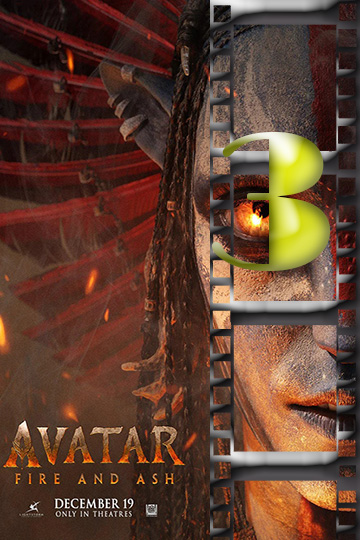
What’s It About
One year after settling in with the Metkayina Clan, Jake and Neytiri’s family grapples with grief after Neteyam’s death. Eventually, they encounter a new, aggressive Na’vi tribe called the Ash People, led by the fiery tribe leader, Varang, who has allied with Jake’s enemy, Quaritch, as the conflict on Pandora escalates to devastating consequences.


MOVIESinMO REVIEW
James Cameron spent three years making another “Avatar” movie, but I think he should have stopped after the first one. “Fire and Ash” is now in theaters, and while the scorched, Mad Max-style landscapes look impressive and the ash effects are convincing, Cameron has basically made the same movie for a third time. While the backgrounds are different (i.e., forest, ocean, volcano), it’s basically the same plot. I’m a Black film critic, and I am getting tired of seeing the Hollywood white savior recycle the same narrative with such a lack of imagination when pretending it’s going to tackle the issue of colonization. Jake Sully and his family are again the focus of this film. They try to live in peace until Colonel Quaritch comes after them, forcing Jake to move his family to a new place. This time, they meet the Mangkwan, or “ash people,” Na’vi who live near volcanoes and whose lands were destroyed by eruptions. Unlike other Na’vi, they are angry at their goddess Eywa for not protecting them, so they use human technology and weapons. Quaritch teams up with their leader, Varang, to hunt Jake, leading to another big battle where Jake leads everyone to victory. If this sounds familiar, it’s because it’s almost the same story as the first two movies. Jake arrives somewhere new, the locals don’t trust him, his family learns their ways, and when danger comes, Jake’s military skills save the day. We’ve seen this three times now, and Cameron plans to make two more movies with the same formula. What really bothers me is that the ash people could have been interesting. Their goddess abandoned them during the eruptions, so they lost faith in the spiritual beliefs that define other Na’vi. They’re bitter, violent, and willing to work with colonizers. That’s a complicated and realistic situation. Throughout history, colonized peoples have sometimes allied with or aided those who were oppressing them due to feelings of abandonment by their own leaders and/or cultural groups. For example, some Native Americans provided support to the United States’ military; in Africa, some indigenous people even helped the European slave traders during the slave trade. This is a painful, messy, and human phenomenon. Although Cameron could have explored why colonised peoples sometimes turn against (betray) their fellow oppressed group members rather than forming alliances, he chose not to do so. Varang, the ash people’s leader, is introduced as a powerful and intimidating figure. Oona Chaplin plays the character with intensity, and for a moment, it appears that we might see a Na’vi character develop in complexity; however, the film reduces her once again to a villain for Jake. She is Quaritch’s ally (and perhaps his love interest) and the film treats this as a surprise twist. How did she come to trust humans who have destroyed her world? What other motivation does she have besides seeking to avenge her people? We never find out, because Cameron needs her to be a villain, not a real person. This is how colonizers have always operated: they find groups who feel abandoned or angry, promise them power or revenge, and use them against other colonized people. The British did this in India, playing groups against each other. Europeans did it in Africa, creating conflicts that still cause problems today. American slavers did it by giving some enslaved people slightly better treatment to control others. This “divide and conquer” approach only works because colonizers don’t see the people they use as fully human. The movie shows Quaritch giving Varang weapons and making deals, but never lets her be smart enough to see she’s being used. She’s just angry and violent, while Jake is wise and protective. Once again, the white guy in a blue body is the moral center, while the real Na’vi are either followers or villains. The children of Jake spend a considerable amount of time on their screens. They comprise a collection of rebellious teenagers. All of them believe that their father is an overly strict parent, but eventually, each realizes that their father was indeed correct when they are faced with danger. The focus of the movie is primarily on Spider. As a human child raised by the Na’vi, he is caught in a middle ground between the two worlds of his biological parent (Quaritch) and the environment of his foregone family. The movie treats this as deep, but it’s just another version of the white character whose feelings matter most. Spider is given special powers by Eywa that allow him to breathe the atmosphere of Pandora despite all evidence to the contrary. These powers have been granted to Spider in order to assist him in his role in the story arc of the film. Kiri is characterized as a ‘chosen one’ spiritually and has connections with Eywa; however, all of Kiri’s notable supernatural milestones occur only when the story requires her assistance through saving acts. Sigourney Weaver voices her as a teenager, which feels odd, and Kiri mainly exists to rescue people at convenient times. The movie keeps saying she’s important, but never shows us why, except that she’s useful. The action scenes are technically impressive. Cameron knows how to film battles, and the volcanic setting gives him new visuals to use. There’s lava, ash storms, and burning forests. The impressive nature of the 3D effects on-screen is beginning to wear thin due to all the similar action sequences across the three installments. Once again, we have all the chases, ambushes, and last minute rescues, which create an overall monotonous pattern, regardless of how expensive the film appears to be. The main issue I have with this film is that the movie’s discussion of spirituality doesn’t demonstrate a true understanding of spirituality itself. Eywa represents the spirituality of the Na’vi and is responsible for connecting all life on Pandora. Unfortunately, the only time Eywa is significant is when she facilitates victory in battle. The characters pray to her for assistance in their battle against humans, and demonstrate their own spiritually connectedness through acts of violence. This is indicative of a new form of colonization. Traditional concepts of spirituality encompass a far deeper and much broader set of concerns than those surrounding violence. These traditional concepts include: Why do bad things happen to good people? How can one find meaning in suffering? In what ways are we connected through our spirituality? The ash people eventually come to grips with the nature of their faith in Eywa after feeling a significant personal loss. The creators of the film chose not to address this spiritual crisis. Rather, they depict the ash people as misguided in their disbelief of Eywa, portraying faith as an easy solution to overcoming life’s obstacles. Stop believing, and you become evil. That’s not complex; it’s just propaganda. Cameron spent over three hundred million dollars and three years making this movie. He clearly thinks he’s saying something important about environmentalism and respecting Indigenous cultures. But you can’t honor Indigenous peoples while making them side characters in a white man’s story. You can’t criticize colonialism while using the same old colonial storytelling tricks. And you can’t make anti-war movies where war solves everything. The most upsetting thing is that viewers of this film will likely be misled by it and believe they are learning about colonialism when, in fact, they are not. When people view Jake defending the Na’vi and rally behind him as a hero or an ally, they will not take into account how colonialism operates or continues to exist presently; therefore, they will not relate what they see happening on Pandora to the ongoing devastation occurring within the Amazon Basin, the Arctic region, or Alaska’s northwest coast. Even in the future, people will lack awareness about how the colonial mindset of whites in charge, with Indigenous peoples merely following, is repeated throughout the movie’s storyline. “Fire and Ash” will earn billions of dollars at the box office. The film’s visual effects will receive eulogies. Cameron will alert everyone to the next sequel. For us all to think of this as innovative cinema is an egregious error. “Fire and Ash” is essentially a reworking of the same theme and storyline, simply done with more elaborate computer-generated graphics and far more money. The franchise’s main purpose has transitioned into being just like the corporate monsters it claims to despise; it is simply another large corporation extracting resources and returning nothing beneficial. This movie lacks the ability to make its audience feel emotionally connected to any of the characters. In contrast to the second film that had some level of novelty by using the ocean as an element of the story, this film is nothing more than a waste of goodwill and patience while displaying great visuals.
Our Rating – A Burned Out 3