

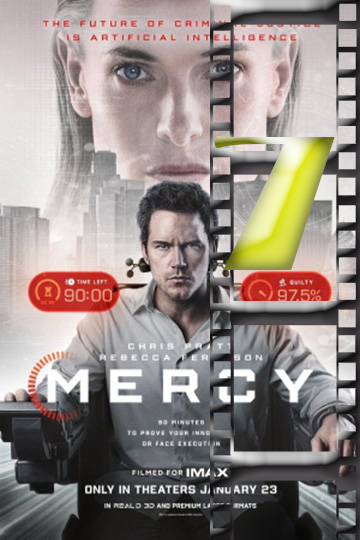

What’s It About
In the near future, an advanced AI judge tells a captive detective that he’s on trial for the murder of his wife. If he fails to prove his innocence within 90 minutes, he’ll be executed on the spot.
MOVIESinMO REVIEW
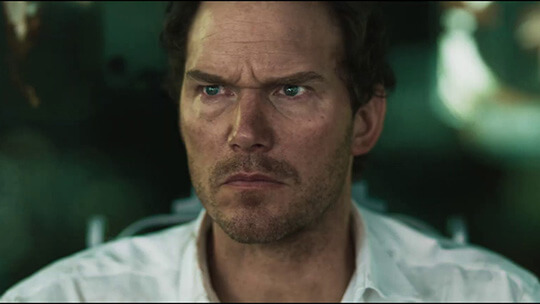
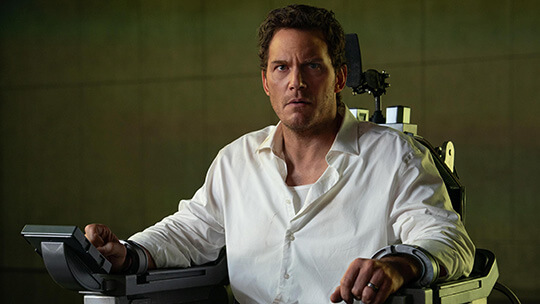
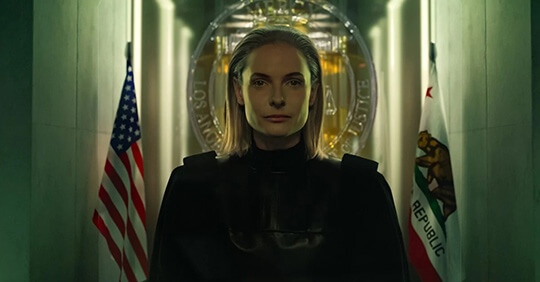
Imagine waking up tied to a chair, being accused of murdering your wife, and having only ninety minutes to prove your innocence. “Mercy” is a sci-fi thriller that revolves around this weird idea. Detective Chris Raven (Chris Pratt) is a cop who becomes trapped in the system he helped establish. The twist? There is no jury, no lawyers, and no human judge. Just an artificial intelligence named Judge Maddox, embodied by Rebecca Ferguson, who has the power to decide if you live or die. The setting of the film is a gritty future Los Angeles. Crime is rampant, people are angry and protesting in the streets, and the homeless are living in tents. The traditional court system had fallen behind, so the city decided to innovate and go for something horrifying. They set up an AI-powered court where trials are conducted rapidly, and penalties are handed out even more quickly. If nobody can prove, using evidence, that they are not guilty in 90 minutes, then they get executed right there and then. So, no appeals, no second chances, and no leaving your chair alive. Director Timur Bekmambetov keeps the film at a swift pace from beginning to end. With constantly changing visuals of cameras, phone records, social media, and numerous other types of digital information, the screen is quite a busy place. Besides feeling a bit too much on purpose, the movie helps us understand the pressure Chris Raven is put under when he’s racing to save himself. That countdown clock is the most brutal of all the characters; it never stops ticking and keeps reminding everyone that time is almost up. Chris Pratt’s performance is pretty satisfactory. At first, his character seems lost and frightened, but later he is able to turn on his detective mode as he comes to terms with what he sees as a threat. Pratt demonstrates how a guy can be emotionally shattered, furious, and scared all at once. He’ll make you root for Raven to survive that chair while the story becomes somewhat ridiculous. Rebecca Ferguson should also be commended for her work. The role of a cold AI judge could have been monotonous and dull, but through her, Judge Maddox is felt as a real and potent entity, without any overkill. Probably the most significant merit of “Mercy” is the introduction of the idea. An AI determining a person’s guilt or innocence is a matter that strikes at the heart of our apprehensions about technological control over the very aspects of life that require human discretion. It addresses some deep questions about what could happen if we place machines in charge of decisions that call for compassion, understanding, and second looks/the opportunity for redemption. However, where the movie scrapes along is in the way it deals with those questions that were raised. Rather than exposing the hazards of an AI-influenced justice system, it stays on the surface level. The real gripe isn’t merely that a computer operates the courtroom. The more significant problem is that whoever programmed the system made it so that people are assumed guilty if they’re not proven innocent, the defendants are left without lawyers, without time to prepare, and are given only 90 minutes to defend themselves. This kind of system is evil, whether there is a human or a machine in charge. Moreover, the movie never directly confronts the ones who built this broken system, or why anyone could have even thought it was okay. Nevertheless, the detective work scenes are sufficiently interesting. Since Raven is restricted to his chair, he settles the case by bringing in and talking to witnesses, reviewing security tapes, analyzing bank statements, and figuring out the series of events happening at the same time. Meanwhile, Jaq, his colleague (portrayed by Kali Reis), assists from a distance. His daughter Britt (Kylie Rogers), who is torn about whether or not she should believe her dad’s innocence, is a source of emotional tension. Rob, Chris Sullivan’s character, who is the AA sponsor, shows up to offer encouragement. Even when the script doesn’t give them much, the actors make their roles believable. The movie adds a subplot that just sits there. There is this entire sequence about how the poor live in heavily policed “zones, ” but it feels as if the filmmakers just wanted to be politically correct or current. There is no meaningful connection to the main storyline. Plus, the film keeps a lot of twists and turns, and some of them force the suspension of disbelief quite a bit. The hostage situation that happens feels artificial, and the chase on futuristic police bikes looks cheap and poorly made. One can clearly see that the movie had to be very economical with its special effects. The thing that keeps “Mercy” going quite entertainingly in spite of the many flaws is the never-ending tension. The ninety-minute countdown creates an unremitting pressure. You are as aware of every passing second as Raven is. And it also contains something about our present life and how much of our personal information is already online. Every text message, picture, and purchase that we make is stored at some server somewhere. The film points out how easily all this data can be retrieved and used against somebody, and it is not a little bit scary. Music by Ramin Djawadi and the sharp editing also contribute to the maintenance of the urgent atmosphere throughout. The visual style, with its multiple screens and rapid transitions, imitates the way we get information nowadays. It is overpowering, but it works: the audience feels like they are interpreting the same clues as the detective at the same time. “Mercy” probably represents the ideal of a simple thriller that does not make an effort to be deep. It is not going for a position of a “Minority Report” or “The Fugitive, ” although you can spot a blend of those films. Rather, it is a tight murder mystery wrapped up in a science fiction package. The acting is good, the tempo stays consistent, and the new premise hooks your mental curiosity first of all. Indeed, the want of finding out the truth of the matter prevails the question of whether or not heaven will help Raven out before it is too late. The film never quite gets to be the warning story it had the potential to be. It throws around concepts like surveillance, automation, and justice, but that is all there is to it. This is a pity because a quite intelligent and deeper version of this story does exist and is waiting to be factored in. Instead, the audience just gets something less layered and more for fun, which neglects to challenge the audience to think. Still, a movie that at least momentarily makes one think about the extent of power we are already handing to technology is a good thing. “Mercy” doesn’t have all the answers, but it does raise the appropriate questions. We live in a world in which AI is already determining who gets a loan, who gets a job, and who is a criminal risk. It is not too far off that it could be deciding who lives or dies. In summary, “Mercy” is a fairly pleasant way of wasting time. It is stylish, intense, and more enjoyable than what one would initially expect. The imagination is there, the playing works, and the countdown fails to let go of the tension. Just do not anticipate that it will haunt you after the credits roll or that it is going to give you anything particularly profound about the perils of artificial intelligence. It is entertaining, but for one view only, thrilling, but soon to be forgotten. As Maximus said in Gladiator – “Are you not entertained!?”
OUR RATING – A MERCILESS 7
MEDIA
- Genre – Sci-Fi
- Street date
- Digital – February 17, 2026
- 4K/Blu-Ray/DVD – April 7, 2026
- Video – 1080p
- Screen size – 2.20:1
- Sound – English Dolby Atmos/TrueHD 7.1, French DTS-HD Master Audio 5.1, English Dolby Digital 5.1
- Subtitles – English, English SDH, Spanish, French
Extras
- none