

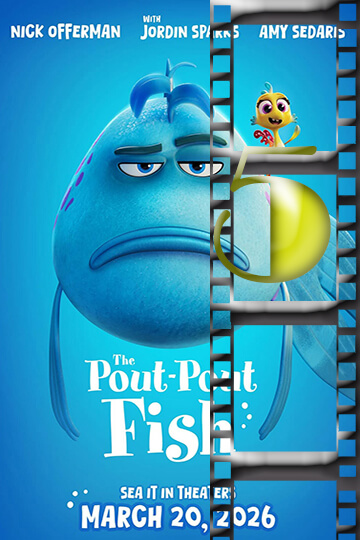

What’s It About
Living on a rundown shipwreck, Mr. Fish one day discovers a hyperactive young sea dragon Pip – who had mistaken his home for a junkyard – pilfering his belongings. The heated argument that ensues leaves both their houses in ruin. But there is hope. Embarking on a seemingly impossible quest in search of the mythical “Shimmer” to grant them a wish, there’s only one problem: someone else is on the hunt.



MOVIESinMO REVIEW
Although The Pout-Pout Fish isn’t really a “bad” movie, it’s also not really a “great” movie; it’s somewhere in between… bright & colorful and just manages to hold the attention of children for the duration of the movie. As for adults? Bring a charger for your cell phone and some patience, as the movie was not made with adult audiences in mind. Directed by Ricard Cussó and Rio Harrington, and written by Elise Allen and Elie Choufany, The Pout-Pout Fish is based on Deborah Diesen’s beloved children’s book series, which started back in 2008 and even found its way to an off-Broadway stage in 2019. The film is a joint production between America’s Viva Pictures and Australia’s Maslow Entertainment, and that partnership shows up loudly in the voice cast, a blend of American and Australian talent that gives the movie a distinctive sound, even when the story itself refuses to take any chances. Mr. Fish is the lead character of this film, an ocean pout fish, and has a permanent frown, which is representative of his personality as well. He is voiced by Nick Offerman, and on paper, this seems like a big win for the casting directors. Offerman has one of those really deep, dry voices that draws you in, whether he intends to or not. Unfortunately, the script does not provide Offerman sufficient material to use other than being querulous. There is no sharpness to his grumpiness, no real edge — just a fish who frowns and occasionally mutters something mildly amusing. His character’s backstory explains that his father raised him to distrust strangers, which turned a once-lively little fish into the isolated, bitter creature he becomes as an adult. That is actually a meaningful idea. But the film rushes past it before it can land with any real weight. Mr. Fish’s life changes when Pip enters the picture. She is a young, high-energy sea dragon voiced by Nina Oyama, and she represents everything Mr. Fish is not: joyful, talkative, and completely unbothered by his cold attitude. After a string of accidents destroys both of their homes, the two are forced into a partnership to find a mythical Siamese fighting fish named Shimmer, voiced by Jordin Sparks. Shimmer is said to grant wishes, though she does so rarely and takes a long time to recover her power between grants. Pip believes Shimmer can restore what they lost before Pip’s parents return home with nearly 300 or 400 new baby siblings; the film cannot quite decide on a number. Mr. Fish, it turns out, actually crossed paths with Shimmer during his childhood, which adds a small but interesting layer to his character that the movie unfortunately does not develop nearly enough. When it comes to trying to stop the efforts of Benji, who is a young cuttlefish, simply speaking as to his relationship with Miss Shimmer, Benji will be voiced by Remy Hii, and Benji has a major force working against him, which is too much kelp in their water community that blocks out sunlight. Benji’s desire for Shimmer’s wish is just as significant to him as Mr. Fish’s and Pip’s desire, so the race is on for whoever can get to Miss Shimmer first. Benji’s relationship with his mother (the leader of all the cuttlefish) Marin will be played by Miranda Otto and her presence before the camera gives weight to her character and the rest of the characters around her; however, the movie takes much of the time following along side Benji’s journey instead of the actual story (the development of the friendship between Mr. Fish and Pip) that the viewer should be focusing on. The supporting cast adds some texture to the journey. Amy Sedaris voices three valley-girl pink dolphins, and she alone earns three distinct performances from a small amount of screen time. That is the most creative use of a voice actor in the entire film. Adding to the list is also a friendly octopus named Hector who runs a hardware store, a duo of jellyfish named Shaz and Baz, a lost baby whale, and a network of starfish that function like an underwater version of social media, which is the film’s cleverest visual joke. These encounters follow a repetitive pattern: Mr. Fish and Pip arrive somewhere, talk to a creature, get a clue, and move to the next location. That cycle repeats until the ending arrives, and it all feels very by-the-numbers. The animation is where this film falls the furthest behind. In a world where The Wild Robot, Pixar’s Inside Out 2, and DreamWorks’ best work have set a high standard, The Pout-Pout Fish looks noticeably plain. The reef scenes are flat. The movement of minor characters occasionally looks stiff. The colors are bright, and the designs are energetic, but there is no real sense of wonder, no moment where the underwater world stretches out in a way that takes your breath away. For a story set in the ocean, that is a significant missed opportunity. Animation, when done right, can carry a thin story. Here, it cannot. What the film does carry, imperfectly but sincerely, is heart. The central message, that going outside your comfort zone to help someone else can change your entire outlook on life, is a worthy one, and it connects most naturally through Offerman’s performance. Even when the lines are flat, there is something warm and real in how he delivers them. The relationship between Mr. Fish and Pip, despite its predictability, works because Offerman and Oyama build genuine chemistry. You believe, by the end, that these two characters needed each other. The humor is the film’s weakest element. Most of the jokes are simple and visible from a mile away. A school of fish stops traffic at a crosswalk. Sea creatures use ocean puns where land expressions would normally go. Children under ten will probably laugh. Anyone older will sit quietly and check the runtime. At its core, The Pout-Pout Fish knows exactly what it is trying to do and who it is trying to reach. It aims squarely at young children, kindergarten through early elementary school, and it hits that target. The film utilizes multiple clear messages, colorful characters, and rapid storytelling to captivate its audience, who have shorter attention spans; however, the film relies entirely too much on employing its themes with no opportunity for its characters to actually earn them! For example, why is Mr. Fish telling everyone about how much he has grown by saying it out loud instead of showing us his growth through his actions? This is not a book! We want to see the emotional payoff from the experience. If you have young children who already love the books, take them. They will enjoy themselves. If you are hoping for a film that works on multiple levels, the way the best animated movies do, this is not that film. The Pout-Pout Fish reaches for the surface but never quite breaks through.
OUR RATING – A SHALLOW 5