

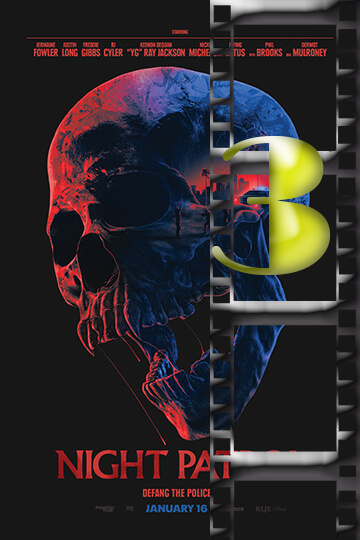

What’s It About
An LAPD officer discovers a police task force is harboring a horrific secret that endangers residents of the housing projects he grew up in.
MOVIESinMO REVIEW
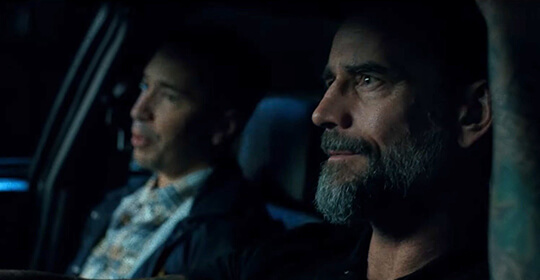
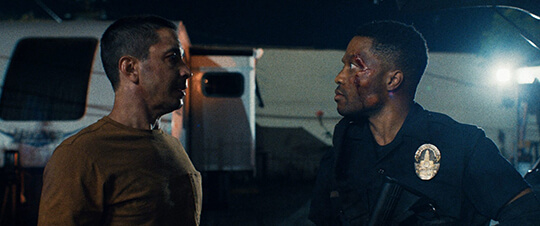
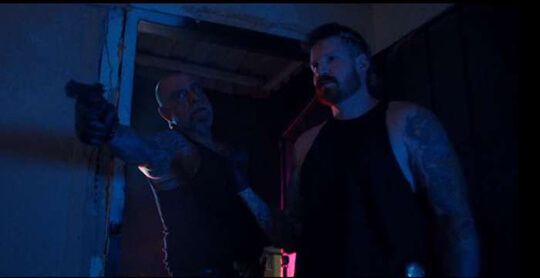
There is something deeply frustrating about watching a film that carries a powerful idea on its back and then trips over its own feet before it ever gets moving. Night Patrol, directed by Ryan Prows and co-written by Prows, Tim Cairo, Jake Gibson, and Shaye Ogbonna, arrives with one of the most electric premises a horror film could offer in today’s political climate, and then wastes nearly every second of it. The setup is genuinely compelling. The Los Angeles Police Department harbors a secret unit operating after dark. These are not just dirty cops. The concept of white supremacist vampire gangs hunting down black people in the U.S. for generations using redlining and gang warfare as a cover is horrific, urgent, and socially relevant. Instead, Night Patrol is an incoherent, bloated mess that disrespects the very communities it claims to defend. The story opens with Wazi (RJ Cyler), a young man sitting in an interrogation room, badly wounded. The film then jumps back a few days to explain how he got there. Wazi has been secretly dating Primo (Zuri Reed), and the two face a Romeo and Juliet situation; he is a member of the Crips, she is connected to the Bloods. The Night Patrol officer finds Primo in their parked vehicle and kills him abruptly, and Wazi runs away before this action takes place. So, the first scene builds up, creates tension, and sets up an eventual story that has serious results. From there, the film splits into multiple perspectives across three acts, following LAPD officers Ethan Hawkins (Justin Long) and Xavier Carr (Jermaine Fowler), along with the gang community responding to the attacks. Xavier, it turns out, is Wazi’s older brother, a former Crip who chose law enforcement to make a difference. Their mother, Ayanda (Nicki Micheaux), is rooted in African spiritual traditions and turns out to be the only person who truly understands what the Night Patrol really is. The idea of centering Black ancestral knowledge as the weapon against white supremacist evil is genuinely interesting. This is an issue because the film has treated the idea as a joke for much of its runtime; Ayanda has been ridiculed for her beliefs and the film has constantly tried to make us laugh at her, as well as generally using Zulu-based spiritual practices as little but a “billboard” until we have the final fight and suddenly want the audience to believe in the importance of those spiritual practices; therefore, the tonal inconsistencies within the film are not only failures in terms of story-telling, but also show a real lack of respect! In this instance, the portrayal of Justin Long’s character Ethan contains more complete development than any other character, indicating that a larger problem has been created by the film itself. Ethan’s character has a slow-burning tension, showing how a man’s desire for purpose and loyalty to his family can be rationalized through his own evil acts when commanded by the very institution that he belongs to. With a calm and unsettling performance, Justin Long has provided the viewer with the depth for Ethan to rise to the level of one of the stronger characters in the film; however, the opposite is true for the character of Xavier: A black ex-gang member who is attempting to follow a righteous path, witness to the murder of his brother, and with his mother’s possession being the key to his redemption. The film does little to provide Xavier’s character any development or complexity for viewers to care about him as a person, and it fails to provide any real attempt at reconciling the contradictions of the decision for Xavier to be part of the very system that is killing off his family There is a scene where Xavier performs a Scared Straight presentation for young kids, playing up his past to frighten them straight. It is uncomfortable in a way the film does not seem to notice. The supporting cast includes genuine talent, Freddie Gibbs as Bornelius, Primo’s older brother and Blood faction leader, along with YG and Flying Lotus rounding out the crew, but none of them are given enough material to make their characters feel real. They appear, react, and disappear. Dermot Mulroney turns up as Sarge, the undead head of the Night Patrol and Ethan’s deceased father, and CM Punk plays his aggressive deputy. Punk brings physical intimidation to the screen, but his acting limitations become apparent quickly. Ryan Prows clearly wanted to build a tapestry, a wide community portrait in the tradition of films like Dead Presidents. This ambition is commendable, but ultimately, ambition without implementation equals noise – and Night Patrol is very noisy. The film fails to have any emotion because there are so many different angles throughout its 3-act structure. Characters are brought into the story only to then not be in it anymore due to how the writing guidance has been followed (i.e., they don’t follow the story). The action sequences are cartoonish rather than thrilling. The visual effects range from decent to genuinely cheap-looking. The editing and camera work seem to compete against each other rather than work together. What is most damaging, though, is the racial politics embedded in the film’s DNA. The Night Patrol’s racism is treated like a costume rather than a system. The stereotypical nature of the portrayal of Black people is made apparent in this movie; mothers are portrayed as spiritually impaired, gang members are portrayed as being shallow, and the only respectable cop in this movie cannot find his courage. The film not only regularly uses the N word, but also consistently shows graphic images of Black people being harmed, and ultimately wraps up the entire movie with a message about community pride, which was poorly executed. A film this messy handling subject matter this serious does not earn the right to its moral conclusion. It should be pointed out that 3 out of the 4 authors (Pro, Cairo & Gibson) are white males documenting black communities’ experiences with police violence. While being white males does not automatically disqualify their work, it places a significant burden on them to demonstrate an appropriate degree of care, research, and respect for the individuals being written about–none of which appears to be evident. The tone often feels like an outsider’s idea of what this story should look like rather than something rooted in genuine understanding. Night Patrol is not without its small pleasures. The opening stretch carries real momentum. Long’s performance holds attention. The core mythology, when the film finally commits to it, has genuine imagination underneath. But none of those pieces connect into something coherent or worthy of the subject matter. There are films that have walked this same road with far more discipline and power. Night Patrol had the blueprint and fumbled it badly. The community deserved better. So did the audience.
OUR RATING – A HEARTBEAT-LESS 3
MEDIA
- Genre – Horror
Street date
- Digital – February 10, 2026
- Blu-Ray/DVD – June 30, 2026
- Video – 1080p
- Screen size 2.35:1
- Sound – English DTS-HD Master 5.1
- Subtitles – English SDH, Spanish
Extras
- Filmmaker Commentaries
- Extra Scenes
- BTS Featurette
- Outtakes Reel
- VFX Reel