

What’s It About
Woody, Buzz, Jessie, and the rest of the gang’s jobs are challenged when they’re introduced to electronics, a new threat to playtime.
MOVIESinMO REVIEW
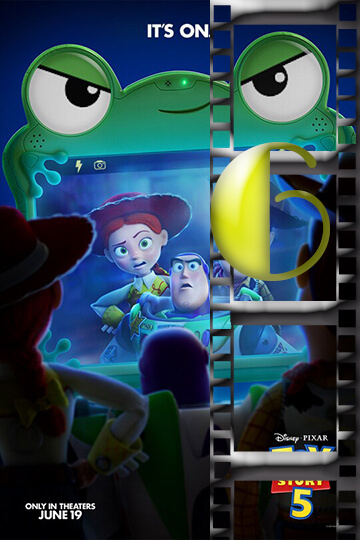
Every franchise has a moment where it will have to prove that they still belong at the table. Five Toy Story movies in, and the franchise sits in that uncomfortable chair where it has not failed outright but has also not fully justified itself. With Toy Story 5 coming out and having an honest conversation about what childhood looks like today, in addition to the way kids use tablets, group chat apps, and dopamine-driven video games, the concern is real; however, the results are mixed. Somewhere between heartfelt integrity and franchise obligation exist moments of warmth that allow the film to prove that it deserved to exist without ever erasing the question of whether or not it should have existed. The biggest swing this movie takes is pulling Jessie (Joan Cusack) out of the background and planting her front and center. That choice turns out better than anything else in the movie for sure. Jessie suffers from a particular kind of pain – she fears abandonment, the sort of love that just disappears one day. The film centers on this pain and uses it to build a solid emotional trajectory, unlike the plot that meanders too much. Cusack delivers what is easily the most affecting performance in the entire cast, threading resilience and vulnerability through every scene without once tipping into the kind of tearful manipulation these movies can sometimes rely on too heavily. Bonnie (Scarlett Spears), an 8-year-old girl, is imaginative and loving, but has difficulty forming friendships with other children her age in ways that are equally sweet and painfully painful for the viewer. Her parents mean well but are also constantly absent; they decide that giving Bonnie a tablet called Lilypad (voiced by Greta Lee), which produces sounds through chirps and bling, is a great way for her to connect to other children via group chats. Although Lilypad functions as an antagonist to Bonnie, the film ultimately softens the portrayal of Lilypad into a much more nuanced one. The film ultimately argues that technology itself is not the enemy; rather, it is technology that is left unchecked and given without boundaries or balance that takes away the value of being a child. The validity of the claim can be argued, albeit with varying degrees of sensitivity; in some instances, the film can oversell its message. It seemed that the film worked well when it was confident in its audience’s ability to understand what was going on without having to explain every nuance; conversely, the film often found itself at a loss to find ways to describe what was going on as the film would move forward with its narrative, which caused it to stop to provide an explanation of its premise. One example of such irony is that, while Disney is producing a movie that has a message about the detrimental effects of having an excessive amount of time spent looking at screen-based goods, Disney is also marketing overly expensive, wholesale-distributed Stokes Lilypads when selling their products. Ultimately, the film’s inability to properly address the contradiction of producing a Les Mills product and providing an inferior product is reflected in the manner in which the film attempts to resolve the conflict. Woody (Tom Hanks) and Buzz (Tim Allen) return, and since this franchise’s release schedule has kept our heroes from concluding their respective storylines, we now have a little bit more time spent on screen for them to do this again. Woody’s bald head, and his poncho, while it is laughed at by the audience but ultimately not punny for the writer’s vision of Woody as a wise old sage without any particular place to be, is now just added-at-the-hip comfort food, something you want to enjoy but have no real use for when it comes right down to it; in other words, he is there, and you are glad to see him, but there is nothing in the script that will make any difference for him. Buzz does have a little more in terms of character development, but even this is barely more than a brief scene, as opposed to either an entire act (or series of acts) in the first half of the film that will amount to anything beyond simply wasting time waiting for others to catch up. Furthermore, while it is interesting that the film could use the idea of a bunch of identical machines trying to figure out how to individually define a meaning for themselves, ultimately, the film does not take that idea far enough, and thus, it is of little significance beyond that point in the film where it is presented. The supporting cast delivers some of the film’s sharpest pleasures. Conan O’Brien as Smarty Pants, a discarded digital potty trainer with toilet paper rolls for eyes and a genuinely filthy sense of humor, is a flat-out scene stealer. His crew, Atlas (Craig Robinson), a talking GPS, and Snappy (Shelby Rabara), a toddler camera, form what the film calls “the double A team,” a group of obsolete devices who have made peace with their own expiration dates in ways the classic toys have not. O’Brien and Cusack build a real chemistry together, the kind of warm, sparring friendship that recalls the best dynamic Hanks and Allen had in the early installments. Ernie Hudson’s Combat Carl, reimagined in a tutu and fully committed to the energy, is wonderful in the limited time he receives. The film is genuinely overstuffed with characters, and too many of them spend the runtime waiting in corners for the story to circle back around. Toy Story 5’s strongest points come from its more subtle scenes, such as how beautifully illustrated Bonnie’s imaginative sequences have been drawn out in hand-drawn style; how a stuffed animal (a toy pony) could gallop beside an actual horse as both comical and surprisingly touching; and how emotional the connection back through Jessie’s third-act storyline to Emily (Jessie’s first owner) is as it reaches for real emotion despite its slightly forced route. Randy Newman’s soundtrack runs throughout all these moments like a comforting hand on your shoulder, often not overpoweringly loud but always there to enhance each scene. As you might expect, Pixar has created stunning quality animation: gorgeous rural scenery that wants to be stopped and examined closely at each detail; highly detailed neighborhood scenes; and the contrast of how your typically worn, well-loved analog toy looks when compared to an electronic display screen, all equal or more than what most of your script will be. Time has always been a major theme in the Toy Story franchise. It has been about how quickly time passes and how people outgrow their toys, and how the purpose of the toys changes or even disappears altogether. Toy Story 5 is aware of this theme and goes back to its roots with sincerity. However, Toy Story 5 also has the added burden of being the fifth installment in a long-running franchise that has been created by a corporation that has an obligation to keep the franchise alive, while also providing an awkward message that doesn t fit with the corporate structure that created it. As such, Toy Story 5 turned out to be a better film than it had any business being and a little less than it should have been. Like a childhood toy that you have forgotten about, when you find it in the back of your closet, it is still a real toy, but it does not feel as good as it did when you first had it.
OUR RATING – A DÉJÀ VU 6
- The Toys Are Back in Town: A look at reuniting the classic characters and introducing new additions.
- Casting Playtime: Interviews with the cast, including new voices like Conan O’Brien and Greta Lee.
- 50 Buzzes and The Great Escape: A technical breakdown of a key action sequence.
- The Lost Toys: An exploration of early designs, concepts, and characters that were cut from the film. [1]
Deleted Scenes
Introduced by director Andrew Stanton and co-director Kenna Harris:
- First Meet
- Failed Rescue
- Playtime
- Goodbye Charlie
- Reunion
Other Bonus Content
- Feature Commentary: Audio commentary featuring co-director Kenna Harris, production designer Bob Pauley, and VFX supervisor Thomas Jordan.
- Gag Reel: Outtakes and fun moments from the voice recording sessions.
- Music & Lyric Videos: Taylor Swift’s original song “I Knew It, I Knew You” (digital-only bonus)