

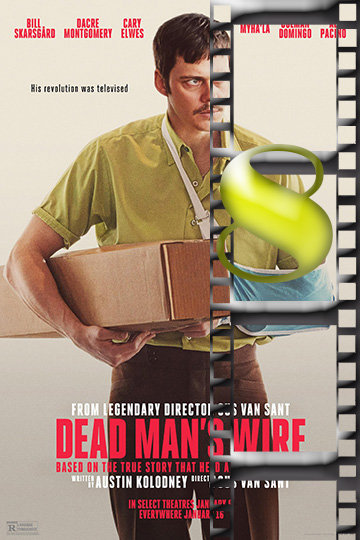
What’s It About
On February 8, 1977, Tony Kiritsis entered the office of Richard Hall, president of the Meridian Mortgage Company, and took him hostage with a sawed-off shotgun wired with a “dead man’s wire” from the trigger to Tony’s own neck.

MOVIESinMO REVIEW
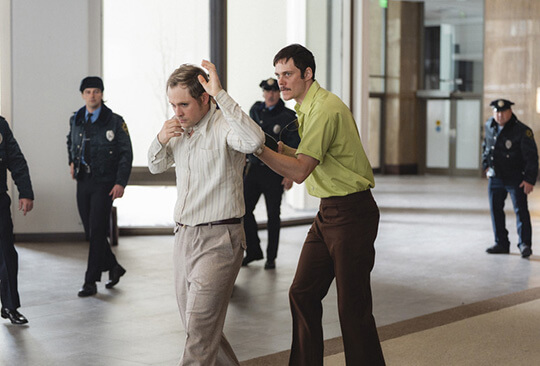
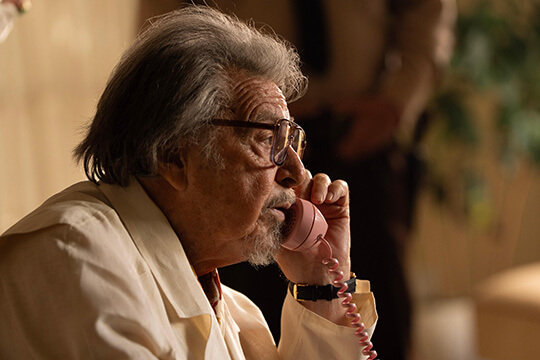
Gus Van Sant has come back with “Dead Man’s Wire, ” a suspenseful psychological drama, after an interval of seven years. It shows a time when the whole nation was witnessing a person’s financial destitution becoming a source of entertainment in the main evening news. The play dramatizes the 1977 Indianapolis hostage, taking incident with Tony Kiritsis, in which the real Tony was the antagonist of the story, and it is quite accurately and uncomfortably recreated here. Bill Skarsgård plays the part of Kiritsis, a property developer going through tough times. He is seen entering the Meridian Mortgage Company with what looks like blueprints, rolled. The receptionist understands that he must be one of their regular customers, so she lets him go down the corridor without questioning. What she doesn’t realize is that there is a shotgun inside the box that is not only modified but also has a wire mechanism attached to it, which guarantees destruction of the mutual kind. Kiritsis advances towards the mortgage broker Richard Hall, played by Dacre Montgomery, and wraps a wire noose around his neck, closing the wire to the trigger of the shotgun. It is frightful and simple physics: if any of the two males falls or is shot, the wire will pull the trigger, and Hall will die instantly. The whole thing started with a 17-acre piece of land in Tennessee that Kiritsis owns but is unable to develop due to missed mortgage payments. He believes that the Hall family, especially the owner of the company, M. L. Hall, are the ones that have planned his financial demise so that they can buy the land at a foreclosure price and then flip it for a huge profit. The movie is looking to answer whether this conspiracy is real or just exists in Kiritsis’s malfunctioning mind. Van Sant has the viewers puzzled and frustrated, but at the same time intellectually honest, as he never provides the viewer with simple answers. In the movie “Dead Man’s Wire”, the filmmakers delve into the media’s tendency to transform a crisis into a spectacle, a theme that is hardly ever touched on in regular hostage thrillers. When Kiritsis, who was armed with a gun, took Hall outside the building, the local TV news was there filming the whole thing. The videos were then broadcast on different channels across the nation, which interrupted the regular programs with such urgency that nowadays we would simply say it was a viral video. People all over the US were glued to their TV sets, yet were half scared of witnessing the direct execution of a man on a show. This was social media, less 1977, but already there was an insatiable desire for brutal entertainment. Skarsgård wonderfully interprets the character of Tony Kiritsis. What made the real Tony Kiritsis contradict himself was the fact that he became unhinged and started to use profanities in his press conference, which, for quite some miraculous reason, was broadcast live even during primetime. Skarsgård mimics that frantic and motivational energy but also provides several layers of suffering and shrewdness, so that the character of Kiritsis appears more as a human being pushing his limits than an insane individual wielding a weapon. At one point, he talks about “private equity traps” and states that he “really wants the lenders in Indianapolis to feel guilty. ” The things he says to display his awareness are in total conflict with his van having a license plate saying “TOPLESS” and with his moaning in one car scene about how “since Market Street, his shorts keep on riding up.” Van Sant exposes these contrasts without any sort of criticism and basically trusts the viewer to be able to judge the moral complexity on their own. The choice of Al Pacino to play M. L. Hall is not without a deeper meaning. He was the leading man in “Dog Day Afternoon,” a 1975 film by Sidney Lumet, which tells a story of a hostage crisis that got real and revealed the shortcomings of the institution. Pacino executes the role of a corporate businessman to the extent of making it appear sinister. For example, the times he is in charge of the imprisoned son, father, and mother, for him, is just another business transaction that he can easily write off. It is absolutely uncanny how little power such a man has to perceive the problem since, to him, it is an inherent belief that money keeps one out of trouble. Pacino is 85 years old now, and with his curly gray hairpiece and self-satisfied Midwestern accent that oozes arrogance, we get a lasting impression of the very essence of contempt from his short presence on the screen. Dacre Montgomery, previously known for his roles in “Stranger Things” and the Power Rangers series, is taken most of the time in the film, enduring a gun barrel pressed against his skull and trying not to move or make any unwanted noise, which may seem to have a very limited acting range. However, he manages to bring in some elements of humor interspersed with humanity. After a few hours have passed, Hall goes through a significant change, as now he is not just an abused prisoner but is on the verge of becoming a collaborator, to the point that his survival instinct forces him to get emotionally connected with his captor. Their odd relationship that becomes real and not created for the sake of drama, which is developed between the two characters, is something the viewer can believe, and it feels natural. Colman Domingo is seen in the role of Fred Temple, a jazz radio personality who becomes the voice of Kiritsis. WIBC, AM news director Fred Heckman was trusted by the real hostage taker, and that was the person he insisted on calling during the whole event of the hostage crisis. Van Sant made the character of this journalist into a DJ, and that allowed both the broadening of possibilities in the cultural area and the smooth fusing of music, images, and monologue. Temple is very careful and aware that his very excitable white fan is only after the validation that they don’t quite understand the racial dynamics at play, and is always ready to be disappointed. Domingo does a wonderful job illustrating the pompous tightroping of the black public figures who have to please certain fans without necessarily encouraging parasocial fantasies that might turn out to be dangerous. When Kiritsis “soul dances” for Hall just as a child would for a teacher, this scene becomes both preposterous and character disclosing about how black people perform the role of their race in the US. The filmmakers had gone to great lengths to recreate the 1977 Indianapolis. This is not the disco glamour of Studio 54, but rather, the everyday Midwest during winter, which is shown via the specific hues of the clothes, the simultaneous talking, and the environmental sounds that are so natural that they don’t give the feeling of being artificially made. The phones are really something on their own, rotary dials, long cords, busy signals that actually had significance. Danny Elfman, who is the composer, integrates the sound of a harp into the suspenseful drumbeat that brings along amusement and real tension. Van Sant was a 25, year, old at the time the incident happened, so that may be why he has managed to put so much effort into making everything look physically real. There is just nothing that might look as if it has been staged. Everything that is to be done, starting from production design to costumes and cinematography, got together to make the documentation rather than the recreation from the viewing point of the audience. First time screenplay writer Austin Kolodney, who penned the script at the Los Angeles Zoo while working as a janitor, deserves a lot of credit for not only keeping the historical details intact but also for writing a powerful play that had a great flow to it. “Dead Man’s Wire” is reminiscent of “Dog Day Afternoon, ” “Network, ” and “Badlands, ” in spirit only, without copying their style. What Van Sant ended up doing is establishing a connection with what made these movies great, that is, the way they dealt with problems which were quite disturbing to the viewers of the 1970s and have presently become even more so. Anxiety over finances, exploitation of the media, violence of the institutions, and the American notion that everyone is entitled to be wealthy. These are the main themes embedded throughout the film, that is done in such a way that they are not noticed as vocabulary. The major problem seems to be the film’s failure to make the viewers intensely curious about the resolution. When the authors have already set up the situation, then the second half of the movie will get into its rhythm, which feels like a chore even at times. Anyway, the dark humor as well as Skarsgård’s devoted acting are what keep the interest alive even when the story is a bit slow to move forward. There were people who, looking at some of Kiritsis’s actions, drew a line that connected him to more recent figures like Luigi Mangione, who has been charged with murdering the CEO of UnitedHealthcare. Not only is such a comparison very misleading, but the point has been lost in it nevertheless. There is always economic frustration in the world, no matter which period. The madness that is distinctly American that is witnessed in “Dead Man’s Wire” lies in the unspoken agreement that failure in money matters is failure in life’s terms, that being broke automatically entitles one to rage against a system which promised one of prosperity but here struggle appeared instead. If anything, Van Sant refuses to portray Kiritsis as any sort of Robin Hood figure who takes down corrupt institutions. The film doesn’t give viewers a nod of approval when Kiritsis proclaims that “I’m a goddamned national hero. ” This diplomatic attitude not only serves the viewers’ intelligence by giving them the chance to inquire whether it is judgment or justification that fits, but by showing the ups and downs in the characters that the truth is rarely simple and easy to find in a crisis. “Dead Man’s Wire” works as both a historical re-enactment and a modern day commentary. It makes us aware of the fact that our media circus today is not a new thing at all, that there has been a long history of television exploiting violence and despair, way before the invention of the smartphone. Above all else, it shows us a complicated guy who commits wrong acts for somewhat reasonable grounds and whose coming to terms with us emotionally will certainly continue even after the end credits have rolled.
OUR RATING – A NEWSWORTHY 8