

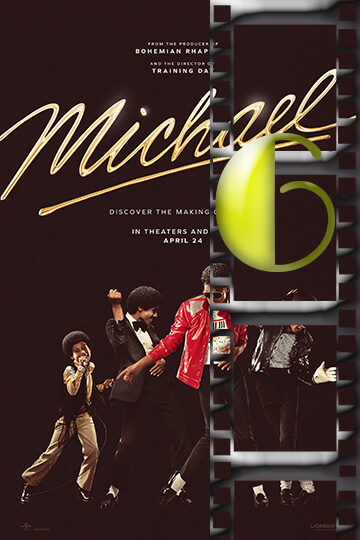

What’s It About
The story of pop superstar Michael Jackson — from his extraordinary early days in the Jackson 5 to the visionary artist whose creative ambition fuels a relentless pursuit to become the biggest entertainer in the world.
MOVIESinMO REVIEW
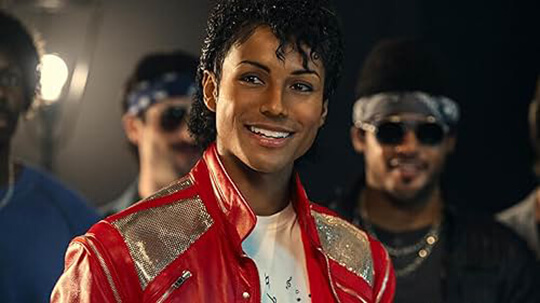
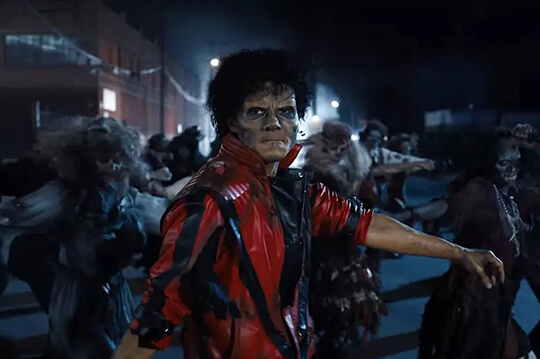
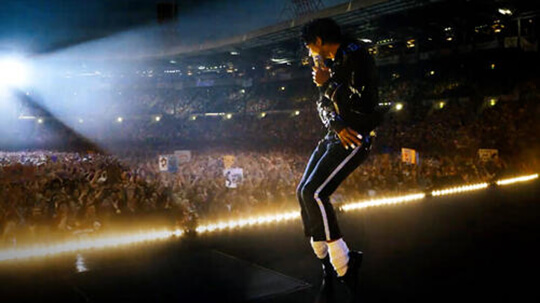
We been waiting on this, so let me get straight to the point. Michael Jackson is not just a pop star to Black people. He is not just somebody you put on at a wedding or hum along to in the grocery store. Michael Jackson is a full cultural inheritance — handed down like Sunday dinners and church hats, studied like scripture, debated like family. Off the Wall, Thriller, Bad, Dangerous — that is a run of albums that stands above almost everything else in the history of recorded music. He sold more records than almost any artist who ever lived. World leaders requested his time. People fainted at his concerts on every continent. His music video releases were national events. So when Hollywood announces a biopic about the man, Black audiences do not just show up curious. We show up with standards. That is what makes the new film Michael, directed by Antoine Fuqua and starring Jaafar Jackson as the King of Pop himself, such a complicated experience. There is real craftsmanship happening on that screen. There is genuine love for the music. But there is also a carefulness — a deliberate pulling back from the full story — that feels less like artistic choice and more like protection. And when you know the full weight of what Michael Jackson meant to Black culture, that protection starts to feel like a disservice. The film opens in 1960s Gary, Indiana, a city that most people outside the Midwest only know because of the Jacksons. The young Michael Jackson (Juliano Valdi) is a very special boy. His voice comes out of him prior to his becoming confident, leaving that gap between talent (which is vast) and freedom (which is limited) as the focus of the story. In addition to everything else, Joe Jackson (Colman Domingo), the magnetic antagonist of the piece, looms over Michael at every moment, and as of now, Joe Jackson has given the best villain performance by an actor this year. Domingo plays Joe not as a simple monster but as a man who uses charm the way other people use threats. He believes in his sons completely — but only as products. He beats Michael for mistakes at rehearsal. He tears apart the boy’s appearance, criticizing his nose and his face until those words take up permanent residence in Michael’s mind. Domingo gives us a man who genuinely cannot see the difference between loving a child and owning one. Michael’s relationship with Joe gives the first half of this movie a lot of energy. We travel with the Jacksons through the years, when they were the Jackson 5, the rise through Motown, and the delicate time in which Michael records by himself. Larenz Tate plays Berry Gordy and carries himself well; unfortunately, the screenplay does not allow him to have any room to be himself. Laura Harrier plays Suzanne de Passe, a key player in the success of the Jacksons at Motown, and the film almost forgets she is even there. Kendrick Sampson steps in as Quincy Jones and immediately reminds you how much the movie needs him — and then he disappears just as fast. For a story about a man whose genius was shaped by the people around him, Michael treats most of those people like furniture. The film’s second half grows steadier. Michael, now fully inhabited by Jaafar Jackson, partners with entertainment lawyer John Branca, played with sharp energy by Miles Teller, to break free of his father’s management and build his own empire. The development of “Beat It,” “Thriller,” and “Billie Jean” is much more than just successful songs; they are also well-thought-out visual images made for a specific purpose. Fuqua’s background as a music video director has helped him learn this language and be able to speak it fluently. The recreations carry weight. The colors in cinematographer Dion Beebe’s frames pop with a warmth and brightness that feel like memory itself — not reality, but the way you remember something beautiful. The costume and makeup departments deserve their own applause. The work they did to reflect Michael’s evolving look across the decades, from his early Jackson 5 outfits to his legendary performance costumes, is stunning and precise. And now let me talk about the son of Jermaine, Jaafar Jackson. That’s something to think about. Casting Michael Jackson’s real-life nephew is a possible stunt, an imitation of the world-famous artist dressed up like him in a rhinestone glove. However, it actually contributes the most to the movie’s overall strength. As opposed to mimicking his uncle, Jaafar uses movement, vocalizations, and bodily position with a way of being like he has been inhabited; the spirit of Michael Jackson is in him, not via imitation, but by something larger – a bloodline connection, a memory of the things he has observed over the years. When Jaafar performs with dance, it doesn’t feel like a tribute; it feels like an extension. But here is where the film draws its line, and here is where it loses the conversation it could have started. Michael concludes in 1988. A title card at the end reads simply, “His story continues.” The film made with the support of the Jackson estate, produced by people with a clear interest in the legacy, stops its clock before 1993, before the allegations, before the trials, before the years when Michael’s story grew thorns that cannot be pruned away by a graceful ending. Director Fuqua reportedly filmed a version of this story that ran three and a half hours and addressed more of Michael’s full life. What we received instead is a curated highlight reel. Now, this matters differently to Black audiences than it might to others. White audiences, even those who genuinely love Michael Jackson’s music, often engage with him as entertainment. For Black communities, Michael Jackson is evidence — evidence of what Black excellence can produce when it refuses to accept a ceiling. His fight to get his videos on MTV, depicted here in a powerful scene where he has Walter Yetnikoff, the president of CBS Records International, threaten to pull major white artists from MTV, unless they open their doors to Black creators, was not just a career strategy. It was a declaration. His entire rise — out of Gary, through an abusive household, past every industry barrier placed in front of a young Black man — carried meaning beyond music. A film that chooses to honor that journey deserves to honor all of it, not just the parts that photograph well. Michael delivers an incredible show. In addition to being able to see the show from your seat, the experience of being with Michael and listening to the music is an absolute blast! Domingo portrays Michael’s father, Joe, in such a unique way that his performance will stick with you. Jaafar Jackson is the only cast member that carries the film and doesn’t falter. For die-hard fans, it will give you something significant to look forward to. Overall, it feels like the most extravagant tribute concert ever made; you are mesmerized one minute and left feeling empty the next. While Mike publicly professed his love for all of his brothers, they remain in the shadows, even though Janet can’t be in this film because of that dispute over her rights to perform. Her absence leaves an even larger hole since Rebbie is also missing. The emotional arc that should have driven the entire story — Michael’s desperate need to prove himself beyond his father’s shadow, to earn recognition from an industry that wanted to use him without fully respecting him, to become something no one had ever seen before — gets scattered across too many recreation sequences and not enough honest drama. Compared to other recent biopics, Michael lands somewhere around Bohemian Rhapsody territory: visually impressive, musically thrilling, and significantly less than the full truth. The 1992 ABC miniseries The Jacksons: An American Dream still tells the family story with more honesty and emotional depth, and that was made for television thirty-four years ago. Michael Jackson deserved a film as fearless as he was. What we received is a film as careful as the estate that approved it. That is not nothing — the King’s crown is visible, and it shines. But a crown without the full story of how it was earned, and what it cost, is just decoration. Go see it. Turn up your soul on the way home. And then go back to the records, where the real story never stopped playing.
OUR RATING – AN EMPTY KINGDOM 6
MEDIA
- Genre – Biography
Street date
- Digital – June 9, 2026
- 4K/Blu-Ray/DVD – July 14, 2026
- Video – 1080p
- Screen size 1.85:1
- Sound – English: Dolby Atmos
English: Dolby TrueHD 7.1 (48kHz, 24-bit)
French (Canada): Dolby Digital 5.1
Spanish: Dolby Digital 5.1 - Audio descriptive
- Subtitles – English SDH, French, Spanish
Extras
- Don’t Stop ‘Til You Get Enough – The Making of Michael
- From Gary to Greatness: The Jackson Brothers – Featurette
- Home is Where the Heart Is: Behind the Gates of Hayvenhurst – Featurette
- In the Mirror: Becoming Michael and Joe-Time Lapses – Featurette
- First Look
- Becoming Michael
- Before the Big Screen
- Original Trailers