


WHAT’S IT ABOUT
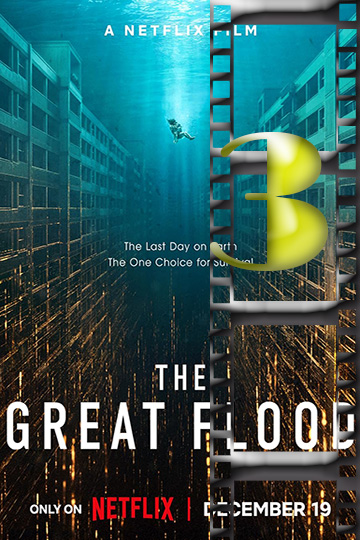
Kim Da-mi stars as Gu An-na, humanity’s last hope, torn between survival and the future of mankind. In the midst of a frantic escape from a flooded apartment complex, An-na clutches Shin Ja-in and safeguards life-saving medication, underscoring her unwavering maternal resolve.
MOVIESinMO REVIEW
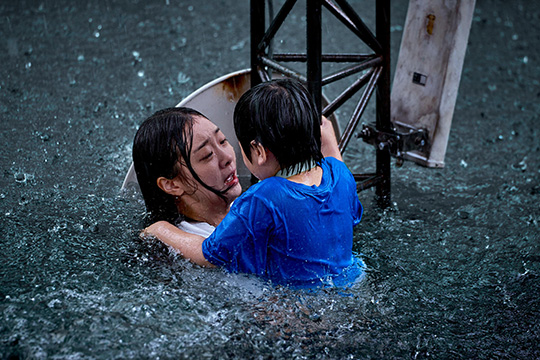
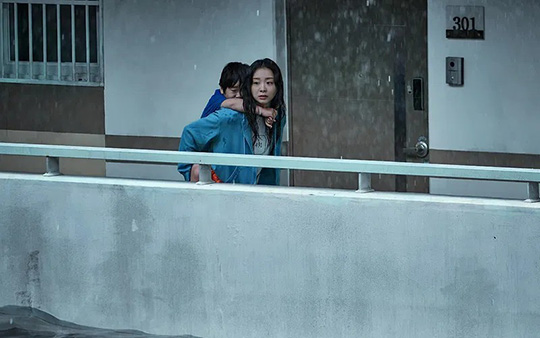
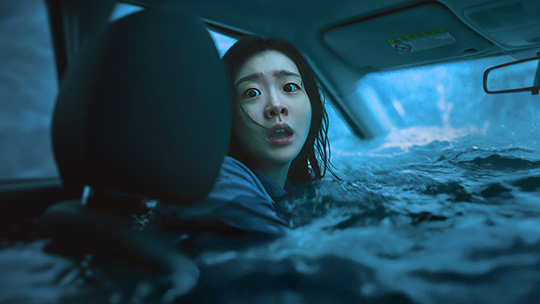
South Korean director Kim Byung, woo might have imagined that with “The Great Flood, ” his new Netflix disaster movie from 2025, he was creating a real hit. For almost forty minutes, in fact, he had me convinced. However, the rest of the film took a sharp turn for the worse. The movie opens with a scene of An-na, played by Kim Da-mi, being awakened by her over-energetic six-year-old son Ja-in. He has on swim goggles and is jumping around as if it were Christmas morning, which looks to be a bit off until you figure out what is going to happen. An-na is depicted as a single mom, an artificial intelligence researcher. However, the reason for this is still unclear. She is exhausted, feeling irritated with her child, and is simply trying to survive another day. Soon after, the planet seems to be ending. Water begins seeping into their third-floor apartment. At first it’s just a puddle, then it’s at her ankles, then suddenly it’s rushing in like somebody left a fire hydrant running. An-na grabs her son, his medicine bag, and tries to head upstairs in their thirty-story building. Outside the windows, massive waves are crashing toward them. An asteroid hit Antarctica and melted everything, turning the whole planet into one big swimming pool. This is humanity’s last day on Earth. The opening scenes really hit you in the gut. Director Kim is definitely adept at escalating tension, and An-na’s journey with her son strapped to her back through the stairwells of a seemingly never ending chaos of neighbors in despair gave me a shiver down my spine. It looked like the fire was real. The effects are okay; it just seems like a few shots are a little off. You really get the sense that the tension is escalating as each floor is flooded with water, gas pipes blow, and everyone frantically rushes to the upper floors with no escape in sight. Kim Da-mi is absolutely the best choice for the role, as she is seen swimming through the smoke-filled hallways, explosions are happening around her, and with her fierce and unyielding spirit, she makes you feel like cheering her on. She teams up with Hee Jo, a security officer played by Park Hae Soo, who informs her that she is, in fact, the last hope of mankind. Since she is working with AI, she is, in theory, the one to re-establish the human race. No pressure at all, right? He’s attempting to get her and her son on a helicopter at the top of the building so that they can escape to wherever the scientists are going to be restarting life. For the initial forty minutes, “The Great Flood” operates exactly as a disaster film ought to. You hold on to your seat, wishing that they get through it, feeling the time running as the water level goes up and the choices dwindle. The movie knows how to make you empathize with a mother who is frantically trying to save her child. It goes for those basic fears of suffocation, of being trapped, of seeing everything you know getting devoured by something you can’t control. However, after that, Kim seems to want to be Christopher Nolan. It stops being a simple survival story and becomes a perplexing science fiction puzzle that overrates its intelligence around the halfway point. Time keeps repeating. An-na keeps getting separated from her son and finding him again. There are strange numbers on the shirts of people. Nothing makes sense anymore, and not in that exciting way where you are trying to figure it out. It is more like that irritating way where you are looking closely at the screen and wondering what the director was smoking. The movie obviously wants to be “Interstellar” or “Inception, ” taking ideas about time and reality without understanding what made those films so great. It almost literally throws coded symbols and past traumas at you, adding twist after twist until everything is a tangled mess. The problem is that director Kim tries to force two completely different movies together, the visceral disaster thriller and the cerebral sci-fi brain teaser, and they just don’t work. What really hurts is how the movie forgets about the emotional stuff that made the first half so great. You don’t care about whether An-na and her son survive because you can’t even follow what’s happening anymore. The rules keep changing. Reality keeps shifting. At one point, An-na looks like she could win an Olympic gold in underwater swimming based on how long she holds her breath, which becomes more and more ridiculous each time it happens. The child Ja-in certainly doesn’t contribute to the situation. He behaves as if he were extremely delighted to swim in his flooded apartment while the world is ending, which might be understandable later in the story, but mostly just irritates. Six, year, olds normally wouldn’t make a big deal out of an apocalypse, even in films. The film, by its final act, has lost entirely the very little drive it had left. Although just under two hours, the movie feels way longer because of its constant repetition without giving anything new. The viewer’s mindset shifts from wishing for the characters’ survival to wishing for the movie’s end. The melodrama is intensified enormously, demanding us to empathize with circumstances that we hardly comprehend anymore. Kim Byung, woo obviously had a vision. It is evident that he wanted to make something that would work on different levels, combining brutal and shocking scenes with perplexing ideas. However, ambition without the proper execution simply results in a disaster. It is comparable to witnessing someone attempting to juggle too many balls and dropping all of them. Korean cinema has had difficulty with science fiction in the recent past, and “The Great Flood” is another film that has joined that list. The movies “Jung_E” and “The Silent Sea” had obvious issues because they adopted Hollywood-ish plots without knowing how to make them appealing on an emotional level. Disaster films inherently revolve around family drama after all, it is only natural that you want to protect your loved ones when buildings are collapsing, or floods are rising. However, when complicated sci-fi elements concerning AI, time loops, or something else are added, the emotional connection is lost in translation. The movie was packed with the right ingredients to become a hit during its first forty minutes: an engaging lead performance, exciting action sequences, real stakes, and authentic tension. If Kim had relied on that simple story and taken it to its logical end, we could have had something extraordinary. Unfortunately, he was overly ambitious and made the horrible decision of turning his disaster film into a philosophical statement about humanity, technology, and time. Sometimes the simplest way is the right way. “The Great Flood” is such a case: when you try to be everything at the same time, you become nothing. The film, which could have been a gripping survival thriller, is suffocated by its director’s conflicting ambitions and thus fails to hold the audience’s attention. I suggest that you save your time and forget this film.
OUR RATING – A DISASTEROUS 3