

What’s It About
A “Man From the Future” arrives at a diner in Los Angeles, where he must recruit the precise combination of disgruntled patrons to join him on a one-night quest to save the world from the terminal threat of a rogue artificial intelligence
MOVIESinMO REVIEW
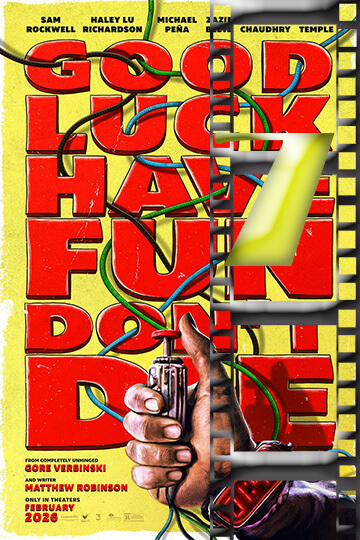
Let me be honest with you right from the jump. This movie has no business being as entertaining as it is. A wild-eyed man in a torn raincoat, mismatched boots, covered in wires and devices like he crawled out of a junkyard, storms into a Los Angeles diner claiming he is from the future — and somehow, for most of its two hours and fourteen minutes, Good Luck, Have Fun, Don’t Die earns every bit of the chaos it promises. Director Gore Verbinski — the same filmmaker who gave us the first Pirates of the Caribbean and the underrated animated gem Rango — returns with something genuinely strange and genuinely alive. This is a movie that screams at you, grabs you by the collar, and refuses to let go. And in a season full of remakes, sequels, and AI-generated mediocrity, that kind of energy deserves real respect. The man referred to as the Man from the Future in the credits of the film stars Sam Rockwell as the lead character. He enters a Hollywood diner named Norms, wearing a bomb strapped to his chest and an extraordinary amount of confidence. Although he has no intention of robbing anyone, his goal is to save mankind from destruction. He bursts into Norms, a real Hollywood diner, wearing a bomb on his chest and enough confidence to match it. He is not there to rob anyone. He is there to save the world. He announces that this is his 117th trip to this exact moment in time, with these exact same strangers, searching for the right combination of people to help him complete one mission — stop a nine-year-old boy from finishing the artificial intelligence program that will eventually destroy all of humanity. The group he recruits includes a school teacher couple, a rideshare driver, a grieving mother, a woman dressed as a princess for children’s birthday parties, and one young woman so sensitive to wireless signals that cell phones give her nosebleeds. They only need to travel a few blocks. And yet everything and everyone in Los Angeles seems determined to prevent them from getting there. What makes the movie work in its first two-thirds is how it earns your investment in these strangers. Between the chase scenes and confrontations, the film steps back to show you short films — flashbacks into the lives of several characters that feel like complete episodes of the television series Black Mirror. These segments carry real weight. In one, teachers Mark and Janet (played by Michael Peña and Zazie Beetz) face a classroom of teenagers so consumed by their phones that they have become something close to zombies. The scene turns horror fast, and Beetz grounds it with sharp, focused energy that makes you want a whole film centered on her alone. The strongest of these segments belongs to Juno Temple, who plays Susan, a mother destroyed by grief. Her son was killed in a school shooting, and a program now exists that allows parents to clone their lost children — customizing personality traits the way you would configure a new laptop at an Apple Store. Temple does not play this for laughs, even when the film around her absolutely does. She plays it like it is real, and that commitment transforms the segment into something genuinely disturbing and genuinely moving at the same time. It is the kind of work that reminds you what separates a performer from an actor. Haley Lu Richardson brings equal depth to Ingrid, the princess-costumed young woman allergic to technology. Richardson makes her feel like a full person, not a gimmick, and her relationship with Rockwell’s character slowly reveals layers that give the film its most emotionally grounded moments. Now here is where this review gets real. The film has things to say, and most of what it says is worth hearing. Phones are destroying attention spans. Social media builds addiction the same way corporations have always built addiction — deliberately and profitably. Young people are being handed tools that damage them by the same adults who then criticize them for using those tools. The film understands this, at least partially. However, it keeps aiming its frustration almost entirely at teenagers and young people, while the adults and corporations behind the technology walk away clean. That is a soft swing. A bolder film would have followed the money. You cannot genuinely critique technology addiction without naming the billionaires and business decisions that designed it to be addictive in the first place. There is also a casting tension worth naming. Rockwell is nearly sixty years old. Having him play the messenger from the future — the voice warning younger generations about the world they are building — reads more like an older generation pointing fingers than a future generation demanding accountability. Beetz, who is in her early thirties, or Richardson, who is in her late twenties, would have carried that message with more credibility and more urgency. It is not a fatal flaw, but it is a missed opportunity. The final thirty minutes lose the thread. Verbinski has a documented history of letting his third acts collapse under their own ambition — anyone who sat through the last two Pirates of the Caribbean sequels or 2016’s A Cure for Wellness knows exactly what this feels like. Good Luck, Have Fun, Don’t Die suffers the same way. It stacks endings on top of endings, tangles its own logic, and covers the confusion with flashy effects and technical language. The movie talks fast and hopes you do not notice the gaps. But here is what stays with you: the film is wildly original. In a movie landscape where artificial intelligence is actively eating creative work alive, Verbinski and screenwriter Matthew Robinson made something that could only come from human imagination. There is a CGI centaur with a cat’s head that sprays glittery confetti. There are phone-addicted teenagers moving in packs like something out of a horror film. There is genuine anger buried inside genuine comedy, and that combination is rare. Good Luck, Have Fun, Don’t Die is messy, overlong, and not entirely sure what it wants to be by the time the credits roll. But it is alive in a way that most studio films have completely forgotten how to be. It challenges you, entertains you, and occasionally genuinely unsettles you — which is more than most films with three times the budget can claim. See it. Argue about it after. That is exactly what it wants.
OUR RATING – A FUTURISTIC 7