

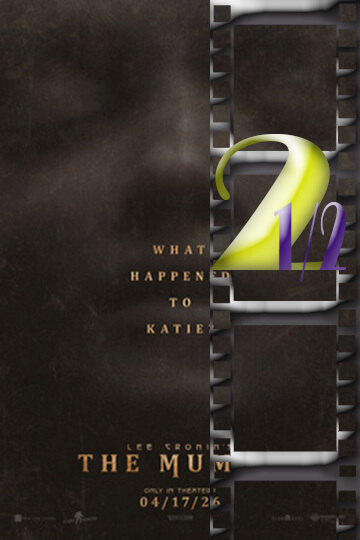

What’s It About
The young daughter of a journalist disappears into the desert without a trace. Eight years later, the broken family is shocked when she is returned to them, as what should be a joyful reunion turns into a living nightmare.
MOVIESinMO REVIEW
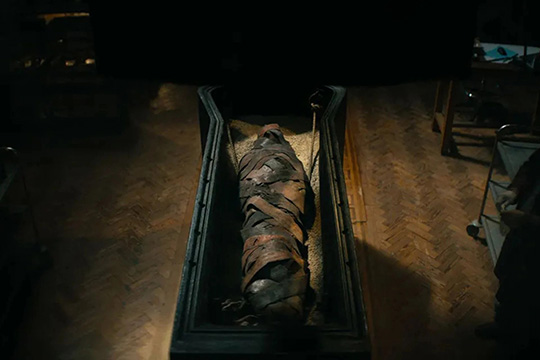
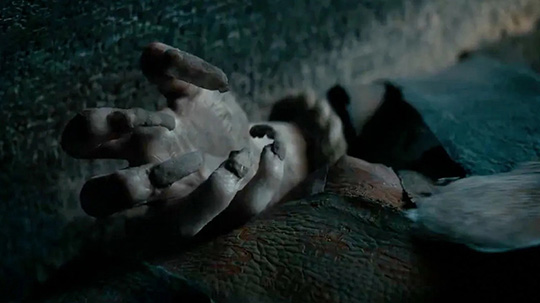
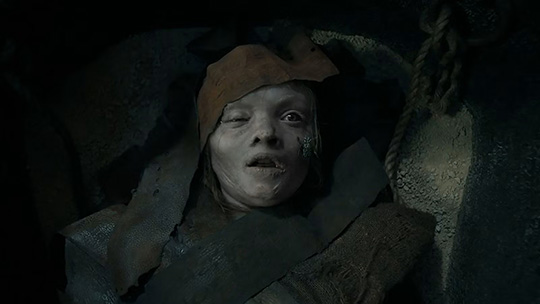
When I walked into Lee Cronin’s The Mummy, I was genuinely ready to believe. I had seen what Cronin did with Evil Dead Rise — how he took a franchise that had every reason to feel tired and breathed something real into it. He brought grief into a genre that usually just brings guts. He understood that horror works best when it means something. So yes, I had hope. And no, that hope did not survive the runtime. The story follows Charlie (Jack Reynor), a journalist living in Cairo with his wife Larissa (Laia Costa) and their children, whose young daughter Katie is kidnapped and disappears without a trace. Eight years later, she turns up — pale, silent, wrapped in bandages, and found inside a sarcophagus. The family brings her home to New Mexico, and things go wrong very fast. Katie is no longer just a traumatized little girl. Something ancient has moved into her body and made itself comfortable, and it has no intention of leaving. That is the setup. It is a strong one. Strong enough that you keep waiting for the movie to become what it is clearly capable of becoming. That moment never arrives. The film’s first sin is that it ignores the very thing that makes Mummy stories worth telling. At their core, these are stories about colonial theft — about Western characters who enter sacred spaces, take what does not belong to them, and then act surprised when the dead demand payment. Even the 2017 Tom Cruise version, as genuinely awful as it was, understood that the Mummy represented the fury of the displaced. Cronin wanted no part of that conversation. He stripped the mythology down to a possession story and called it something new. The problem is that it is not new. It is just The Exorcist with hieroglyphics in the background. The comparison to William Friedkin’s 1973 masterwork follows this film like a shadow it cannot outrun. A young girl possessed by something evil. A desperate parent trying to understand what is happening to their child. A house that becomes a battleground. These are the bones of that earlier film, and Cronin borrows them without offering anything in return. The Exorcist worked because it placed its horror inside a crisis of faith — it asked what a person does when evil is real and God feels silent. Cronin’s film gestures at love as the answer to darkness, but it never builds that idea into anything you can actually hold onto. Natalie Grace, who plays Katie, does everything the script asks of her. She crawls. She screeches. She stares with the kind of emptiness that is genuinely uncomfortable to watch. But the character is given no interior life beyond the possession itself. There is a compelling idea hiding in this film — the notion that an ancient evil would study a family and learn to imitate their love in order to destroy them from within. That is frightening. That deserved to be the engine of the entire movie. Instead, it gets mentioned and then set aside while the film chases other concerns. One of those concerns is a parallel investigation happening back in Egypt, where Detective Dalia Zaki (May Calamawy) tries to piece together what happened to Katie during her years of disappearance. Calamawy is a talented performer who deserved a real role in a real movie. Here she is given an expository function — she exists to deliver information to the audience that the other characters cannot provide. Her storyline does not develop. It does not connect meaningfully to anything happening in New Mexico. It simply takes up time, and this film already has far too much time to fill. At over two hours, The Mummy runs longer than it has any business running, and you feel every extra minute pressing down on you. The pacing is the film’s most damaging problem. Cronin proved with Evil Dead Rise that he could build and sustain tension inside a confined space. That film moved. This one wanders. It stalls in family drama that never develops the characters enough to make you care about their relationships. It lingers on conversations that repeat information you already have. And then, when it finally decides to turn up the horror, the film dumps gore onto the screen in a way that feels less like terror and more like compensation. You can pour a bucket of slime on a blank wall and call it art. That does not make it art. That makes it a wet wall. There are moments — genuinely, a handful of them — where you catch a glimpse of the film Cronin intended to make. The cold open, in which a child is taken through a hole in a garden gate during a sandstorm, carries real dread. The initial return of Katie, wheelchair-bound and ruined, hits with the kind of quiet devastation that horror rarely earns. And Cronin’s technical command is never in question. He frames shots with confidence, plays with symmetry, and understands how to use space. But he reaches for the same visual tricks far too often — the split-screen depth-of-field shot that places two subjects in focus at different distances appears so many times it stops functioning as a stylistic choice and starts feeling like a habit he cannot break. The ending completes the disappointment. The film arrives at its climax without having earned one, throws an action sequence at the audience that looks expensive but feels empty, and then cannot decide how to close. It hedges between two possible conclusions like a student who studied for the wrong test. What it leaves behind is not productive ambiguity. It is just unfinished work. Lee Cronin is not a bad filmmaker. That is what makes this sting. A bad filmmaker would have produced something easy to dismiss. What Cronin made instead is a film that keeps reminding you of its own potential — that keeps showing you the door it could walk through — and then chooses to stay in the hallway. The Mummy as a character carries centuries of meaning. Colonialism. Stolen history. The power of the dead to hold the living accountable. Cronin had all of that available to him and chose to make a possession movie that forgets it is supposed to possess you. By the time the credits roll, the only thing this film has taken from you is two hours and the memory of a director who once made you believe horror could still say something worth hearing.
OUR RATING – A VOMIT-INDUCING 2.5
MEDIA
- Genre – Horror
Street date
- Digital – May 19, 2026
- 4K/Blu-Ray/DVD – July 14, 2026
- Video – 1080p
- Screen size 2.39:1
- Sound – English Dolby Atmos
- Subtitles – English, Parisian French, Latin Spanish, Castilian Spanish, Finnish, German, Italian, Japanese, Norwegian, Swedish, Dutch, Danish, Czech, Complex Chinese
Extras
- Audio Commentary featuring Lee Cronin
- The Making of Lee Cronin’s The Mummy (HD 10:57)
- Bloody Grotesque Spectacle (HD 7:47)
- Producing Possession and Ancient Demons (HD 5:41)
- Deleted Scenes (HD 10:03)