

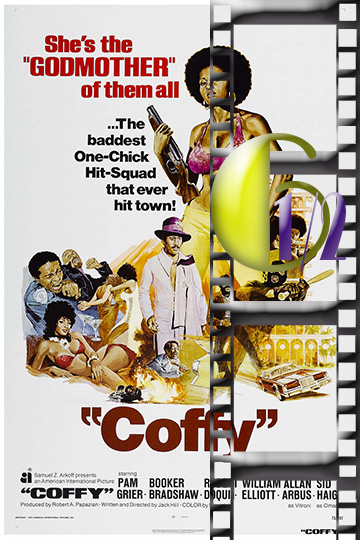
WHAT’S IT ABOUT
As a nurse, Coffy (Pam Grier) has seen the ill effects of drugs up close, but it isn’t until her little sister becomes addicted to heroin that she finally decides to wage a one-woman battle. Disguised as a prostitute, Coffy goes on a killing rampage, at first going after street dealers and pimps such as sleazy King George (Robert DoQui), then gradually working her way up to bigger honchos. She’s shocked, however, when she discovers that her politician boyfriend (Booker Bradshaw) is involved.
MOVIESinMO REVIEW
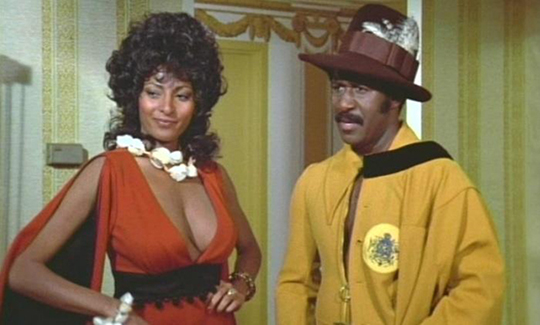
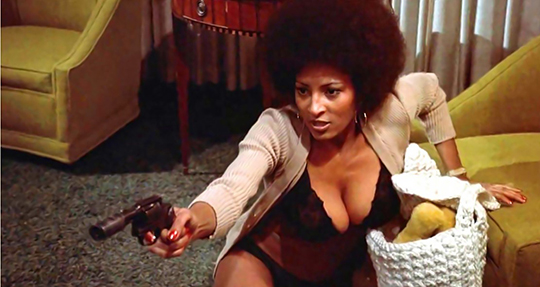
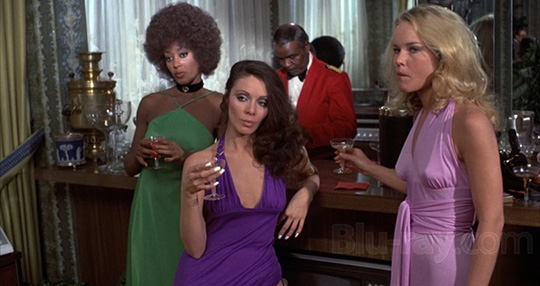
When I saw “Coffy”, I had to remind myself that this picture was released in 1973, more than half a century ago. That’s a crucial background to emphasize because witnessing it nowadays is like landing in a totally alien world of Black films. This is a Jack Hill’s directorial piece, and the famous Pam Grier plays the lead in a plot where a nurse decides to single, handedly eliminate the drug dealers that caused her younger sister’s addiction. In a nutshell, it’s a revenge flick with a touch of plenty violence, sex, and seriously raw elements that put you in deep thought of the meanings of the two eras, then and now. “Coffy,” back in 1973, was a movie of the so-called blaxploitation era. Such films were largely made for the Black urban communities and were box office hits. The Black community was in great need of positive on-screen representation as lead characters, irrespective of the characters being pimps, drug dealers, or vigilantes. The white mainstream film critics then were on the fence about “Coffy”. Some disregarded it as exploitation trash, zeroing in on the violence and sexuality, without realizing the significance of a strong black female character on screen who controls her own story. Roger Ebert gave it a 2.5 rating, saying the movie was well-made for an exploitation film but still just another exploitation show. Nevertheless, the African American community turned up in force for Pam Grier, who went on to become a star as “Coffy,” providing a Black female character that was just as human as anyone, and most especially didn’t take the roles of a house, helper, mammy, or tragic victim. My emotions are somewhat mixed and somewhat complicated after watching “Coffy,” and I reckon a lot of Black viewers would agree with me. On the positive side, in fact, Pam Grier literally captivates you in this flick with her beauty, strength, high IQ, and total control of her environment and her choices. When Coffy is seen as a prostitute in order to get close to the drug lords, or she opens fire in a gangster’s den, Grier has so much intense energy that you can’t turn your eyes away from the wonder of it. Having a Black woman flaunt this level of physical strength and sexual independence was a real revolution in 1973. She was not looking for a man to rescue her. She was the one doing the rescuing, even if her way of doing so was highly violent. But by today’s standards, things get tricky here and there. Of course, the film not only portrays Pam Grier as powerful, but it also visually capitalizes on her body in a way that can make one feel uncomfortable in the present. There are a lot of nude shots, some of which are maybe, for the plot, but most of them appear to be simply for the sake of filming a nude Black woman. The camera shots get stuck in women’s bodily parts in a way that objectifies them, although the plot is trying to make the character of Coffy look powerful. It’s a weird contradiction in which the film wants to celebrate the strength of African American women, but at the same time, it treats women as mere objects for the male gaze. The whole movie is affected by this tension. The depiction of the African American community is yet another area in which current viewers might experience some difficulty with the film. The only exception is that the drug dealers may be rightly accused of being predators that destroy their own community, but, of course, on the other hand, there are almost no positive representations of Black men doing ordinary, decent things. The movie\’s antagonist is a slick gangster who symbolizes all the evil that comes with selling out your own people for money. On the other hand, the lady friend of Coffy is a city councilman who talks the talk of raising the community to a higher level, but he is found to be as corrupt as anyone else. It is quite a morose depiction of Black life that deepens some negative stereotypes, notwithstanding the fact that it is trying to highlight the issue of corruption. The film’s language is yet another area that a viewer feels differently nowadays. The N-word is used loosely throughout the movie, as indeed other slurs and rough street language are. To authentically portray the character of a specific place and people, the director might have decided to use such language back in 1973. Today, we know this kind of language existed, and depending on where you are, it still exists. Hearing it in such a casual and frequent manner in a movie can be disturbing, particularly if you’re with your non-Black friends. This provokes the question of “Who was this movie made for? ” and “Would that way of doing things be effective nowadays? ” It’s a Black movie for Black people. My opinion is that “Coffy” is still relevant. The central plot of a woman avenging the drug trade, which had devastating effects on her family, is still very much attractive. The violent sequences are quite thrilling, and Pam Grier’s acting constantly reminds you that she is a legend. When Coffy finds out that her boyfriend is corrupt, she confronts him, and the anguish and anger flicker in her face are deeply real. You can sense her heartbreak and fury. Such quality of acting goes beyond the film’s reliance on exploitation elements. Today, whether “Coffy” is accepted viewing is a matter of situation. Without a doubt, the film is a significant landmark in Black cinema because it showcases the trajectory of representation visually. It is also an essential film for film students and people interested in Black culture, as watching it will help them understand that particular moment in our cinematographic history. But would it be made today with the same pattern? Absolutely not. We would demand multifaceted characters, less objectification, and a more real picture of the Black community. Would the audience today like it? Both halves of the coin can be heard. Fans of action and lovers of old movies would probably want to watch it. Pam Grier is not just a woman’s name, her fans from different generations would be glad to see her in the prime of her career. However, young viewers who are used to better storytelling and representation of characters might find it painful, and brush with the already existing problem of the film frame. The rhythm is slower than that of the current action movies, and the gender politics are so old that they look like from another planet compared to today’s ones. I believe that as a Black man, I, just like you, recognize what this film symbolizes, and I’m glad that it exists because it paved the way for better Black flicks to follow. Pam Grier deserves every acclaim for holding this film on her shoulders and becoming an icon. At the same time, I am unable to turn a blind eye to the movie’s failings, the very ways in which it seems to contradict its own message of empowerment, and how it needs to be overhauled thoroughly if it were to be made into a contemporary piece. In a nutshell, it is a very complex part of our cultural history, and thus it is really important both to study it critically and to understand it in its context. However, one should not expect it to be void of any significant problems.
OUR RATING – A CLASSICALLY VENGEFUL 6.5