

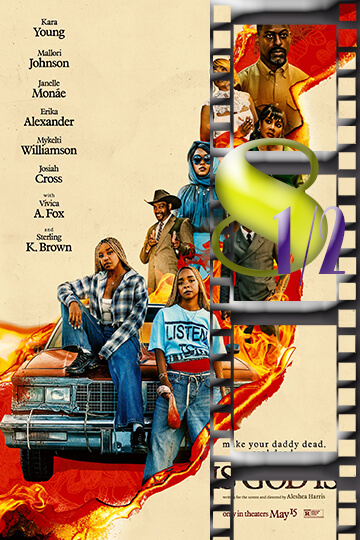

What’s It About
Twin sisters with disfiguring burn scars are ordered by their bedridden mother to kill their abusive father, who caused their scars. They must decide whether to seek vengeance or find mercy.


MOVIESinMO REVIEW
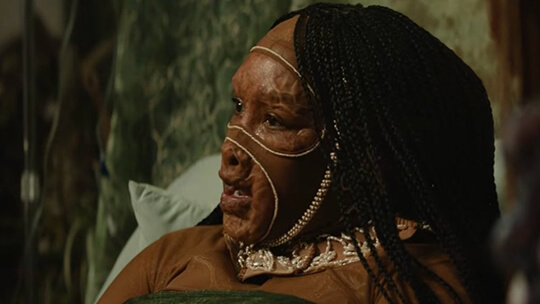
There are films that arrive without fanfare but hit harder than anything at the multiplex. “Is God Is” is that kind of film. Written and directed by Aleshea Harris, adapted from her Obie Award-winning, off-Broadway play, for which she was later nominated for the Pulitzer Prize for Drama, this debut announces a new voice in Black cinema. Fearless, poetic, and unwilling to look away. This is not a movie about being Black. It is a movie about surviving. But for those of us who know the specific pain that passes through Black families like a current, absent fathers, mothers left burning, children carrying wounds they never asked for, Is God Is speaks directly to us. Fraternal twins Racine (Kara Young) and Anaia (Mallori Johnson) grew up in abusive foster homes with one rule: sisterhood first. Both carry burn scars from a fire their own father set when they were small. Racine’s scars hide under her clothes. Anaia covers her face, making her a target everywhere she goes. Anyone who dares say something cruel about Anaia answers to Racine and her fists with a lot of zero regret. Harris opens with a black-and-white flashback of the young twins on a school bench. Kids walk by, taunting Anaia. Racine rises without a word, handles it, and sits back down. That single scene tells you everything. In the present, the sisters lose their jobs when Racine again defends her sister at work. Then Racine reveals she’s been writing to their mother, Ruby (Vivica A. Fox), a woman they believed was dead. They drive south in a wide, cinematic classic car to find Ruby bedridden and covered in decades-old burn scars. Ruby has one dying request: find their father, the man known only as Man (Sterling K. Brown), and kill him. In flashback, we learn that Man violated a restraining order, doused their mother in lighter fluid, struck a match, and walked out of their lives forever. The twins’ scars are the evidence he left behind. Now Ruby wants her bill paid. Racine’s character is played by Kara Young, whose fierce energy is felt throughout the film. This new role confirms that she was born to appear on screen, according to theatre (where she has already built a name and reputation), as Racine was created with Mallori Johnson, who discovered Anaia while portraying an individual who communicates with others using a restricted facial prosthetic mask. Mallori Johnson’s portrayal found the film’s biggest challenge, whether justice demands blood or can be achieved in other ways, through her manner of performing. In addition to Kara Young and Mallori Johnson’s electric chemistry, Vivica A. Fox is cast as Ruby, a woman whose scars and limitations do not limit her in any fashion. At age 61 and a well-known actress prior to this film, she allows the audience no opportunity to sympathize with her, but rather she defines an image that represents every year of stage and film work that she has done. Additionally, the legacy of these casting jobs carries significant weight, as Fox previously portrayed a mother of a daughter who might one day seek revenge, in Quentin Tarantino’s 2003 movie, Kill Bill: Volume 1; therefore, the mothers/daughters become two; however, they are both black and scarred and have complete ownership of their projects. Man’s character (Sterling K. Brown) has very limited exposure initially, and he is created to become almost a larger-than-life character until he is first fully seen on-screen, where he displays a combination of softness and overwhelming stability on camera, which creates a new side of him that has never been witnessed before. The supporting actors (Erika Alexander, Mykelti Williamson, and Janelle Monáe) did a great job acting to support the progress of Man’s character development; all three actors are considered supporting cast due to their roles not providing opportunities for similarities in mannerisms. “Is God Is” is a journey from grief to awakening in relation to how black men navigate their space in this world after being oppressed, by projecting those feelings onto the people they love when they come home after being crushed by this world. Anaia finally refers to her father at one point after contemplating what is going on with him, and tries to find answers to why he tried to kill Anaia’s mom. His answer to her four years and two across the world from the time she was born was answered in one sentence with only six words………”She wouldn’t let me hold her.” Holding her is not his reality. A restraining order is not reality, history is not reality, the two daughters standing in front of him that he destroyed in a violent way is not his reality, therefore, the only answer he can give is “because she wouldn’t let me hold her.” In those few words, Harris has identified a wound that the Black community has had to bear for far too long, which is the expectation that a woman will support her man regardless of the cost. Harris also chooses to address the issue of the community providing protection for men such as this. The individuals the twins meet who either protected or supported Man(s) aren’t shown as evildoers, but rather as things which are known. By being an “every” Black girl who is not given the fullness of what the world has available, Racine and Aniya are representative of all Black girls. This is simply the title – Ruby, who gave these daughters their lives, represents God. However, with God being shown as the one person that suffered the most, it creates questions about who this world was created for when we first came into it. The film’s third act stumbles slightly; the final confrontation between Man and his daughters does not hit as hard as the build-up deserves. It is a stumble, not a fall, and it is the only thing standing between this film and greatness. But Harris’ vision is crystal clear throughout, and Is God Is already feels timeless, like a story that was passed down rather than written. The Black community needs to see this film, together, in theaters, with full attention. It holds a mirror up and does not blink. Aleshea Harris has arrived. The performances are extraordinary, the ideas are urgent, and the voice behind it is one of the most important new voices in American filmmaking today. Go see it. Then stay and talk. Because it will bring something up. That is the whole point.
OUR RATING – A VENGEFUL 8.5
MEDIA
- Genre – Drama
Street date
- Digital – June 2, 2026
- Blu-Ray/DVD – July 28, 2026
- Video – 1080p
- Screen size 2.39:1
- Sound – English DTS-HD MA 5.1, Dolby Digital 5.1 Spanish and French, English Descriptive Audio
- Subtitles – English SDH, French, Spanish
Extras
- none