

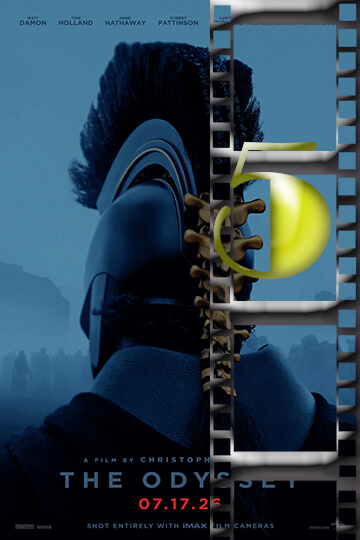
What’s It About
The Odyssey follows Odysseus, the legendary Greek king of Ithaca, on his long and perilous journey home following the Trojan War, chronicling his encounters with mythical beings such as the Cyclops Polyphemus, sirens, and the witch-goddess Circe, while attempting to reunite with his wife, Penelope.
MOVIESinMO REVIEW
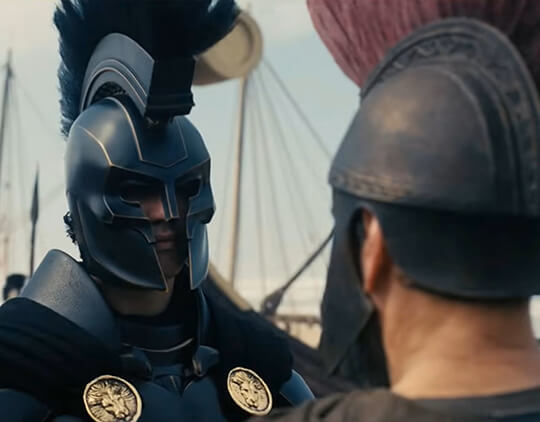
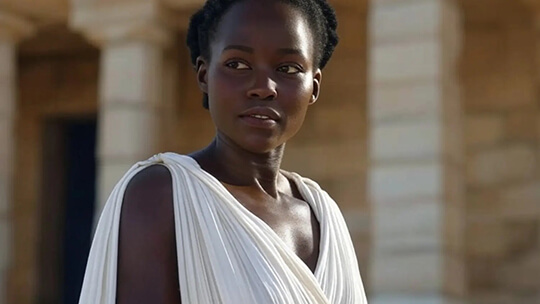
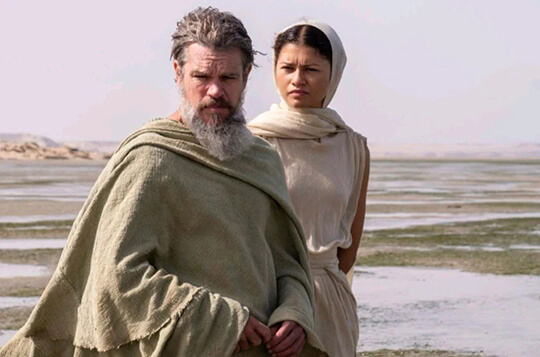
I’ve seen how Hollywood erased the color from ancient history for a long time, and I’m tired of pretending that it’s unintentional. Christopher Nolan’s The Odyssey had actual science and history on its side. The bones and DNA and the pictures on the old vases, they all agree: the people described by Homer were dark-skinned, dark-haired, and dark-eyed, closer to what would become Mediterranean, North African, or Middle Eastern now, and definitely not pale-skinned people that we see in books and movies for the past two hundred years. A movie like this reaches more people over one weekend than a textbook reaches over ten years. If the facts are correct, people learn how to see the past; if they are wrong, you’re teaching people to see whiteness where it doesn’t belong. You know that whitewashing doesn’t just happen. No, the European scholars had to come up with the myth of ancient Greece being white because they needed Greece to be similar to their own. They relied on their lies and on the museums that stripped the color from the ancient statues and presented white marble as the original. So you may call it “white fragility,” which makes history seem like an insult. That allowed Hollywood to make its version of Greece and present it for the last two centuries. So, once it was announced that Lupita Nyong’o would play Helen and Elliot Page would play a new character named Sinon, it seemed that the director was finally going to tell the truth and not some myth this time. The film is about Odysseus, the part played by Matt Damon, a soldier, trying to return to Ithaca after fighting for ten long years in Troy. The journey back takes another great deal of time and is full of mistakes and sorrows. Penelope, played by Anne Hathaway, is at home, surrounded by countless suitors, led by the nice and sleazy Robert Pattinson, while their son Telemachus (Tom Holland) is also trying to get information about his father’s whereabouts. The plot is not straightforward and develops towards the final confrontation with Odysseus. In this way, Christopher Nolan shows Odysseus not only as a manipulator but also as a traumatized soldier. This is the main uniqueness of the film, with Odysseus showing that war is terrible. Things get tricky when you see who’s really significant in the narrative and who’s just an ornament. Lupita Nyong’o plays Helen and Clytemnestra in this movie and gives her all in each character. But take a closer look at the part written for her. Helen is alive only to blame herself and feel sorry for her life; Clytemnestra only lives long enough to die at the hands of her son. Both characters are powerless; they are there to suffer the consequences of men’s actions. What’s the advantage of employing such a remarkable black actress if she is still portrayed as a symbol of pain rather than a person making choices? The same problem faces Anne Hathaway as Penelope. The film tells us that she is ruling her kingdom alone, yet the character is depicted as a victim waiting for a man to act. Unlike Penelope, Mia Goth’s character has even less freedom. After the war, she is reduced to a minor schemer who is subject to circumstances rather than a woman who has undergone terrible experiences. Elliot Page gets a pretty raw deal too. His role as Sinon is that of a soldier inadvertently caught up in the event of planting the Trojan Horse – bearing the heavy guilt of the carnage that followed. This is such a brilliant premise that the filmmakers could have constructed a great storyline around it. However, the filmmakers chose the other route and killed him off within the first 20 minutes, using the sad event to inflict emotional trauma on the main character. Nolan is good at tone but not so much with respect to people. Samantha Morton plays Circe brilliantly, and the scene in which she turns soldiers into pigs is a sharp and powerful both in terms of language and as a good lesson for men who storm into others’ territory uninvited and get mad at being treated like the danger they are. In contrast, Charlize Theron portrays Calypso in such a manner that she appears more as a gentle caregiver than a kidnapper; thus, depriving the story of moral depth that Nolan obviously wished to achieve through that story element. In turn, Zendaya has absolutely nothing to do as Athena, with her obvious acting talent wasted in providing some minor role. In terms of how the film looks, it’s a big win in terms of emotional feel. Nolan likes to use his IMAX cameras, and while it definitely looks great on a big screen, big doesn’t mean deep. Directors like David Lean knew how to take a massive shot and make us feel intimate, allowing us to connect to a character’s emotions while an infinite ocean stretches behind them. Most of Nolan’s big scenes, like the Cyclops fight, the burning of Troy, or the storm at sea, simply look great, but they do not make us feel anything new. Well, here’s the thing. The Odyssey was supposed to do something very unique that not many movies have tried to achieve: show people of color, especially Black audiences who rarely get to see their history reflected in movies. Getting the history right was the first step, and Nolan nailed it. But history becomes relevant when it is carried out by a powerful story. Give these actors real character arcs, allow Helen to say her words herself, not only carry her wounds and scars. Allow Sinon to live long enough to do something important. Trust Zendaya with such a powerful character. In this case, such a movie can change the perception of the ancient world for the whole generation.
OUR RATING – A WHITEWASHED 5