

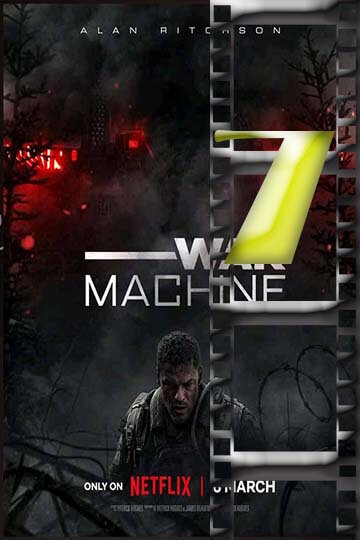

WHAT’S IT ABOUT
During the final stage of US Army Ranger selection, an elite team’s training exercise turns into a fight for survival against an unimaginable threat.

MOVIESinMO REVIEW
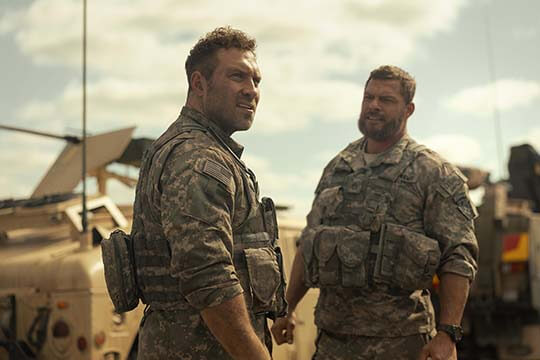
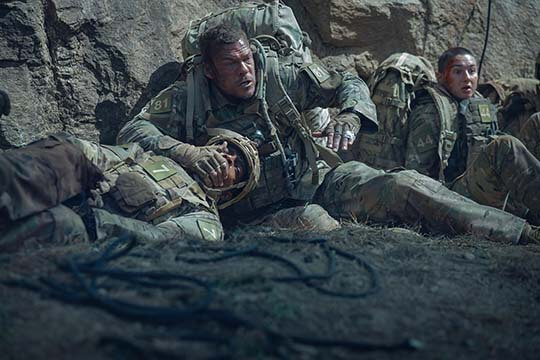
To start with, War Machine is definitely a Predator movie; they take all of the original movie’s structure and visual style and simply put a new coat of paint on it to create a modern movie that will finish the job of erasing from your mind almost everything you have seen before. And here is the thing: when a movie knows exactly what it is and commits to that fully, it earns a certain kind of respect. War Machine earns it. Alan Ritchson, who plays the handsome, muscle-bound, bald giant on the popular Amazon Prime Video series The Reacher, stars as a soldier with the designation of “81” (the same number assigned to him during the Early Assessment and Selection Program of Army Rangers, also known as RASP) in the movie. His story begins in the Afghan desert, where he and his younger brother are having a pleasant moment together on a sunny day before being attacked out of nowhere, leading to the death of his brother. 81 loses his brother and carries the burden of that loss while dedicating himself to fulfilling their teenage promise of becoming Army Rangers. Director Patrick Hughes wastes no time. The first thirty minutes of War Machine play out like a leaner version of Top Gun, minus the volleyball scene and the karaoke bar. Ritchson’s 81 enters RASP as someone who wants nothing to do with the people around him. He refuses leadership. He keeps to himself. His commanding officers, played by Dennis Quaid in full growl mode and a largely underused Esai Morales, are not convinced that raw strength and iron will can replace the ability to lead a team. The program grinds candidates down to their core, and Hughes films the training sequences with enough grit and sweat to make them feel real rather than staged. What makes 81 different from typical action heroes is that he is not running toward fame but running from sadness. 7, played by Stephan James, who brought out his nuanced abilities while acting in If Beale Street Could Talk, is the only person who has a natural understanding of who 81 is as a person without being told about him. Two of these two have connected naturally with each other and support each other quietly during times of stress and pressure, rather than being overly comical or trying to be buddies. That choice gives the film an emotional weight that most action movies do not bother reaching for. Then the mission begins. The final field exercise sends 81 and his squad into the remote Colorado mountains for what is supposed to be a combat simulation. They stumble onto what looks like a crashed alien vehicle. Before anyone can fully process what they are looking at, it transforms into a heavily armed, bipedal machine that begins targeting and destroying everything in its path with lasers, bombs, and energy pulses. The war machine has arrived, and there is nothing simulated about what follows. Hughes shifts gears hard at this point, and the film becomes a relentless chase through forests, rapids, and mountain terrain. The action is brutal in a way that earns its R rating honestly. Soldiers lose limbs. Bodies are thrown off cliffs. The violence does not feel decorative, it has weight to it, and that weight matters because the audience has spent enough time with these characters to feel their losses. Keiynan Lonsdale as 60, Blake Richardson as the squad’s most anxious member, 15, Alex King as 44, and Jack Patten as 109 round out the group. Most serve as narrative anchors rather than fully developed characters, but they fill their roles with enough energy to keep things moving. The war machine itself is not the most original design in science fiction history. It looks like a more streamlined version of the ED-209 from RoboCop, a hulking, relentless instrument of destruction that does not negotiate and does not stop. But Hughes makes it terrifying through placement and patience. The machine does not rush. It hunts. And watching a squad of elite soldiers struggle to find any advantage against it creates genuine tension. Director of photography Aaron Morton uses the natural landscape brilliantly, shadow, rain, construction sites, and white-water rapids all become part of the battlefield. At the heart of everything is Ritchson. He uses his large frame to his advantage, and Hughes gives him every opportunity to showcase his talents. However, it is the undercurrent of determination, rather than sheer strength, that makes this performance effective. Ritchson does not wish to be seen as a hero; he only wishes to keep the promise he has made to himself. With his mission disintegrating around him and facing the inevitability of leadership, you see 81 come to terms with the burden of responsibility live. Although not overtly dramatic or showy, he is intentional. He is a spiritual successor to the 1980s action hero archetype, intelligent, athletic, emotionally controlled—but modernized just slightly to feel like a contemporary version of those characters. Where War Machine stumbles is in two specific areas. First, the final act loses the practical, grounded energy that makes the middle of the film so effective. As the budget runs thin and CGI takes over from real stuntwork and location shooting, the action sequences begin to look like something out of a video game cutscene. The film earns its tension through physical reality, bodies in real water, soldiers on real mountains, and when that texture disappears, so does some of the excitement. A second way in which this piece is culturally connected to the broader military culture (and, therefore, more difficult to ignore) is its relationship with that culture: for the first half-hour of the film, the audience will find that this is essentially a recruitment ad, where all of the soldiers are portrayed as virtuous, where their training has almost a religious aspect, and where the military institution is glorified (with very little opportunity for contradiction).. In a moment when many people carry complicated feelings about the American military, that one-note patriotism can feel like a wall between the audience and the story. Still, War Machine hits the target it sets for itself. It is a throwback action film built for audiences who want to feel something in their chest, not just watch things explode. Hughes finds solid ground by respecting the genre instead of trying to deconstruct it. The film is lean, propulsive, and honest about what it is. In a streaming landscape crowded with movies trying to be everything at once, there is something genuinely refreshing about a film that picks a lane and stays in it. War Machine is not breaking new ground. It is not trying to. What it is doing is delivering a well-made, hard-hitting action film anchored by a star with the size, screen presence, and quiet emotional intelligence to carry it. Alan Ritchson is building something real with roles like this, a filmography that may not get enough credit yet, but is starting to demand attention. War Machine is the best version of the movie it wants to be, and for fans of old-school action cinema, that is more than enough reason to press play.
OUR RATING – AN OLD-SCHOOL 7