


WHAT’S IT ABOUT
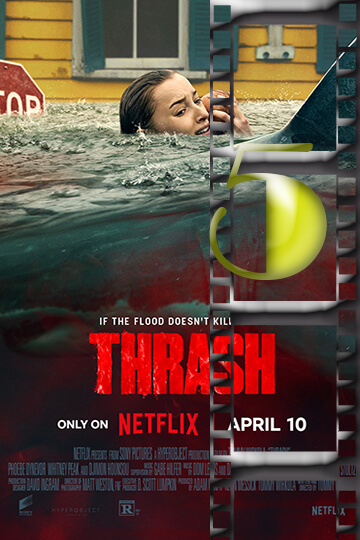
Amidst a catastrophic hurricane, a coastal town battles nature’s wrath and an onslaught of sharks. Braving torrential rain, debris, and darkness, they unite to survive the deadly predators and make it through the storm.
MOVIESinMO REVIEW
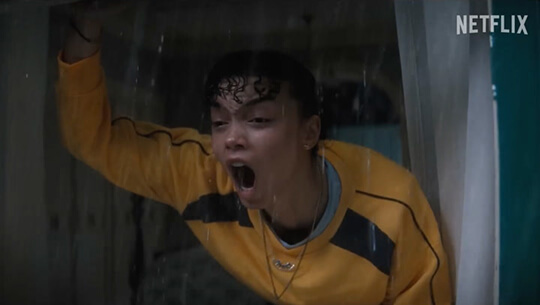
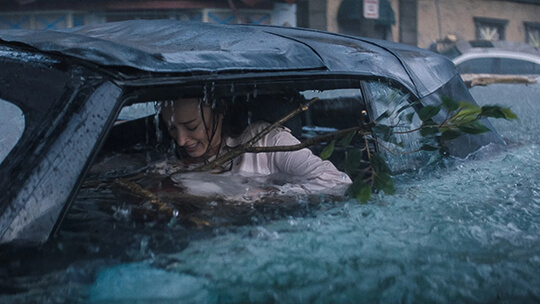
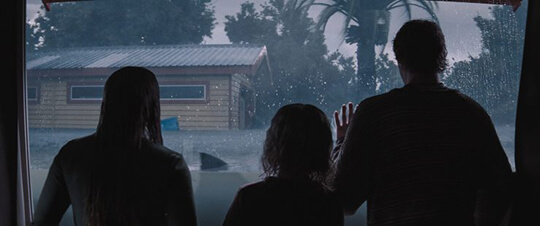
Before we even get into it, there is a version of Thrash that works beautifully. A Category 5 hurricane is drowning a small Southern town. Bull sharks are swimming through living rooms. A pregnant woman trapped in a car. A teenager fighting her own fear just to save a stranger. That version of this movie? I would watch that twice on a Friday night with no complaints. What we actually got, though, is something messier — a film that keeps interrupting itself at the worst possible moments, like someone who tells a great story but stops every few sentences to explain the joke. Tommy Wirkola directed Thrash — just as he also directed the very wild Violent Night — and this picture has had a long, rough road from when it was originally shot back in 2024 and called Beneath the Storm, to when it was going to be a big Sony theatrical release (and was even changed to Shiver), to finally being passed around and then being available now on streaming without much promotion. The behind-the-scenes situations are not visible, which is a statement about the movie’s production. What is visible, however, is the accompanying creative chaos – the movie can’t seem to figure out what it is or who it should follow and exactly how serious we should take all that we see. The setup is strong. Hurricane Henry is about to tear through Annieville, South Carolina, and most people with any sense have already left town. The ones who stay behind form our cast of characters. Lisa, played by Phoebe Dynevor, is nine months pregnant, recently abandoned by the father of her child, and somehow still finishing a shift at a meat-packing plant when she should be heading to the hospital. Dakota, played by Whitney Peak, is a teenager dealing with serious agoraphobia after the death of her parents, choosing to ride out the storm alone in her family home rather than face the outside world. Meanwhile, three foster siblings — Dee, Ron, and Will — are stuck with a guardian who cares more about money than their safety. And out on the water, marine researcher Dale, played by Djimon Hounsou, notices unusual shark activity right as the levees break and realizes his niece Dakota is directly in the path of it all. When the flooding hits, and the sharks follow the blood trail from a wrecked meat truck straight into town, the movie briefly catches fire. There is something genuinely wild about watching a bull shark glide through a flooded suburban street, and Wirkola has a good eye for physical chaos. The storm itself looks massive. The rising water feels dangerous. A few deaths land with real impact, including one that involves the foster kids and a sequence that plays like a dark, underwater version of Home Alone — set to Vanessa Carlton’s “A Thousand Miles,” of all things — that somehow earns its place in the film. Hounsou consistently puts more effort into the material than it deserves to be done. He brings heft and meaning to all of his scenes, bringing an intensity to the lines about sharks and personal backstory that causes you to lament the fact that what he’s being given to work with doesn’t match his level of commitment. Dakota brings a true vulnerability to her character, creating an authenticity in her fear instead of just another storyline constructed out of convenience. The way in which Dakota’s anxiety creates tension with her need to protect Lisa produces some of the film’s best scenes. But here is where the problems stack up. The screenplay keeps tripping over itself. Lisa, barely rescued from the rising water, immediately starts giving Dakota orders like she has known her for years. There is almost no breathing room given to let these two women actually connect before the film demands we care deeply about their bond. Dynevor is clearly talented, but her character’s arc shifts so quickly and without enough foundation that it becomes difficult to follow her emotional logic. The foster kids’ storyline, meanwhile, exists in an almost entirely separate film. Their subplot involves neglect, possible financial fraud by their guardian, and a full dramatic resolution — all crammed into the margins of a shark disaster movie running under 90 minutes. It is not that the material is bad. Some of it is actually the most entertaining the film has to offer. The issue is that it pulls focus in a story that already has too many places it is trying to go at the same time. And then there is the dialogue, which is the movie’s most consistent problem. Characters stop in the middle of flooding and shark attacks to deliver background information, explain their personal histories, or land jokes that do not quite work. A reporter who tags along with Dale exists almost entirely to ask questions nobody in that situation would actually ask — functioning as a human paragraph of exposition rather than a real person. One moment, Dale delivers a line correcting someone’s assumptions about African geography that is meant to be sharp and pointed, but lands somewhere between confusing and unintentionally funny. The shark effects, it should be said, are uneven. Some shots look polished and convincing. Others look like the budget ran out during the third week of production. For a movie whose central threat is supposed to terrify us, the sharks are not always scary enough to do that job. What Wirkola wanted to make, I think, was a film that balanced genuine human drama with the kind of over-the-top creature feature energy that made Deep Blue Sea a cult classic. That film understood exactly how ridiculous it was and went all the way. Thrash keeps hedging its bets — too grounded to be gleefully absurd, too goofy to be truly frightening. It sits in the middle, trying to appeal to everyone and fully satisfying almost no one. There is still something worth watching here. The performances from Peak and Hounsou carry real emotional weight. Several set pieces land cleanly. The film’s final act finally commits to the kind of wild energy the whole thing needed from the jump. But it takes too long to get there, and too many stumbles happen along the way. Thrash is not a disaster — it is just a movie that almost became something great and settled for being merely watchable. That might be enough for a late-night Netflix scroll. For those of us who wanted more, it leaves a mark like a shallow bite — noticeable, but not quite enough to do the real damage.
OUR RATING – A BAD SHARKNADO CLONE 5