

WHAT’S IT ABOUT
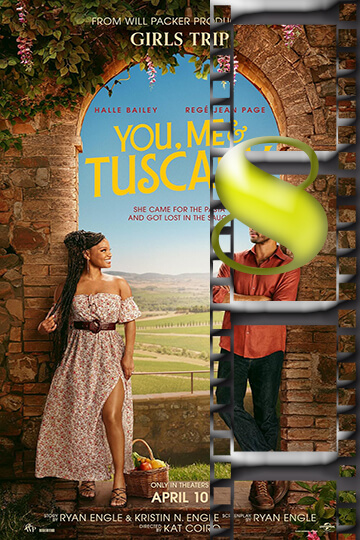
Anna impulsively jets off to Tuscany, Italy, to stay at a stranger’s villa without permission. Caught inside the house by the man’s mother, she convinces the woman that she’s his fiancée. That little lie soon becomes a big problem when Anna develops a growing attraction to the stranger’s handsome cousin.
MOVIESinMO REVIEW
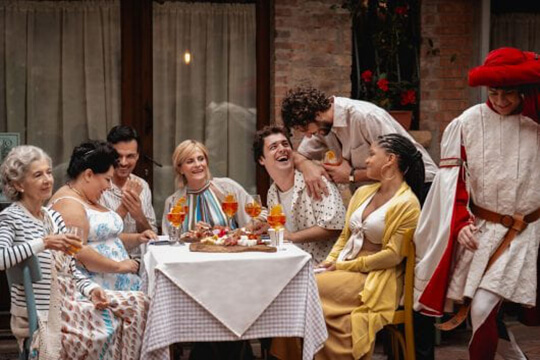
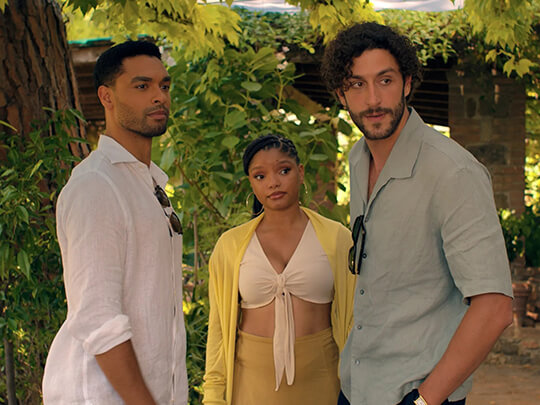
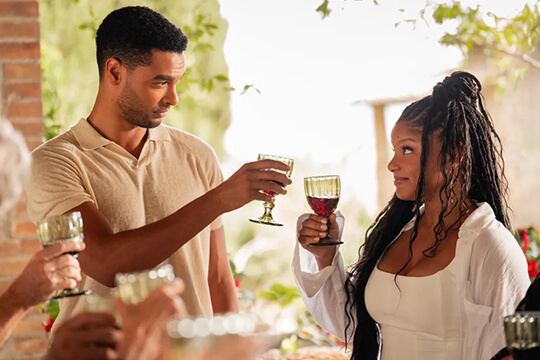
There is a moment in You, Me & Tuscany where Anna, played by Halle Bailey, texts her best friend back home after catching a glimpse of Michael, played by Regé-Jean Page, soaking wet and shirtless in the middle of a Tuscan vineyard. That one text says everything. It is real, funny, and the kind of moment that reminds you exactly why representation in film is not just important — it is necessary. When we see ourselves reflected on screen, not as stereotypes, but in ways that feel true, joyful, and free, the conversation shifts. And that shift is so confident, beautiful, and genuine. Set against the rolling hills and golden landscapes of Tuscany, Italy — specifically a small town called Pienza — You, Me & Tuscany follows Anna, a culinary school dropout who has been quietly falling apart since losing her mother. She makes ends meet in New York City by house-sitting for wealthy clients, borrowing other people’s lives because she has lost the thread of her own. After a terrible day that costs her both her job and her housing, Anna meets Matteo, a charming Italian man played by Lorenzo de Moor, and through a series of events that only work in the world of romantic comedies, she ends up staying at his empty family villa in Tuscany. The problem begins when Matteo’s family arrives unexpectedly and assumes Anna is his fiancée. Instead of telling the truth, Anna leans into the lie — and things only get more complicated when she starts developing real feelings for Matteo’s adopted brother, Michael. Yes, the premise is far-fetched. No reasonable person would do what Anna does. But that is the magic of a well-made romantic comedy. You are not supposed to question it. You are supposed to feel it. And You, Me & Tuscany makes you feel every single moment. Director Kat Coiro, whose background is mostly in television, shoots Italy the way it deserves to be seen. The countryside does not just serve as a backdrop — it becomes a character of its own. The farmland, the vineyards, the architecture, and the food all move through the screen and land directly in your chest. This film will make you want to apply for a passport. It will make you want to cook a real meal. It will make you want to call someone you love and tell them you are done going through the motions. That kind of feeling does not come from special effects or a massive budget. It comes from authenticity, and this film has it in abundance. What separates You, Me & Tuscany from the flood of forgettable romantic content that streaming platforms push out every few weeks is the quality of its characters. Halle Bailey carries this film with a quiet strength that does not announce itself. Her Anna is not written as a superhero or a symbol. She is a young woman who is grieving, struggling, and still trying to figure out who she is without her mother’s guiding hand. Bailey does not just play the role — she inhabits it. There is an “I am just trying to get through the day” energy to her performance that is both grounded and deeply relatable. Watching her slowly come alive in Italy, surrounded by warmth and beauty she never expected, is genuinely moving. Regé-Jean Page as Michael brings a different kind of presence. He is magnetic without trying to be. His Michael is thoughtful, a little guarded, and carries a natural authority that never tips into arrogance. The chemistry between Bailey and Page is the kind that cannot be manufactured. It feels lived-in and real, the sort of connection that makes you lean forward in your seat, hoping these two people figure it out before the credits roll. The supporting cast adds tremendous texture. Aziza Scott as Anna’s best friend Claire is sharp, funny, and exactly the kind of friend everyone needs — the one who tells you the truth even when you do not want to hear it. Marco Calvani as Lorenzo, the cab driver, is unexpectedly the emotional core of the film. He is warm, genuine, and so wholesome that every scene he appears in brings an immediate smile. Stella Pecollo as Auntie Francesca rounds out a family unit that feels imperfect in all the right ways — loving, loud, and full of life. Now here is what needs to be said directly, because it matters: most mainstream Hollywood romantic comedies have historically been built around the fantasy lives of White women. Films like Eat, Pray, Love and Under the Tuscan Sun set a standard for what “escapism” looks like on screen, and for decades, that standard did not include us. The dominant entertainment industry has long operated under the assumption that Black audiences would simply watch whatever was placed in front of them, or that our experiences did not translate to the kind of sweeping, joyful romance that deserves a theatrical release and a Tuscany backdrop. You, Me & Tuscany challenges that assumption without making a speech about it. It simply exists, beautifully and unapologetically, with two Black leads at the center of a love story set in one of the most breathtaking places on earth. The movie does not reduce Black people to trauma or conflict — in general, Anna and Michael exist in Italian spaces as everyday human beings, as curious, funny, loving, and warm people. There are small instances of shared experiences that recognize Anna and Michael’s similar identities without making it a lesson for the audience. These moments will resonate because of their subtlety, rather than being written to educate. Black people will immediately identify with those moments. This is the kind of film that communities need to see together, in a theater, not alone on a couch with a phone in hand. It inspires something. It opens a door and suggests that joy, adventure, and romance are not reserved for certain people. They belong to all of us. You, Me & Tuscany is not a perfect film. Certain characters could have been developed further, and the story follows a familiar path from beginning to end. But perfection was never the goal here. The goal was to remind Black audiences that our stories deserve to be told on the grandest stages available — and that when given the right cast, the right director, and the right landscape, we can produce something that does not just entertain. It moves people. It stays with them. It makes them want more. That is exactly what great cinema is supposed to do.
OUR RATING – A TRAVEL-SIZED 8
MEDIA
- Genre – Rom-Com
Street date
- Digital – May 12, 2026
- Blu-Ray/DVD – June 16, 2026
- Video – 1080p
- Screen size 2.39:1
- Sound – English (Dolby TrueHD 7.1), Spanish (Dolby Digital Plus 7.1)
- Subtitles – English, English SDH, Spanish, French
Extras
- FEATURE COMMENTARY WITH DIRECTOR KAT COIRO AND PRODUCER WILL PACKER
- YOU & ME – Go behind the scenes with Halle Bailey and Regé-Jean Page as they develop their characters in the Italian countryside.
- RACING THROUGH TUSCANY – Inspired by the real-life Italian culture of barrel racing, join Regé-Jean Page and Lorenzo de Moor on set as they celebrate this spirited tradition with lots of brotherly love.
- LA FAMIGLIA – Spotlighting the lively, loving Italian family that made YOU, ME & TUSCANY truly special, join us as we celebrate the film’s bighearted ensemble.
- TASTE OF ITALY – From the delicious food to the breathtaking countrysides, Italy played a starring role in this film. Join filmmakers on set for a first-hand look at the beauty of Tuscany.
- GOING GREEN IN ITALY – See the extra steps cast and crew took to keep up sustainability in Italy.
- Optional English, French Canadian, Latin American Spanish subtitles for the main feature