

What’s It About
A group of shoplifters take aim at a cutthroat fashion maven by stealing her clothes and reselling them at a lower price, what they call “fashion-forward philanthropy.”
MOVIESinMO REVIEW
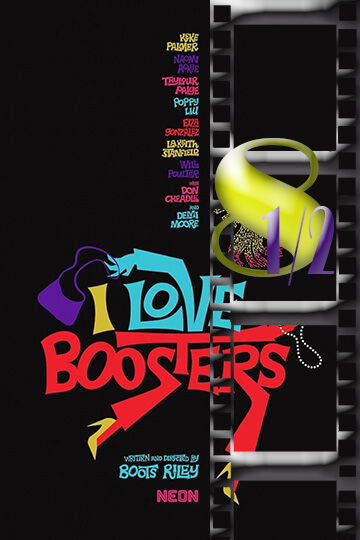
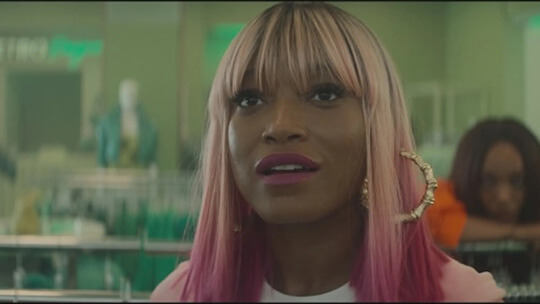
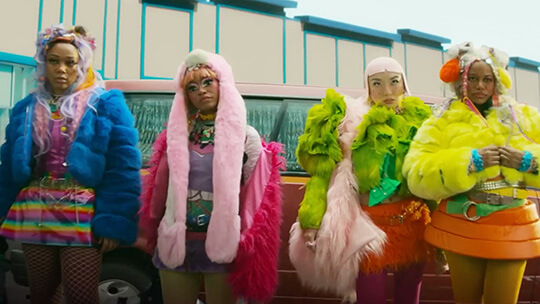
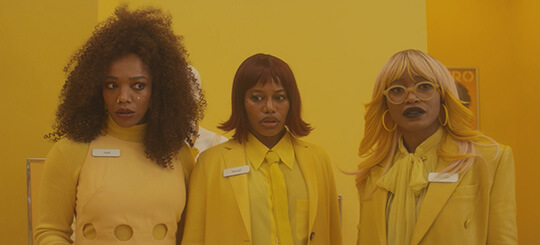
When a Black filmmaker uses his art to speak truth about wealth, workers, and what this system does to people at the bottom, that is not just entertainment. That is a cultural event. Boots Riley, rapper, activist, and now one of the sharpest directors working in American cinema, has returned with his second feature film, I Love Boosters, and it lands with the force of something this world genuinely needs right now. Eight years passed between Riley’s jaw-dropping debut, Sorry to Bother You (2018), and this follow-up. That gap matters because the world he is commenting on has not improved. If anything, it has gotten worse. Workers are still being squeezed. Wages are still disappearing. People of color are still being told to be grateful for whatever scraps fall off the table. Riley sees all of it, and he builds entire movie worlds out of that pain and that anger, but he wraps it in so much color, comedy, and pure creative electricity that you almost forget how heavy the message actually is. Almost. I Love Boosters focuses on three women attempting to survive in an alternate Bay Area. Corvette (Keke Palmer) is a genuinely talented fashion designer, but has no chance of making it professionally as a designer. She and her two closest friends, Sade (Naomi Ackie) and Mariah (Taylour Paige), operate a boosting business where they steal very expensive designer clothes from high-end retailers and resell them at affordable prices to the average consumer. They don’t just consider themselves criminals; they consider themselves redistributors; Robin Hoods with high heels and a solid understanding of fabrics. Their main target is Metro Designers, one of the largest and most successful fashion companies built on Clean lines, icy aesthetics, and the exploitation of workers. Christie Smith (portrayed by Demi Moore), the woman behind the scenes, is all three things in a completely unhinged manner. Christie has a lot of vanity, lacks compassion for those who work for or shop in her establishments, and will take ideas from Black designers and deem them “low class” while still telling them directly. She exemplifies what a true villain is like. She is a reflection of herself. The film shifts direction when Corvette and her crew discover that someone else has already been hitting the Metro stores harder than they ever could. That someone is Jianhu (Poppy Liu), a worker from one of Christie’s Chinese factories who has arrived carrying a machine that does things no machine should be able to do. Her arrival opens the story up in ways that are genuinely difficult to describe without spoiling the experience, but understand this: what begins as a street-level heist story gradually transforms into something that touches science fiction, body horror, stop-motion animation, and social revolution all at once. A labor organizer named Violeta (Eiza González) rounds out the group, and the five women together form one of the most interesting ensemble casts of 2026. Now, here is where a Black critic has to stop and say what other reviewers might only hint at. This film is for us. Not exclusively, anyone with a conscience and an open mind can receive its message, but I Love Boosters speaks directly to the experience of Black and brown communities navigating a system that was never designed to let them win. Corvette is not just a fictional character. This character embodies all young females of African descent who have a talent or skill, yet are overshadowed by others who possess fewer skills and receive far more benefits than they do. In actuality, Christie represents every business that benefits from the creative works of the Afr./Black community, but continues to deny them the right to own anything they create. This includes all the workers in a factory located in another country that produces the items that they designed and created, but do not see or get paid for what they have produced, and their experiences mirror those of many workers across the United States and the World. The working conditions described in this film, 30-second lunch breaks, unsafe products manufactured in environments using toxic chemicals, and workers who have no voice or protections against retaliation from their employer, were not fictitious. They were all factual. Riley has always remarked that the intent of his artistic works is to expose how Capitalism is damaging to working-class individuals. In 2026, when many Black and Brown communities are currently suffering from increased cost of living, fear of losing their jobs, and loss of their work rights, this film will serve as a visual demonstration of those communities’ solidarity through its recognition that they see and will not ignore what is happening. Keke Palmer carries this film on her back and makes it look effortless. She plays Corvette with a full range — funny, heartbroken, determined, conflicted, dangerous. Her scenes with Moore generate a specific tension that only works because both actresses are fully committed. There is a fascinating dynamic between Corvette and Christie, rooted in the painful truth that Black artists often find themselves shaped by the very institutions and figures that exploit them. Corvette idolizes Christie even as she fights against everything Christie represents. That contradiction is not a flaw in the writing. It is the whole point. The supporting cast delivers throughout. Ackie and Paige give their characters grounded humanity even when the story around them goes completely over the edge. Liu brings quiet intensity to Jianhu, grounding the film’s most outrageous plot device in genuine emotion. Don Cheadle appears in a role so heavily transformed by makeup and performance that he is nearly unrecognizable, and the result is one of the more compelling side characters in any film this year. LaKeith Stanfield, who also appeared in Sorry to Bother You, takes on a role that starts as a romantic interest and evolves into something genuinely disturbing, shot by Riley with a visual language all its own. The technical craft surrounding this film demands recognition. Cinematographer Natasha Braier creates a world that feels alive and slightly wrong in the best possible way. Costume designers Shirley Kurata and Lindsey Hartman dress this film like a high-fashion editorial that has been taken over by revolutionaries. Production designer Christopher Glass constructs spaces that feel architecturally impossible and emotionally precise — Christie’s skyscraper tilts at a steep angle like the whole structure is refusing to stand up straight, which says everything you need to know about what it represents. Does this movie have a lot of disorganized elements or ideas? Yes, it does. It has a number of different ideas and will likely overwhelm you within one viewing of the movie. The second half of the movie especially has too many twists and too many genres. Therefore, some people who watch the movie will be confused. Riley trusts the audience possibly more than the audience is going to be ready for. That trust is a form of respect that the Black and brown audiences do not usually receive from mainstream media. Riley does not make things simpler. Riley does not make things easier. Riley pulls you into the film’s chaos and expects you to keep up. I Love Boosters is not a perfect film. It is something rarer and more valuable than that. It is a film with genuine vision, genuine politics, and genuine love for the communities it represents. In an era when so many movies arrive pre-sanded of anything that might challenge or disturb, Boots Riley walks in with a blowtorch and a full wardrobe. For Black and brown audiences tired of watching their struggles turned into background noise in other people’s stories, this film hands the microphone directly to the people who have always deserved it. For everyone else, it is a vivid, aggressive, wildly entertaining reminder that cinema still has the power to make you see the world differently. Boots Riley is a Black filmmaker with a Black voice making Black art about things that affect all of us. That is not a small thing. That is exactly the thing.
OUR RATING – AN OUTLANDISH 8.5
MEDIA
- Genre – Comedy
Street date
- Digital – June 23, 2026
- 4K/DVD – September 22, 2026
- Video – 1080p
- Screen size 2.39:1
- Sound: English DTS-HD Master Audio 5.1, English: DTS-HD Master Audio 2.0, Audio descriptive
- Subtitles: English SDH, French, French SDH, Spanish, Spanish SDH
Extras
- Feature Commentary: Audio commentary with writer/director Boots Riley
- The Making of I Love Boosters: A 32-minute comprehensive behind-the-scenes featurette exploring production design, special effects, makeup, action sequences, miniatures, and stop-motion work
- Blooper Reel: Outtakes and unscripted moments from the production
- Cast & Crew Interviews:
- Boots Riley and LaKeith Stanfield
- Keke Palmer and Demi Moore
- The Velvet Gang (featuring Naomi Ackie and Taylour Paige)
- Galleries & Promos:
- Photo, storyboard, and concept-art gallery
- Teaser trailer, theatrical trailer, and TV spot