

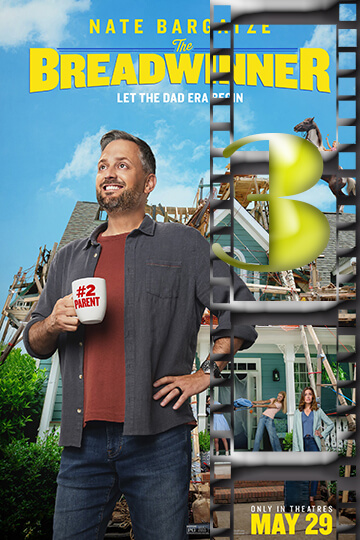

What’s It About
A man becomes a stay-at-home dad when a once-in-a-lifetime opportunity takes his wife on a prolonged business trip for one month. With three young daughters and little experience handling their day-to-day needs, he soon realizes that running a household is the toughest gig he’s ever had.


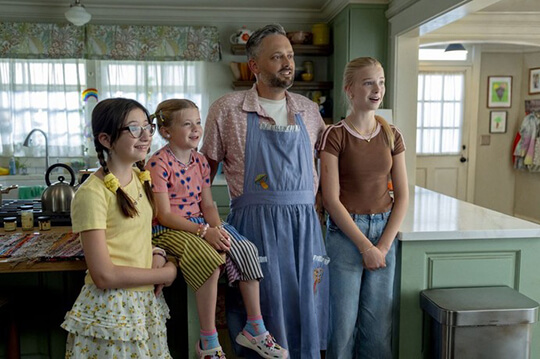
MOVIESinMO REVIEW
The Breadwinner is the sort of movie that makes you regret leaving the house, wishing you had just watched an old favorite at home instead. Directed by Eric Appel and co-written by comedian Nate Bargatze with Dan Lagana, this 2026 film seems to ignore everything that has changed in the last forty years. There is no sign of the feminist movement, no new family dynamics, and no progress at all. Instead, we get a grown man who acts like he has never set foot in his own kitchen, and the film expects us to find this funny. Nate Bargatze stars as Nate Wilcox, and since the character shares his name, it is hard not to see this as a personal story. Nate is a top car salesman at a Toyota dealership in suburban Nashville, but he leaves all the household duties to his wife, Katie, played by the underutilized Mandy Moore. Katie manages the home, raises their three daughters, keeps everyone on schedule, and even invents a children’s organizational tool called the Star Minder. Her invention gets her on Shark Tank, where Lori Greiner agrees to invest if Nate takes over at home while Katie goes to South Korea for manufacturing. What follows is a confusing stretch of time, sometimes two weeks, sometimes a month, where Nate undoes all of Katie’s hard work, and the film expects us to find this funny. It’s important to emphasize that Keaton’s film, Mr. Mom, came out in 1983 during a time of great change in society. As women began entering the workforce in greater numbers, much of the comedic content in the film came from social tension and change. The Breadwinner does not have the same historical context. By 2026, it is not charming to see a father who doesn’t know which schools his children attend, can’t use a toaster, and doesn’t know how to shop for groceries; it is out of touch with reality. The Breadwinner takes what was successful in Mr. Mom, removes it, and replaces it with louder, less clever versions of the same types of jokes. Bargatze’s character travels through his experiences with a bewildered expression as he stumbles down the stairs while doing laundry, burns breakfast, wrecks his car when dropping off his children at school, and buys a horse for his youngest daughter to avoid discussing boundaries. The film exaggerates each of these scenarios to the point where they don’t seem believable, and the humor becomes lost. The reason humor is most effective in comedy is because it is created from something we have experienced. If you take a situation too far, it will not be funny. What makes this even more disappointing is that the supporting cast actually shines. The three daughters—Stella Grace Fitzgerald as Gracie, Birdie Borria as Hadley, and Charlotte Ann Tucker as Sam—have more presence than the lead in almost every scene. When Gracie watches her mom leave and says, “Guess we are on our own now: three orphans,” that line is funnier than most of the second act. Will Forte, playing a desperate roofer, steals every scene he is in. Colin Jost as the lonely stay-at-home dad and Kumail Nanjiani as Nate’s rival at the dealership both bring energy the film does not really earn. It quickly becomes clear that everyone around Bargatze is more interesting than he is. The film is packed with so much product placement that it feels like a feature-length commercial. Toyota, Walmart, Shark Tank, and cereals like Lucky Charms, Cap’n Crunch, and Cocoa Puffs are all shown as if they are starring in their own ads. Sony produces both the film and Shark Tank, so the connection is clear, but watching it play out feels more like a business deal than a real story. This movie attempts to convey the importance of domestic responsibilities as well as Nate’s growth as a person, but it falls short of delivering that payoff. Throughout the film, all Nate has done is create problems for himself by lying to his wife, neglecting to provide for his children’s actual needs, and utilizing outside assistance to handle most of the home responsibilities. When he gives his speech in the third act, it is out of place and doesn’t reflect any of the aforementioned development. The film’s ending is inconsistent with the overall story, as it does not depict an actual journey. All that happened during Nate’s two-week adventure was simple survival; nothing else ever transpired. A couple of short creative scenes. A slow-motion scene of Nate having a ton of laundry using a time-lapse montage. This gives us a hint that there may have been a better version of this story. Then there is the pizza delivery scene that has quiet and unanticipated humor that was a pleasant surprise. These were two minor highlights in a larger movie disappointment. Nate Bargatze is a talented stand-up comedian with a huge following, but that talent does not come through in this film. His low-key, observational style works best with a live audience, where he can feed off their energy. On screen, without that feedback, his delivery feels flat and disconnected, almost like he is watching the movie happen to someone else. He deserved a better script, and the audience deserved a more daring film. The Breadwinner is not the worst movie of 2026, but it is the most unnecessary. It feels like a film that could have been made in 1987, would have been average back then, and now falls below average.
OUR RATING – A REGRETFUL 3
MEDIA
- Genre – Comedy
Street date
- Digital – July 14, 2026
- Blu-Ray/DVD – August 25, 2026
- Video – 1080p
- Screen size 2.39:1
- Sound – English: DTS-HD Master Audio 5.1, French (Canada): DTS-HD Master Audio 5.1, Spanish: DTS-HD Master Audio 5.1, Audio descriptive
- Subtitles – English SDH, French, Spanish
Extras
· Making-of Featurette: Behind-the-scenes look at the production.
· “Daditude, Sharks, and a Horse”: A special featurette covering the casting process.
· Extended Short: “A Standup on Set”.
· Bloopers
· Deleted Scenes
· Line-O-Rama’s