

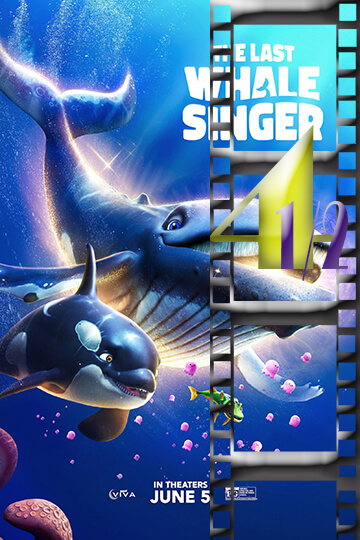

What’s It About
When a monstrous creature escapes from a melting iceberg, a self-doubting teenage humpback whale must face his fears and dive into the darkest depths with his friends, to discover a mystical song that can save the oceans from destruction.


MOVIESinMO REVIEW
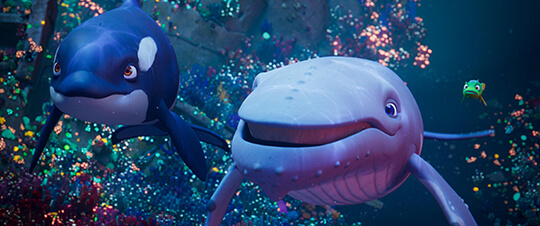
There is a quiet courage in a small animated film that truly believes in its message. The Last Whale Singer, directed by German-based filmmaker Reza Memari, shows that kind of conviction. You can sense it trying hard to make an impact, and at times, it succeeds. Still, working hard and creating something original are not the same, and this film never quite bridges that gap. The story centers on Vincent, a teenage humpback whale voiced by Vincent Tong, who faces a burden familiar to anyone who has watched a Disney film in the past thirty years. His parents, Lani and Humphrey, the last surviving Whale Singer, whose magical voice can heal coral reefs and the ocean, are killed by a cargo ship in the film’s first ten minutes. The event happens off-screen, but the image of their bodies sinking into the dark water is powerful. The emotional impact falls somewhere between Bambi and The Lion King, so children will feel it, and parents may reach for their hands. Walter (Bruce Dinsmore), the remora fish who serves as a full-time caregiver for Vincent, tries to comfort him about the loss of his father (Humphrey) by telling him that his father and mother have gone to “the star pool,” a heavenly underwater location at the bottom of the Mariana Trench. Although this gentle and almost spiritual explanation proves to be a meaningful way for the film to express its message about loss, faith, and courage, when Vincent finds out that the star pool is a graveyard containing the skeletal remains of dead animals, he has another opportunity to deeply consider these issues. In general, this is one of the few moments during the film when the viewer has been given such a thoughtful (and emotional) moment. This is where honesty is needed. The Last Whale Singer is made up of pieces from other films. Mufasa falls from the cliff. Simba runs. Vincent sees his parents die, pulls away from the world, becomes cynical and distant, and is eventually drawn back into a responsibility he never wanted. This story has been told before, and told well. What Memari needed, and only partly achieves, is a reason for the audience to care about this version. Each of the supporting characters makes a contribution to the story. Darya, the deaf orca, provides the group with the toughness that is required, and is voiced by Jennifer Wheeler-Hughes. Karl, the walrus king, rules an inflatable throne over a garbage patch that is truly funny. Y, the jellyfish that is translucent, communicates by sending electrical charges through his body and can read other creatures via a scanner-like ability, making that character really stand out. Walter (an anxious, overly protective character who is always on edge) provides much of the humor in the film. His line, “Why do we always swim toward the weird?” has the humor of someone who is tired of the question and already knows the answer. The film’s greatest strength lies in its environmental message. The ocean is in serious trouble. Examples include dead coral reefs, garbage kingdoms, and an enormous creature known as the Leviathan, a tentacled monster that spews poison into anything it touches. By showing that children can recognize and respond to the ecological disasters that they see in the film and that the destruction of the earth is more than just an adult issue, the film makes a meaningful and non-preachy statement about the environmental crisis young people are facing today. Humans do not appear on screen, but their impact is clearly demonstrated through the characters’ actions. This creative choice is well thought through and effective in achieving the filmmaker’s goals. The technical execution in this film is disappointing and causes major weaknesses to the film as a result. Being a mostly German co-production using video game software for much of its animation results in very poor results from these attempts. The water is not realistic and has no weight, for example, and characters move through the ocean and do not have the sense of weight that an underwater creature would exhibit. This film’s visuals cannot compare to those of Pixar’s Finding Nemo, which was created more than 20 years ago. There are a couple of scenes that look nice, like the star pool with deep purples and blues, but the examples of creature designs are well thought out, but do not support the basic animation of the story, especially in emotion, as there are many spots throughout the film where animation does not support the emotional experiences occurring in the story. The voice performances help the film during its weaker moments. Tong gives Vincent a believable teenage moodiness that slowly becomes warmer, and Dinsmore brings enough humor to Walter to make him the most entertaining character. Overall, the cast gives more than the script asks for. Ultimately, The Last Whale Singer is saved by little, honest moments. The Last Whale Singer’s important message – that even a single voice in doubt has the ability to heal – is expressed in an authentic way. The film fails to express its main message in any new or innovative way. Parents can bring their elementary school-aged children to this film without worry. The grief is handled gently. The environmental themes are suitable for kids and truly encouraging. The humor keeps the story moving. However, if you expect something as strong as the films that inspired it, like Pixar’s work or classic Disney, you may notice the gap between what the film aims for and what it achieves. The Last Whale Singer has good intentions and puts in effort, but in animation, as in most art, good intentions are just the start.
OUR RATING – A SOUR NOTE 4.5