



What’s It About
Based on a true story, a young Black FBI agent (Yahya Abdul-Mateen II) is sent into 1960s Mississippi to investigate a wave of brutal killings targeting civil rights leaders. Forced to work alongside notorious mafia hitman Greg Scarpa (Mark Wahlberg), he finds himself pulled into a deadly hunt where justice and vengeance begin to blur. When the system is broken, two men divided by everything agree on one thing: the law has limits. They don’t.


MOVIESinMO REVIEW
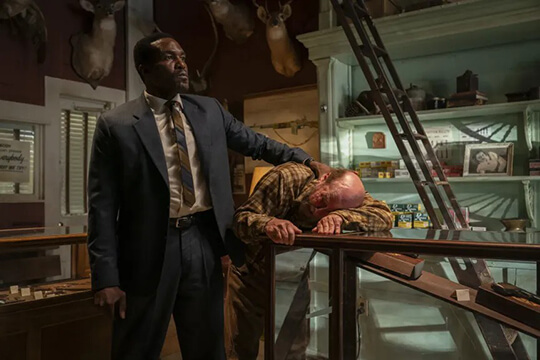
It’s 2026, and here’s another Black story with the obligatory White hero to make it all make sense. And it doesn’t matter if it’s true or fictional; Hollywood keeps selling this same played-out story that Black progress only happens when a White man decides to roll up his sleeves and handle business. Let’s not look at the historical records of who actually built this country. And don’t worry about who built the systems that made the struggle necessary in the first place. But that’s the movie business for you, and I walked into this one already knowing what kind of package deal I was being handed. Let me set the table. “By Any Means” is the second feature from director Elegance Bratton, working from a script by Sascha Penn. It’s pulled from real events surrounding the 1966 murder of Vernon Dahmer, the Mississippi NAACP president who was burned alive in his own home by the Ku Klux Klan. Dahmer’s crime, in their eyes, was paying poll taxes out of his own pocket so Black folks in Hattiesburg could vote. The Klan surrounded his house and set it on fire. He held them off long enough for his family to escape and died from his injuries. That part the film stages well, and it hits hard. The wild part of the true story, and the reason somebody thought this needed to be a movie, is what happened next. The Klan had protection from politicians and police, so the FBI couldn’t work the case straight. They went around the rules and brought in Gregory Scarpa, a hitman for New York’s Colombo crime family who was secretly informing for the Bureau. They pointed him at Mississippi and let him do what he does. The FBI has never admitted this on paper, but court testimony, declassified documents, and multiple books have confirmed the arrangement. That’s genuinely fascinating material. The problem is what got built on top of it. Yahya Abdul-Mateen II plays Wayne Strider, one of the very few Black agents in the FBI at that time. He’s stationed in Chicago, happily married to Allison (Nicole Beharie), and he requests a transfer to the office near his hometown because he believes he can make a difference there. He’s a believer. He trusts the badge, the paperwork, the process. Then Vernon Dahmer, his friend and mentor, played with real dignity by Giancarlo Esposito, is murdered, and Wayne runs face-first into a wall built out of crooked deputies and sheriffs who wear hoods after hours. Enter Mark Wahlberg as Scarpa, wearing a putty nose that fools nobody and an accent that’s somehow less believable than the nose. Wayne’s assignment is basically to be the driver and stay out of the way while this man beats confessions out of people. And this is where my patience started running thin. Wayne is a fully trained federal agent, and the movie still finds time for Scarpa to teach him how to protect himself. A Black man in Mississippi in 1966 needs the mobster from Brooklyn to explain danger to him. Come on now. Wayne’s moral compass is so rigid for so long that he edges close to being the house servant of the story, the good one who follows the rules while the White man gets to be interesting. To be fair, Abdul-Mateen II is a great actor. He carries the emotional weight of the whole picture, and the inner conflict he plays is the strongest thing in it. Wayne slowly figures out that the system he swore to protect does not protect him back. In some moments, that system is just as dangerous as the men in the sheets. That’s a painful realization, and the actor sells every second of it. Wahlberg steals scenes, sure, because he’s playing a version of the role he’s played a dozen times. The two of them have sharp chemistry, and their arguments crackle. You end up caught between cheering them on and shifting in your seat at how far they take things. Now, about the violence. Racists and Klansmen deserve whatever comes to their door, and I’m not going to pretend otherwise. But the film seems more excited about the beatings than about anything they’re supposed to mean. The opening scene has Scarpa chatting about baseball while winding up with a bat to work over an informant. Does this mean his methods get results? There’s no character development. This is Mark Wahlberg doing Mark Wahlberg, not a mobster to be scared of. Anybody else could have escalated that part to new heights. Unfortunately, you just count the punches here. What’s almost impressive is that the made-up FBI agent is more compelling than the real criminal. How Scarpa became an informant, what the Bureau held over him, what kind of man goes home to his family after a day like that, all of that could have been its own movie. Instead, we get a mismatched buddy procedural with no real mystery, since the killers turn out to be exactly the local men you expected from minute ten. The villains are a blur of nameless deputies and neighbors. History already told us who they were, and the film doesn’t even try to add anything. The ending is another torture scene, and by then nobody has learned much. The movie wants to be a serious statement about justice and revenge and also a crowd-pleasing action picture, and it doesn’t fully commit to either. Worse, because Wayne eventually bends toward Scarpa’s way of thinking, the film accidentally suggests the White man had it figured out all along. It even has him wave off Dr. King while nodding at Malcolm X. Sixty years later, with racism getting loud and comfortable again in certain corners of this country, that argument doesn’t hold. The violence in this film didn’t fix the root of anything, and neither did it in real life. Lastly: Samuel Bowers, the Klan leader who ordered the murder, wasn’t convicted until thirty-two years later in 1998. The movie tucks that into the closing credits like a receipt it hopes you won’t read. Dahmer’s family, including his 101-year-old widow Ellie, have spoken out against how loosely this film handles their history. That matters. Bratton makes his point and delivers watered-down entertainment that won’t offend anybody who needed offending. There’s a song called “By Any Means” over the credits, and honestly, the person who wrote it sounds more determined than the movie ever gets.
OUR RATING – A WATERED-DOWN 5