

WHAT’S IT ABOUT
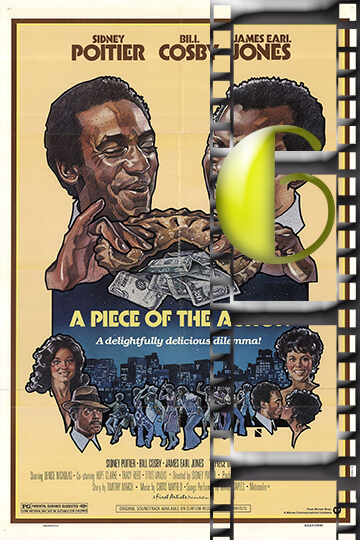
Two con men (Sidney Poitier, Bill Cosby) are persuaded by a retired policeman (James Earl Jones) to volunteer their services to a ghetto youth center.
MOVIESinMO REVIEW
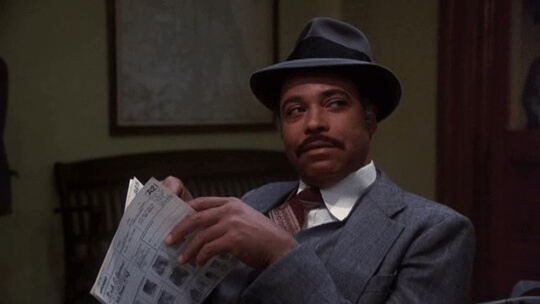
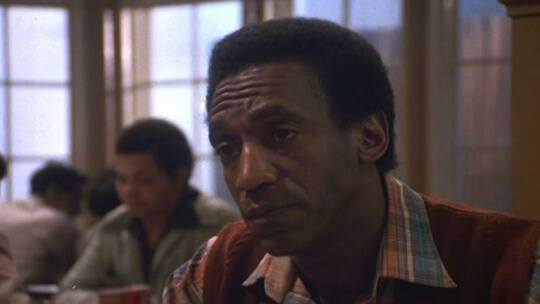
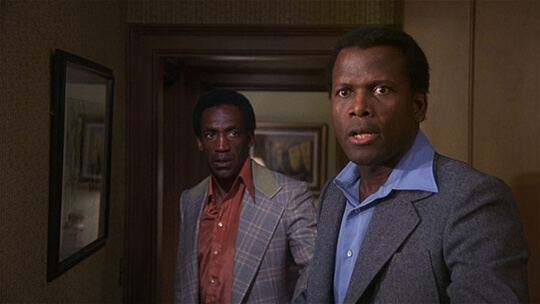
Sidney Poitier’s “A Piece of the Action” arrives as both a trilogy conclusion to the Poitier-Bill Cosby partnership and an intriguing time capsule revealing the complicated deals Black filmmakers endured in the 1970s mainstream marketplace. Nearly fifty years later, this film is a fascinating case study of the way that Black cinema has evolved, what the viewers were thinking at the time versus now, and the tightrope that filmmakers still walk between entertainment and representation. The third and final teaming of Poitier and Cosby, following “Uptown Saturday Night” and “Let’s Do It Again,” “A Piece of the Action” sets the two as small-time gangsters coerced into work at a community center with underprivileged kids. The result is a blend of heist comedy, social drama, and a sentimental redemption story that aligns with Poitier’s goal as a director of entertainment to uplift. The real story follows familiar territory: two sharp-tongued street scammers turned reluctant mentors, initially resentful and eventually redeemed by exposure to youth in need. Poitier’s Manny and Cosby’s Dave are two archetypes of Black manhood – Poitier’s more statesmanlike, restrained approach set against Cosby’s then-iconic folksy everyman humor and comedic flair. When “A Piece of the Action” was out, mainstream critics usually greeted it as pleasant, if boring, entertainment. The film was acclaimed for having positive messages and clean humor, a pleasant place in the “respectable” Black film that white audiences and critics appreciated. The reviews at the time underscored its wholesomeness, also emphasizing its separation from the raw grittiness of the blaxploitation genre that characterized Black cinema and also that it was a film that families could watch together. But, some of those Black viewers and critics were aware of its limitations. The respectability politics of the narrative that proper decorum and middle-class morality would remedy systemic conditions sounded somewhat hollow in the wake of ongoing civil rights struggles and inner-city degradation that characterized the mid-1970s. Viewing “A Piece of the Action” today is a matter of navigating a number of layers of historical context. The film’s treatment of class, education, and community betterment rings both genuine and naive. Its solution to urban ills, individual mentorship, self-control, and personal responsibility is the bootstrap credo that many in today’s audience would recognize as insufficient to address structural injustice. Any modern-day review of “A Piece of the Action” is bound to be in the light of Bill Cosby’s later criminal convictions and his whole recontextualizing as a public figure. Cosby in 1977 was pure, safe Black entertainment – the actor and stand-up who could span racial divides without giving offense to white sensibilities. His performance here sums up that figure to a T: smooth, dad-like, morally right. Contemporary viewers of this film are confronted with the tension between Cosby’s on-screen moral rectitude and his revealed private life. This imposes an inherent level of discomfort that makes scenes that are meant to show his character’s development more disturbing. The emphasis in the movie on the right kind of male role models and protecting young people becomes drastically different in its basis. Sidney Poitier’s direction is strengths and the constraints under which he worked. His commitment to positive representation meant that he needed to avoid the sex and violence of blaxploitation while not compromising on entertainment that would attract Black audiences. The result is a film that does somehow feel sanitized, particularly in contrast with the raw power of films like “Dolemite” or “Black Caesar” today. But Poitier’s concern with community, education, and intergenerational solidarity speaks to values that remain relevant. His work with the young performers is evocative of care, and the film’s fascination with depicting Black institutions (the community center, shops) as essential parts of neighborhood life offers representation that was important during the period and remains so now. Would “A Piece of the Action” resonate today? The answer is complicated. The film’s fundamental themes, community mentorship, second chances, and the power of education, remain current. Its rich, multi-faceted depiction of Black life, both street and institutional, is something much contemporary representation lacks. The film’s approach to social problems, however, feels dated. The suggestion that individual transformation alone can address institutional problems overlooks the structural racism that contemporary audiences know as the cause of city problems. The respectability politics of the movie the unspoken argument that good conduct and middle-class aspiration are the keys to success are in opposition to today’s arguments over systemic change and social organization. As a purely cinematic exercise, “A Piece of the Action” is competent but dull filmmaking. Poitier’s direction is serviceable, prioritizing clarity and character motivation over visual innovation. As. The rhythm of the film sometimes flags, particularly in its second half, and a few of its comedy scenes seem forced and not improvised. The chemistry between Poitier and Cosby remains the biggest selling point of this film, even by today’s viewers’ standards. Their dramatic and comedic styles are different, and this creates interesting tensions, and both actors bring genuine warmth to their exchanges with the child members of the cast. “A Piece of the Action” is a quintessential product of 1970s mainstream Black cinema, good-intentioned, sometimes involving, but contained within the social and commercial constraints of the time. It offers fascinating glimpses into the ways that Black filmmakers compromised in order to attract mass audiences without sacrificing some authentic expression of Black values and life. For contemporary audiences, the film must be most enjoyed as a historical document illuminating the progress and survival of some of the same issues in Black filmmaking. Its genuine belief in individual transformation and neighborhood the better part of the times has a residual power, even though its treatment of social ills falls short by today’s measure. The film would likely discover a niche in viewers interested in cinema history, Sidney Poitier’s films, or 1970s Black cinema. But it does not have the cultural resonance or artistic originality to excite much modern interest beyond these particular audiences. “A Piece of the Action” is both representative of the potential and limitations of its time, an era in which Black directors hoped to appeal to the mainstream while still being true to themselves, tending to create films that met neither aim entirely. It’s still viewable and sometimes compelling, but more like an interesting relic than urgently relevant contemporary filmmaking.
OUR RATING – A SANITIZED 6