

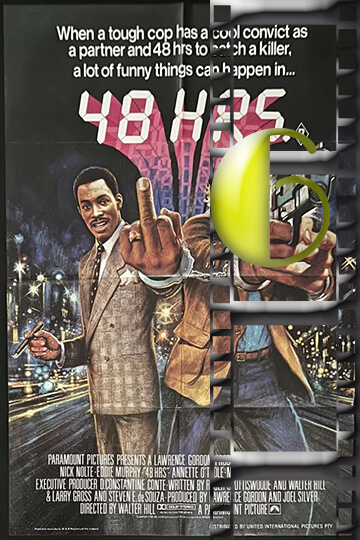
WHAT’S IT ABOUT
Renegade cop Jack Cates (Nick Nolte) pulls bank robber Reggie Hammond (Eddie Murphy) from a federal prison on a 48-hour leave to help him capture Hammond’s old partner, Albert Ganz (James Remar). Having escaped from a prison work crew, Ganz is on a killing spree around San Francisco, on the trail of half a million dollars that went missing after one of his robberies. The cocky Reggie knows where the money is, but spars with the hotheaded Jack as he enjoys his temporary freedom.
MOVIESinMO REVIEW
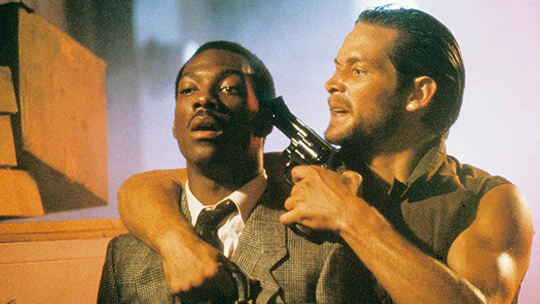
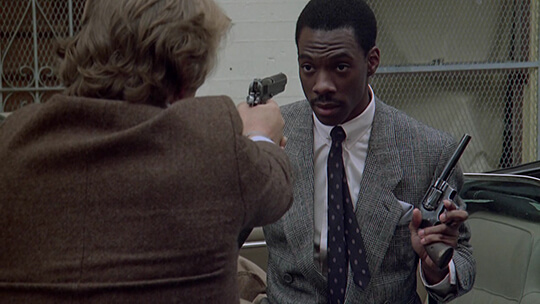
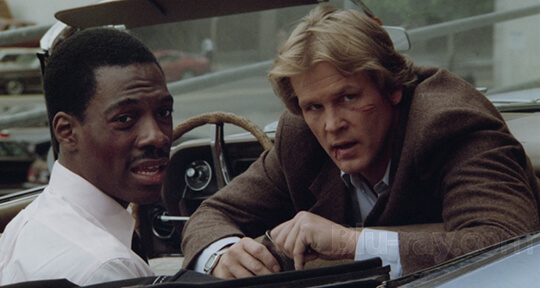
Walter Hill’s “48 Hrs.” premiered in December 1982 as a rowdy, gory buddy cop action-comedy that would serve as the defining style of the decade. Pitting Nick Nolte’s gruff San Francisco detective Jack Cates, against Eddie Murphy’s streetwise ex-con Reggie Hammond, the film set up an explosive battle of egos held together by circumstance and adversarial relationship. Viewed from a modern perspective, though, the film is a work that’s at once a celebration of Murphy’s own undeniable charm and an uncomfortable relic of its time’s racial politics. Critics mostly hailed “48 Hrs.” when it initially screened, describing it as a lively potboiler. Roger Ebert gave it three stars, calling it “a well-crafted example of its type.” It went on to gross over $78 million in the United States, launching Murphy’s film career and establishing the formula for mismatched buddy cop films that would dominate the 1980s and beyond. Contemporaneous reviews touted the chemistry between Murphy and Nolte, the slick direction, and the balanced combination of action and comedy. To this date, that defining consensus remains incomplete and naive. What in 1982 was regarded as edgy humor now sounds like flatly offensive racial exchanges. How the film treats its Black protagonist through a mostly white filter becomes impossible to ignore when viewed through four decades of hindsight and heightened social sensitivity. The most serious issue with “48 Hrs.” is how it situates Murphy’s Reggie Hammond within the narrative framework of the film. Murphy’s performance is irresistibly charming – his natural comedic intelligence and star presence are in evidence even in his debut film – but the character exists to serve the white hero’s narrative. Reggie is literally under duress for much of the film, both figuratively and, at times, very literally, as Cates asserts control via the badge and the threat of sending Hammond back to jail. The film’s most studied scene – Hammond’s explosive altercation in a redneck tavern – is a classic case in point. While Murphy’s performance is intense and the scene crackles with tension, it ends up serving to demonstrate how Black men must be doing some form of risky masculinity in order to be taken seriously in white environments. The scene takes on a different meaning now, with a hint of both empowerment and risky stereotyping that audiences in the present day won’t necessarily appreciate. Hammond endures a steady stream of racial slurs and racial epithets throughout the film, both from the antagonists and even from Cates himself. This might have been intended to show Cates’ character flaws as well, that would presumably be excised through his relationship with Hammond, but the payoff does not feel substantial. The film never quite grapples or critiques its own presentation of regular racism but instead employs it as atmospheric texture for the formation of their friendship. Despite all these important flaws, “48 Hrs.” improves on several technical aspects. Hill’s direction maintains an energetic pace, and San Francisco settings provide the proper rough-around-the-edges setting for the action. The film’s violence packs a punch without going overboard, and the editing keeps gathering steam, leading to its explosive confrontations. Murphy’s performance remains the film’s best component. Even hindered by a wayward script, his own on-screen personality shines through in each scene. His facility at moving between comedy and drama, sometimes in the course of a single beat, hints at the range that will ultimately make him one of the decade’s biggest stars. When given the freedom to improvise or react, Murphy makes solid stuff that might have fallen apart under a less able actor. Nolte delivers decent work as the disheveled, hard-living detective, though the remake of his character is not as well-developed. The film asks us to accept Cates’ development from a party racist to a thoughtful mate without granting the dramatic work to earn that change. Their final handshake is unearned, a narrative shortcut rather than a real payoff. “48 Hrs.” indelibly left its stamp on the buddy cop film genre, establishing tropes that would be reused to the point of nausea during the 1980s and 1990s. The success of mismatched partnerships in films like “Lethal Weapon,” “Beverly Hills Cop,” and “Rush Hour” traces its roots to Hill’s template. Many of these sequel films, however, would handle racial dynamics more discreetly, and it is possible to argue that even within the limitations of the genre, more thoughtful approaches were possible. The film also launched Murphy’s career trajectory, leading to “Trading Places” and “Beverly Hills Cop,” where he could exert more control as both an actor and a character. In retrospect, “48 Hrs.” is one of those bad steps that needed to be taken in order for Murphy to move from stand-up comedian to movie star. It is an answer that requires a messy one. An overt remake of “48 Hrs.” on original racial lines would nowadays incur significant disapproval. Audience members are nowadays more discerning in recognizing and condemning racial stereotypes and power imbalances within mainstream popular culture. The minimizing of racial insults as background detail and the implicit power relationship between the two leads would be extremely uncomfortable for contemporary cinema audiences. But the underlying assumption of the film – cop and criminal in co-operation – remains viable. Modern re-workings would need to be more careful with the racial dynamics, either by re-mapping the criminal player as a more even partner and not inferior or by having it address and deconstruct the racist mindset in the open rather than just representing it. “48 Hrs.” remains worth seeing as a vehicle for Murphy’s emerging talent and as a period artifact of 1980s movie sensibilities. The action scenes hold their own, and Hill’s direction is professionally able throughout. But the racial politics of the movie are now outdated and troubling in ways that make it less politically palatable today. For modern viewers, “48 Hrs.” works best as an artifact of its time and not as forever-funny. It is interesting in what it tells us about how Hollywood treated race in the early 1980s, reminding us how much cultural thinking has progressed. Murphy’s performance transcends the problem. 48 hrs. captures this tension well between Murphy’s inevitable screen presence and the questionable aspects of the film. It is a classic film that ignited a storied career, but it is also a film that audiences today should take a longer view of the cultural nearsightedness of its time.
OUR RATING – A RE-EXAMINED 6