

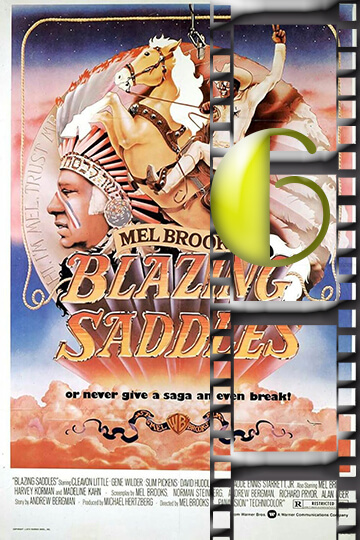
WHAT’S IT ABOUT
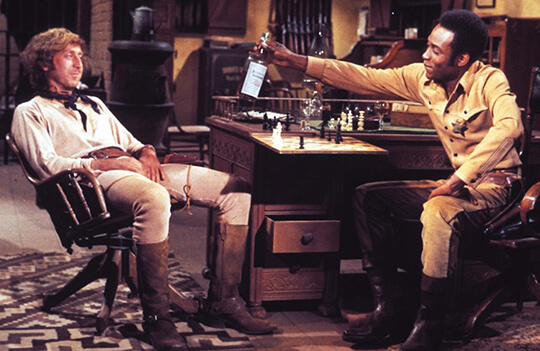
In this satirical take on Westerns, crafty railroad worker Bart (Cleavon Little) becomes the first black sheriff of Rock Ridge, a frontier town about to be destroyed in order to make way for a new railroad. Initially, the people of Rock Ridge harbor a racial bias toward their new leader. However, they warm to him after realizing that Bart and his perpetually drunk gunfighter friend (Gene Wilder) are the only defense against a wave of thugs sent to rid the town of its population.
MOVIESinMO REVIEW
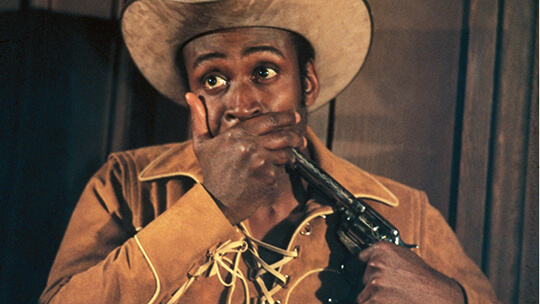
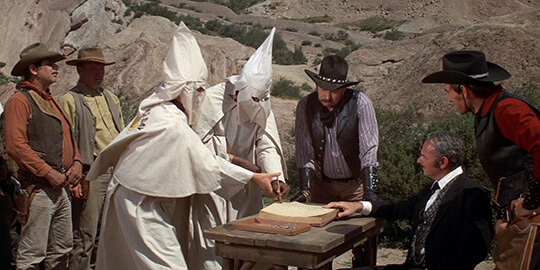
Mel Brooks’ “Blazing Saddles” occupies an uncomfortable position in the history of American film—a film revolutionary for its time but increasingly vexing in the contemporary age. As a Black film critic screening this 1974 spoof Western almost half a century after its original release, I am conflicted about a work that both subverted and reinforced racial stereotypes simultaneously while delivering genuine laughs and stinging social critique. When “Blazing Saddles” debuted, critics were largely divided, though many respected its bold effort to take on racism in America. The movie arrived during a revolutionary period for Hollywood, six years after the Martin Luther King Jr. assassination and at the peak of the still-unfolding civil rights movement. Brooks’ hiring of Cleavon Little as Sheriff Bart, a Black man who was voted into office to protect a racist frontier town, was really counterintuitive for the time. Contemporary critics preferred to highlight the “unfearful” approach of the film to racial humor. Roger Ebert gave it three stars, labeling it “loony” and accepting its uneven implementation. Vincent Canby of The New York Times appreciated its “cheerful vulgarity” and its ability to confront American racism boldly. Most white critics of the time were apparently happy to have a comedy that dealt with racial tensions but kept enough distance by being a parody to be “safe.” This view was based largely on ignoring the fact that the humor was usually at the expense of Black dignity. Brooks professed to be satirizing racism, yet most of the humor based itself on racial slurs and stereotypes that, even in 1974, made Black audiences uncomfortable. Native Americans in the movie were particularly horrific, reduced to unintelligible caricatures who spoke Yiddish—a “gag” more a reflection of Brooks’ own cultural blind spots than any wry observation on Westerns. The only positive aspect of the film is Cleavon Little’s performance as Sheriff Bart. Little brought intelligence, charm, and dignity to a part that could so readily have sunk into minstrelsy. His rendition of a refined, educated Black man muddling his way through an ignorant world of racists was truly progressive for 1974. The “Where the white women at?” scene, while problematic in and of itself, gave Little space to show his comedic timing and disrupt stereotypes about Black masculinity on screen. However, Little’s brilliant performance is always part of a context that frequently strips his character of humanity. The racial comedy of the film is effective on a variety of levels—sometimes mocking white racism, sometimes seemingly encouraging it by exaggeration and repetition. This is also a projection of Brooks’ own conflicted approach to the material: a Jewish director using Black experiences as the vehicle for a more general comment on American bigotry, yet not actually addressing the implications for Black audiences. According to contemporary standards, “Blazing Saddles” is highly problematic. The blanket use of racial slurs, the N-word is employed over a dozen times, would be unthinkable in modern mainstream cinema. The humor in the movie regarding race feels insensitive and dated, relying on shock more than actual wit or insight. Younger audiences and modern audiences generally would likely view much of the humor as more insulting than amusing. The film’s proponents typically argue that it’s “satire” meant to render racism as ridiculous as it is. This explanation, even if partly legitimate, ignores that intending satire does not preclude harmful effects. The bulk of the film’s racial humor operates similarly, whether for their self-described satirical purpose—they normalize the language and behavior they seem to be satirizing.In addition, the movie’s production background questions whose voices were privileged in making it. While Richard Pryor assisted on the script, the result is ultimately more Brooks’ than Pryor’s more subtle understanding of racial dynamics. The overall effect is a film that often appears to be more laughing at Black people rather than with them. Would “Blazing Saddles” today pass? The answer is nuanced. For scholars and film critics of the history of cinema, it remains a rich piece of filmmaking history and racial attitudes from the 1970s. But for ordinary viewers, particularly groups or families of more than one race, the film creates serious issues. Most streaming services have provided content warnings on the film to indicate that it contains harmful content, rather than removing it from their platforms completely, which is probably a reasonable solution because it keeps the film available for historical purposes and warns the viewer of possibly offensive content. The fact that the film remains popular with some indicates both nostalgia for a time when such comedy was more acceptable and sincere love for its better comic elements. The campfire scene, the “Mongo” figure, and most of the visual gags remain funny independent of the racial material in the film. Contemporary audience response would likely be extremely polarized along racial and age lines. White, older-generation audiences who remember the film fondly might still enjoy its irreverence, but audiences across age groups would likely find it outdated and offensive. Black audiences in the contemporary period would likely respond ambivalently—some appreciating Little’s performance and some of the satirical content, others seeing the entire approach as insulting and harmful. The film’s technical achievement—Brooks’s direction, the production design, and a series of excellent comic performances—remains. But it is undone by the offending racial content which permeates so much of the picture. “Blazing Saddles” is the hope and limitation of comedy as social commentary. It should also be praised for attempting to tackle American racism in comedic terms. But it cannot ultimately transcend the prejudices it sets out to satirize. The film remains historically pertinent as a product of its time, yet its racial humor has not aged. To modern audiences, “Blazing Saddles” is less of an entertainment and more of a period document. It does show some insight into racial and humorous attitudes in the 1970s and demonstrates how satirical motivation does not always excuse reprehensible material. Cleavon Little’s classy turn allows us to see what the film could have been like with a slightly more thoughtful treatment of its sensitive issues. With consideration for its historical relevance, technical proficiency, and good heart (and oddly authentic funny moments), this film earns a decent score, but loses serious points for its off-putting racist material and lost opportunities for fresh social commentary. It’s a period piece that today’s consumer should understand accurately in context and critically.
OUR RATING – A COMPLEX LEGACY 6