
WHAT’S IT ABOUT
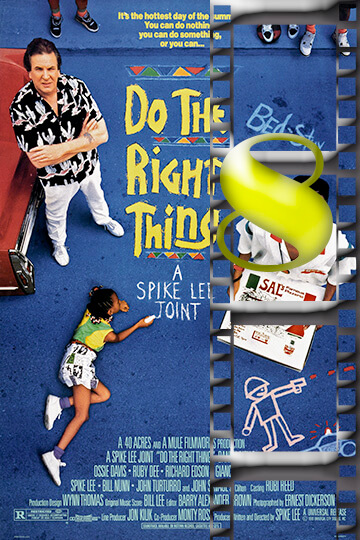
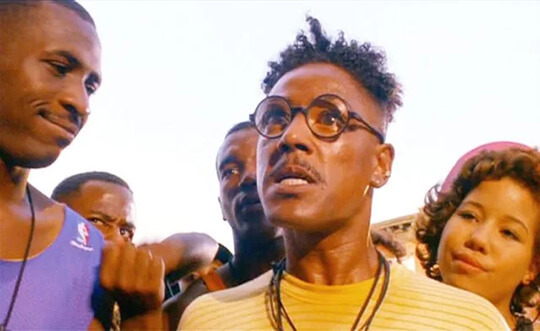
Salvatore “Sal” Fragione (Danny Aiello) is the Italian owner of a pizzeria in Brooklyn. A neighborhood local, Buggin’ Out (Giancarlo Esposito), becomes upset when he sees that the pizzeria’s Wall of Fame exhibits only Italian actors. Buggin’ Out believes a pizzeria in a black neighborhood should showcase black actors, but Sal disagrees. The wall becomes a symbol of racism and hate to Buggin’ Out and to other people in the neighborhood, and tensions rise.
MOVIESinMO REVIEW
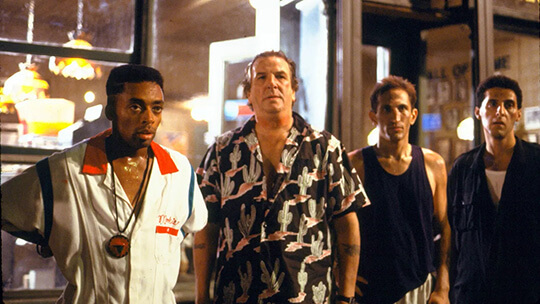
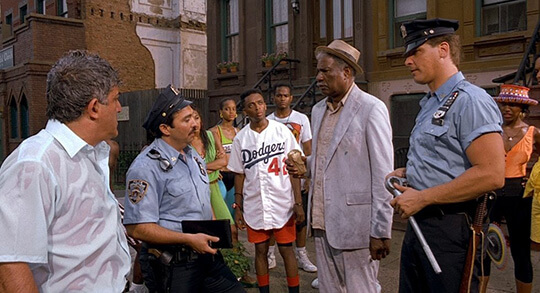
Spike Lee’s “Do the Right Thing” burst onto movie screens during the summer of 1989, falling like a match into the powder keg of American race relations. As a Black film critic writing about this classic 36 years later, what strikes me most is how acutely relevant it continues to be—both artistically superb and socially visionary. Upon its initial release, critical opinion regarding Lee’s masterpiece was surprisingly polarized. White mainstream critics were generally concerned about the possibility of violence brought on by the film, with well-known critics like David Denby cautioning that it could lead Black audiences to riot. New York Magazine’s Joe Klein infamously said the movie was “dangerous.” These responses revealed more about the writers’ own racial anxieties than about the film. Most of them seemed to fail to realize that Lee was not romanticizing violence but thinking about a reality where tensions between races were already set to explode. At the same time, Black critics and audiences in general, recognized something deeply real to Lee’s vision. We saw a rare movie that didn’t sanitize or sentimentalize the Black experience but brought our community in all its complexity, contradiction, and humanity to the screen. The fictional Bed-Stuy community was not a stage set but a living environment of characters with different perspectives within the Black community—ranging from Radio Raheem’s silent rage to Mookie’s ambivalence to Da Mayor’s weathered wisdom. The technical innovations of “Do the Right Thing” were groundbreaking. Ernest Dickerson’s cinematography used color theory to perfection in a hot red-and-pink-hued palette, imagining the rising temperature of the neighborhood both literally and metaphorically. The hip-hop aesthetic of the film—down to Public Enemy’s battle cry “Fight the Power” and the direct-to-camera diatribes—created a recognizable Black cinematic language employed by generations of directors. Is “Do the Right Thing” still effective in today’s day and age? Absolutely, even if contemporary viewers will engage it differently than their counterparts in 1989. Most contemporary audiences will be astonishingly impressed with how prescient the film really is. That infamous scene wherein Radio Raheem is brutalized by cops with an unconstitutional chokehold makes it seem ripped from the current day’s front pages. This was shocking to some viewers in 1989; in post-Ferguson, post-George Floyd America, it is devastatingly familiar. Lee’s depiction of police brutality occurred two years before the Rodney King video and preceded our current age of viral videos recording similar instances of violence. Contemporary audiences may also better see the subtle image of gentrification presented by the film. Sal’s Famous Pizzeria is the beginnings of what became a nationwide pattern of neighborhood regeneration. The confrontations between the older neighbors and arrivals anticipated ownership disputes and issues of displacement, which only grew after the film’s opening. Aspects of “Do the Right Thing” would be done differently today. The characterizations of the Korean owners get the tension of the period but are superficial when compared to the character development granted to others. The gender politics of the film, in communicating Lee’s typical interest in aggressive female roles through the figure of Mother Sister and Jade, are still more about male existence. These are not fatal flaws—these are reverberations of the era and the artist at the time. What remains strongest about “Do the Right Thing” is Lee’s refusal to simplify. The film ends with dueling quotes from Martin Luther King Jr. advocating nonviolence and Malcolm X arguing for self-defense “by any means necessary.” Contemporary audiences, perhaps more sensitive to subtle arguments over institutionalized racism, might better appreciate that this duality was not a cop-out but an honest representation of the difficult choices facing communities under pressure. Would audiences today adore “Do the Right Thing”? Almost undoubtedly. Beyond its social relevance, it remains crazy fun—funny, aesthetically pleasing, and compulsively paced as a narrative. All of the acting is top-notch, from Danny Aiello’s Oscar-nominated turn as Sal to Lee’s own turn as Mookie to Samuel L. Jackson’s smooth radio DJ voiceover. Its timeless status is deserved. For younger viewers who have been raised on the more sophisticated social commentary of films like “Get Out” or “Sorry to Bother You,” the coarseness of Lee’s approach might seem almost refreshing in its unvarnished directness. There is a vitality to “Do the Right Thing” because it was made during an era when such stories did not often receive major studio backing. Whether or not the film remains “acceptable” to see is an interesting question in itself. In our current content-warned world, others would get the message triggering the film for racial slurs, violence, and inflammatory material. But it misses the point altogether. “Do the Right Thing” is meant to be uncomfortable—it’s not a bug, it’s a feature. The film uses that unease as a method of deconstructing how prejudice functions and how racial tension spirals out of control. It’s precisely the kind of hard art that should be encountered, not avoided. The greatest surprise about revisiting “Do the Right Thing” in 2025 is that it’s no longer only a great film but also an era document. It’s not only a capture of an American inner-city moment but also something greater than the moment because of art. As with all things that last, it continues to recontextualize itself with changing society. What was controversial at one moment now looks like prophecy. Lee did not merely shoot a film about racial tension; he constructed a timeless reflection on community, values, and the difficult choices we have to make when our values clash. By inquiring what it means to “do the right thing” in a society that is unjust, he posed a question that remains pertinent today. No wonder this sweltering, high-energy day in Bed-Stuy continues to resonate with each new generation of viewers who find it.
OUR RATING – A LOVE/HATE 8