

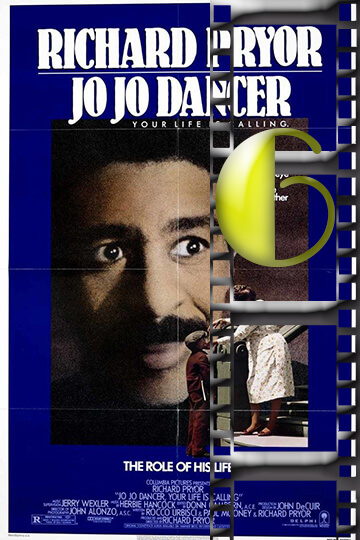
WHAT’S IT ABOUT
Although Jo Jo Dancer (Richard Pryor) has achieved success as a stand-up comedian, he hasn’t found happiness. After receiving severe burns in a narcotics-related incident, Jo Jo remains in a coma, and, while in this state, he looks back on his life. Drifting off into memories of his troubled childhood, Jo Jo revisits his youth, recalling his eventual rise to fame and the decadence that followed. As he considers his existence, he must decide if he wants to go on living or not.
MOVIESinMO REVIEW
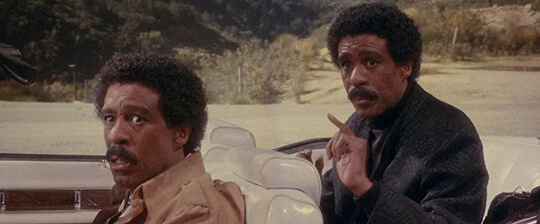
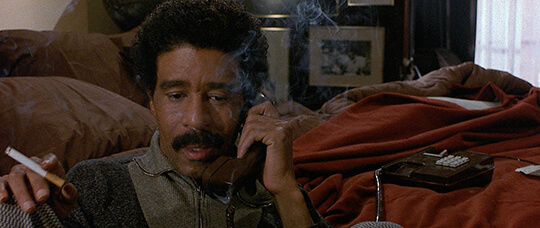
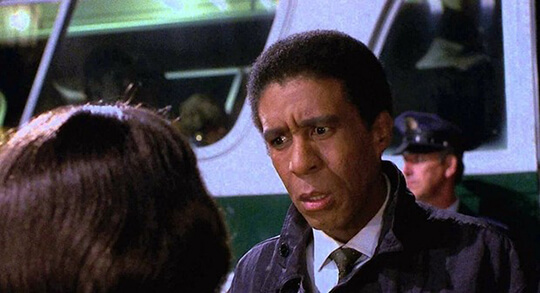
Richard Pryor’s directorial debut in 1986, “Jo Jo Dancer, Your Life Is Calling,” is one of the most truthful and unforgiving analyses of Black manhood, addiction, and self-destruction ever committed to film. Nearly forty years after its release, this deeply personal film is due a reassessment not just as autobiography but as a significant African American film that set so much of the discourse we’re still having today about trauma, mental illness, and fame’s cost to Black communities. Pryor fabricates a narrative in which he, as Jo Jo Dancer (clearly his alter ego), tells the story from a hospital bed, having disfigured himself while freebasing cocaine—recreating Pryor’s real 1980 near-death experience. The structure of the film, as Jo Jo’s ghost living out his life experience, allows for consideration of the institutional and personal factors that set him up for this self-destructive bout. From his childhood in his grandmother’s house of ill repute to the time he became a comedian, Pryor will not whitewash his past nor present himself as merely the victim of circumstance. What sets this film apart is Pryor’s insistence that he is guilty of his own downfall and simultaneously illustrates how racism, poverty, and child trauma prepared him for the ultimate failures that awaited him. The brothel scenes with his grandma (played with fierce dignity by Carmen McRae) don’t squeeze the setting for cheap thrills and titillation. Instead, they reveal how a young Black boy must make it in an adult world where making it means being at risk of premature growing up and emotional compartmentalizing. Mainstream critics, when the film was released in 1986, were largely uncomfortable with the film’s honesty. Most of the criticisms were directed at its “depressing” tone, and audiences were queried about whether they would enjoy watching their beloved comedian so bare. The film was criticized as being “too personal” and less glossy than Hollywood biopic films. The box office was muted, suggesting audiences weren’t quite prepared for this level of introspection from an artist they’d rather see chuck them up laughing. Black critics and audiences were more receptive, appreciating the innovative mode of depicting Black life, unfiltered by the stereotypical lenses of Hollywood. Even within Black circles, however, there was debate regarding whether Pryor’s uncompromising depiction perpetuated or defiantly challenged negative stereotypes. In hindsight, from our modern viewpoint, “Jo Jo Dancer” seems supremely visionary. The film’s exploration of intergenerational trauma, the two-step between art and pain, and the specific way in which racism amplifies personal anguish all seem incredibly timely. When we’ve recently seen movies like “The Last Dance” and “Surviving R. Kelly” explore the complex psychology of Black performers, Pryor’s willingness to perform his own psychological autopsy seems cutting-edge. The way the film portrays addiction as a private failure and public disease tightly aligns with contemporary discourse about the opioid crisis and mental illness within Black Americans. Pryor never makes excuses for himself, but he frames himself within the context that understands how embedded racism creates additional layers of stress and trauma, leading to self-destruction. As a director, Pryor is surprisingly skilled in orchestrating transitions between comedy and pathos without tonally jarring shifts. In his acting, he is not afraid. Instead of the manic energy that defined his stand-up stage persona, he strips bare the wounded man within. Behind-the-scenes support from Debbie Allen as his wife and Art Evans as his friend Sal adds earthiness to the film to keep it from being outright self-indulgence. The cinematography, by John A. Alonzo, manages to catch the glamour of Jo Jo’s success and the hardness of his roots without idealizing either of them. The editing is occasionally slack, which is appropriate to the stream-of-consciousness style of the film and to the blurring of memory and remorse in times of trouble. Would today’s audiences embrace “Jo Jo Dancer”? The answer is complex. Conversely, today’s audiences are accustomed to psychological complexity in what they view. The success of films like “Moonlight,” “The Last Black Man in San Francisco,” and “Waves” shows that audiences are hungry for nuanced depictions of Black manhood that are not clichéd. The pacing and construction of the film may deter viewers to whom a more conventional narrative tempo is normal. The movie asks for patience and emotional investment that are likely to be shortchanged by spectators anticipating more lighthearted fare. Also, some of the movie’s gender arrangements, as realistic as they are to the period and Pryor’s experience, can feel outdated to contemporary audiences more sensitive to matters of masculinity and relationships. “Jo Jo Dancer” represents a high point in Black cinema—a prominent Black actor using his medium to face difficult truths about his people and himself. The integrity of the film in examining how external oppression and internal choices intersect in destructive ways serves as an example of honest storytelling that we still see repeated throughout the work of contemporary filmmakers like Barry Jenkins and Ryan Coogler. The film’s examination of the way fame can sort of magnify and not cure personal pain seems especially timely in our social media era when Black celebrities are under constant pressure and scrutiny and have to contend with the same basic human issues as everyone else. Pryor’s decision to literally burn his life down is a metaphor for how self-destruction is the only way of clinging to control when everything else is determined by forces beyond your control. “Jo Jo Dancer, Your Life Is Calling” remains an important watch, not necessarily because it is a good film, but because it is an obligatory one. The straightforward honesty of Pryor’s commitment to look at his own life without objection is a model of authentic narrative, and can be studied. While the film is episodic, and drifts in places, and is uneven in its pacing, these are minor setbacks placed against its emotional honesty and cross-cultural significance. For modern viewers, the film provides both historical background and universal observations about the human condition. It reminds us that there’s always some private struggle hiding behind the public face and healing only derives from confronting tough truths about ourselves and our world. It won’t satisfy viewers who want to be simply entertained, but “Jo Jo Dancer” rewards those willing to work with its complexity. It is a testament to the power of exposure and the necessity for truth-telling, even when—and indeed, perhaps most especially when—that truth stings.
OUR RATING – A CRITICAL 6