
WHAT’S IT ABOUT
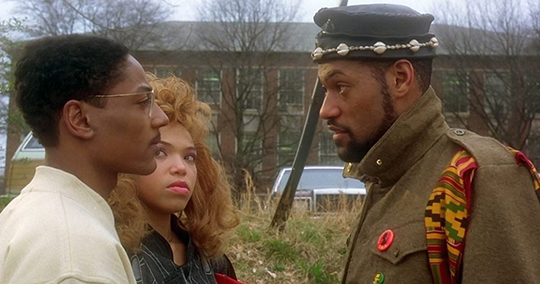
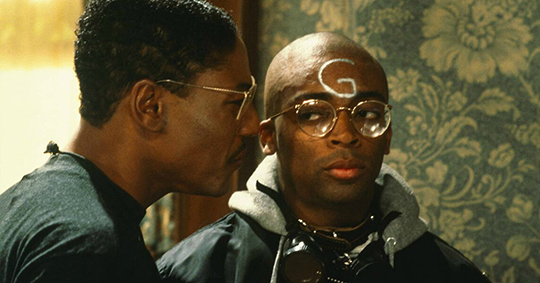
At historically black Mission College, the activist-minded Dap (Larry Fishburne) immerses himself in a world of political rhetoric and social movements — one day, he hopes to rally the students as a united front. At the other end of the spectrum, Julian (Giancarlo Esposito), the head of the biggest fraternity on campus, is more concerned with maintaining a strict social order. In between, Dap’s conflicted cousin, Half-Pint (Spike Lee), spends most of his time rushing the fraternity.
MOVIESinMO REVIEW
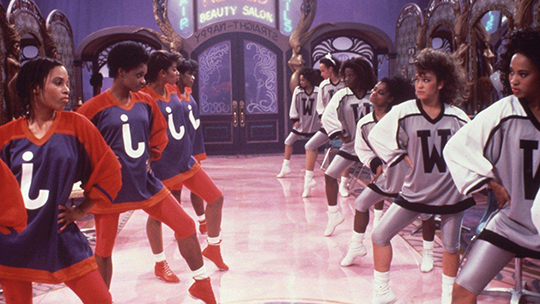
Spike Lee’s sophomore feature film “School Daze” arrived in 1988 like a bolt of lightning across the American cinema landscape. Just a year after his debut success with “She’s Gotta Have It,” the film is Lee’s ambitious attempt to explore the Black identity, colorism, and class struggle within the microcosm of an imaginary historically Black college. As a Black film critic reflecting back on this foundational work from our 2025 perspective, it’s interesting to think about how this intentionally inflammatory film has endured almost four decades of cultural transformation. When “School Daze” was initially released, critics were sharply divided. Most mainstream publications struggled to situate Lee’s intensely personal inquiry into intra-racial conflict. The film’s employment of music, surrealist touches, and unapologetic exploration of colorism through the conflict between the light-skinned “Wannabes” and dark-skinned “Jigaboos” unsettled and perplexed some viewers. The New York Times called it “messy” while acknowledging its dynamism. Black critics did perceive something radical – a film that was gutsy enough to put Black college life center stage and tackle topics the community would gossip about in whispers but would never witness represented on the screen. What’s remarkable about “School Daze” today is how prophetic Lee’s vision proved. His depiction of Mission College, [in limbo] between an activist history and a corporatist future, served as a precursor to real-world conflicts that would occur within HBCUs in years to come. The film’s examination of colorism, class, and gender politics among Black communities was not merely incendiary – it was prophetic. The fundamental conflict between campus activist Dap Dunlap (Laurence Fishburne) and fraternity leader Julian Eaves/Dean Big Brother Almighty (Giancarlo Esposito) remains electrically charged. Their ideological struggle is a confrontation between alternative visions of Black progress that remain relevant today: radical resistance and respectability politics and assimilation. When Dap invokes “Wake up!” against apartheid South Africa and the college’s complicity, he might be organizing a Black Lives Matter protest decades later. What has changed most deeply is our cultural context when watching films. In 1988, many viewers, both Black and white, were uncomfortable with Lee’s unflinching representations of colorism and misogyny in Black communities because they feared stoking racist stereotypes. Viewers now largely see these depictions as necessary truth-telling about intra-community realities rather than stoking racist mythologies. The movie’s treatment of women, however, is its biggest flaw by today’s standards. The infamous “Good and Bad Hair” musical number, while satire, teeters too close to the edge of objectification. The fraternity hazing scenes of female students (particularly the “metabolism” skit) depict a careless sexual humiliation that appears jarringly out of sync with today’s vocabulary. Lee’s camera lingers on women’s bodies in ways that modern audiences will rightly find troubling. While those moments were an accurate representation of some aspects of campus culture, the film sometimes seems complicit in the same objectification it is attempting to critique. All of this notwithstanding, characters like Rachel (Kyme) provide a counterbalance in the form of agency and moral strength. Rachel’s rebuke to Dap for his hypocrisy of fighting for Black freedom while discounting women’s concerns in a horribly modernist moment. “You want everybody to be color blind, but you don’t want us to see that women are still being treated like property,” she reminds him – a line one might write in any contemporary intersectional feminist novel. Visually, “School Daze” remains a thing of beauty. Ernest Dickerson’s directorial style moves smoothly from documentary realism in protest scenes to expressionist stagecraft in the musical scenes. The homecoming parade sequence brims with a joyous celebration of Black campus life rarely captured on film before or since with such candor. The step show competitions reveal cultural practices that mainstream America would only begin to appreciate years down the line. Audiences today would probably be taken aback by the experimental nature of the film. Years before the carefully built-up worlds of “Do the Right Thing” or “Malcolm X,” Lee was ready to defy storytelling conventions with dream sequences, addresses to the camera, and musical numbers that are closer to Bertolt Brecht’s theatrical heritage than Hollywood tradition. There’s a rough creative energy here that sometimes gets lost in Lee’s later, more refined work. Would audiences today enjoy “School Daze”? Yes, but with major caveats. The film must be placed in historical context, but it is worth it in terms of incredible performances (particularly by Fishburne and Esposito), cultural documentation of Black college life, and a vibrant energy that is still revolutionary. For younger Black audiences especially, the film gives a glimpse into how many of today’s arguments on campus have their origins deep in the past. Is it decent viewing according to contemporary standards? Yes, though not without controversy. Contemporary viewers will and should question its gender politics but embrace its honest exploration of colorism and class. The movie demands participation and not passive observation – precisely what Lee intended. Why “School Daze” endures is that it never gives easy answers. In the film’s powerful final sequence, Dap’s desperate “Wake up!” cries out across the fourth wall, calling out not just the characters but the audience to confront uncomfortable realities about cracks in Black communities. That mandate is no less urgent in 2025 than it was in 1988. For all its faults and its era flavor, “School Daze” remains required viewing – not as a masterpiece, maybe, but as a passionate, unpolished, necessary document of an upstart artist attempting to grapple with the questions of identity, community, and obligation that continue to confound us today. At a time of increasingly sanitized and algorithm-tested filmmaking, its willingness to provoke and irritate is more valuable than ever.
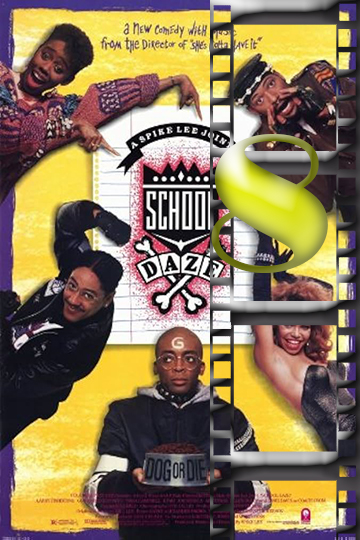
OUR RATING – A CAMPUS REVOLUTION 8