

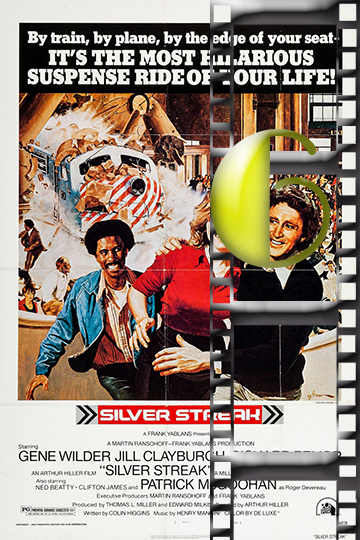
WHAT’S IT ABOUT
While on a cross-country train ride, overworked book editor George Caldwell (Gene Wilder) begins an unexpected romance with an enigmatic woman named Hilly Burns (Jill Clayburgh). His vacation is interrupted, however, when he witnesses a murder for which he is then accused. The true villains kidnap Hilly and eject Caldwell from the moving train. Desperate, Caldwell teams up with car thief Grover Muldoon (Richard Pryor), and together they must save Hilly while avoiding the police.
MOVIESinMO REVIEW
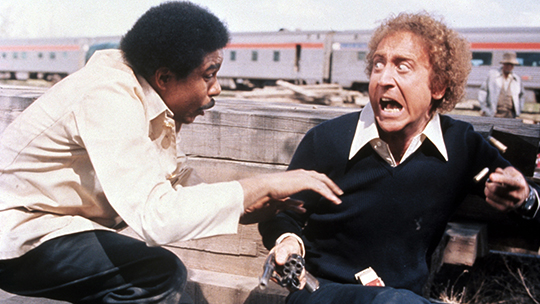
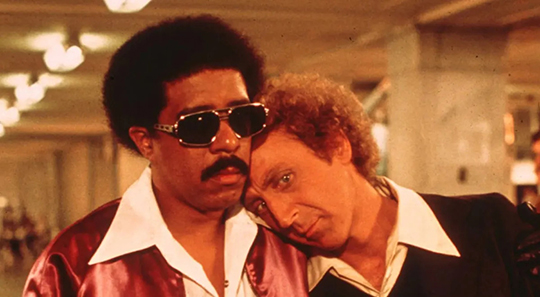
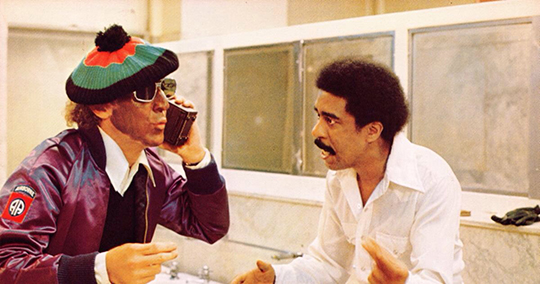
Gene Wilder and Richard Pryor’s original on-screen pairing in “Silver Streak” (1976) set up a comedy benchmark that creates both nostalgic affection and critical reassessment today. As a Black critic assessing this film some nearly 50 years from its original release, I am compelled to traverse the problematic space between admiration for its groundbreaking elements and recognition of its boundary-pushing ones. When “Silver Streak” was initially released, critics largely gave credit to its mix of humor and suspense, with a special recommendation for the rapport between Pryor and Wilder. The film tells the story of book editor George Caldwell (Wilder), who is riding a transcontinental train that turns into a wild and free-wheeling jaunt filled with murder, forgery of paintings, and romance. Pryor’s character, hoodlum Grover Muldoon, appears midway through the movie and steals every scene with his engaging screen presence. Mainstream critics at the time targeted primarily to compliment the genre blend and acting of the leads. Variety called it “a terrific film” that blended “comedy, action, and suspense,” while Roger Ebert praised its “cheerfully implausible plot.” Black publications like Jet magazine signaled the significance of Pryor’s acting, though it was not a racially central point of contention. By today’s standards, “Silver Streak” is a problematic viewing experience. The most explosive section of the film occurs when Wilder’s character becomes an undercover agent in blackface to avoid police arrest, and Pryor’s character teaches him how to “act Black.” In 1976, the scene was laughed at with no critical backlash against its racial sensibilities. Today, it lands with a clumsy thud. The blackface sequence is in this strange suspended place – it’s not presented as mockery in the traditional minstrel tradition, and Wilder’s character never relinquishes agency. The joke appears to be on Wilder’s hapless attempts rather than on Black people themselves. But the sequence does rely on stereotypical “Black mannerisms” that are reductive and squirmy to modern audiences. It is a perfect example of how racial comedy that went unremarked in the past is now being subjected to critical examination. Outside of this instant, though, Pryor’s character is both forward-thinking and problematic. On the one hand, Grover is intelligent, witty, and ultimately heroic – a departure from so many Black characters of the era. On the other, he’s also depicted as a thug who speaks street slang, reinforcing Black criminality myths that films of the era tended to perpetuate. What is fascinating about “Silver Streak” is that it tries to eat its cake and keep it too. It presents Pryor as a stereotype and subversion simultaneously. His character provides biting observations about racial profiling (“They’d nail my ass to the wall”) while using his street smarts to save the oblivious white hero. This dualism captures the period of transition in Hollywood when African American actors were receiving more significant roles but still working within systems that limited their scope. The film’s director, Arthur Hiller, should be thanked for recognizing Pryor’s comedic genius and providing him with a far greater role after observing his rapport with Wilder. This was the launching pad for one of Hollywood’s most successful interracial comedy duos, which would see subsequent films like “Stir Crazy” and pave the way for hundreds of buddy comedies that were to come. Would contemporary viewers enjoy “Silver Streak”? Many would appreciate its suspenseful Hitchcockian quality, witty script, and irrepressible on-screen chemistry between its leads. The train setting is somewhat atmospheric, and Jill Clayburgh brings wit and charm to what could otherwise have been a bland love interest. Patrick McGoohan delivers a wickedly bad art forger villain. But contemporary audiences would find the pace slow compared to contemporary thrillers, and the racial undertones would generate more intense discussion than laughter. The blackface sequence, in fact, would be confusing to many audiences not accustomed to encountering such content within mainstream media. Would “Silver Streak” survive today’s standards of viewing? I believe that it still holds up as entertainment and as history, so long as viewers approach it with context. The film is a vital milestone in Hollywood’s progression toward more integrated narratives despite possessing the racial attitudes of the period. It is a photograph of when American cinema was beginning to struggle with the way that it approached race but hadn’t quite traveled the path all the way down. The relationship between Wilder and Pryor’s characters also offers genuine moments of cross-racial bonding that were well in advance of 1976. They are a believable pair rather than a contrived one, and the screenplay gives them room to develop the mutual respect that exists beyond their racial differences. These elements are surprisingly well-preserved and used to counterbalance some of the film’s more dateline-dictated flaws. For black audiences in general, “Silver Streak” is a mixed bag. There is joy at watching Pryor’s brilliance come through the cracks of what was possible in the era but discomfort at seeing just how many of those cracks there actually were to start with. In one way or another, “Silver Streak” is a time capsule of a time-machine era in the history of American cinema. It takes up the space where classic Hollywood conventions intersect with growing consciousness of a need for more authentic representation. The film is not entirely successful in navigating the transition, but its attempts are nonetheless illuminating. Finally, “Silver Streak” is worth neither unadulterated praise nor complete condemnation. It is an inexact but useful step along Hollywood’s incremental evolution toward more accurate and equitable treatments of race. For contemporary viewers who are prepared to judge its accomplishments and missteps, it offers a complex look at just how far American film has traveled—and how much further it needs to go.
OUR RATING – AN UNCOMFORTABLE 6