

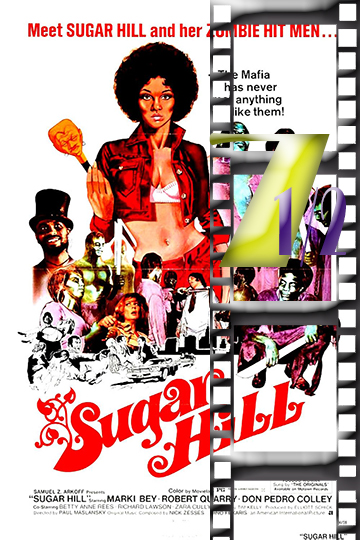
WHAT’S IT ABOUT
When nightclub owner Langston (Larry D. Johnson) refuses to sell out to local mob boss Morgan (Robert Quarry), he is beaten to death by a gang of hired thugs. His grief-stricken fiancee, Diana “Sugar” Hill (Marki Bey), vows revenge for his murder and turns to aged voodoo authority Mama Maitresse (Zara Cully). Together they conjure up the demonic spirit of Baron Samedi (Don Pedro Colley), who agrees to help Sugar. He raises an army of zombies and sets them upon Langston’s killers.
MOVIESinMO REVIEW
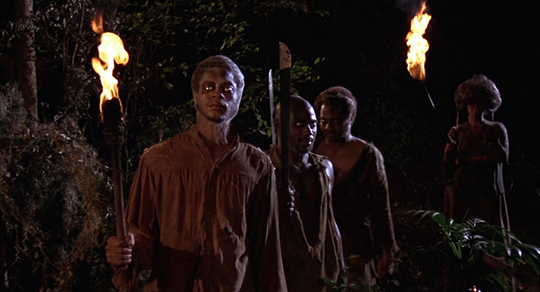
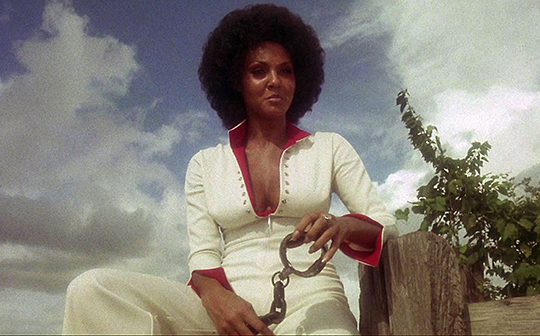
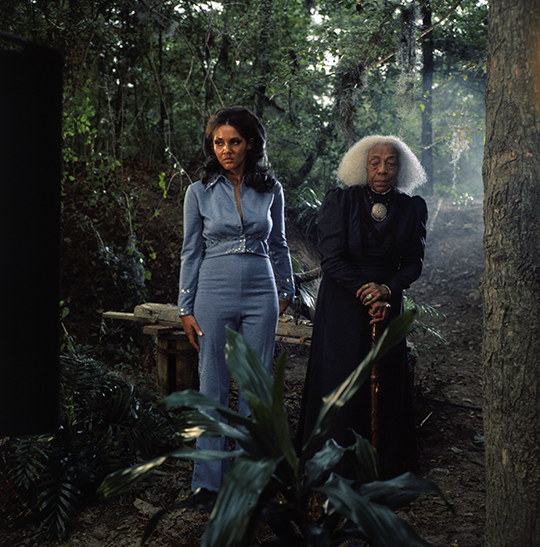
Paul Maslansky’s “Sugar Hill” surfaced in 1974, the height of the blaxploitation era, as a hybrid that merged horror with the genre’s standard themes of Black empowerment and vengeance against white oppression. Starring Marki Bey as Diana “Sugar” Hill, the woman who summons up Baron Samedi and his zombie army to take vengeance on white mobsters who have murdered her boyfriend, the movie is at once the promise and pitfalls of 1970s exploitation cinema. Fifty years later, this voodoo revenge film is worthy of reconsideration by eyes that can appreciate its subversive elements as well as its outmoded style. When “Sugar Hill” was released in 1974 at urban movie houses and drive-ins, mainstream film critics gave it scant attention or ignored it. Reviews it did receive usually relegated it to the “cheap exploitation” class, with white critics not responding to its topic of interest or noticing its cultural significance. This patronizing tone was typical of the broader critical establishment’s own condescending treatment of Blaxploitation films, which were typically ignored as gratuitous brutality when, in reality, they were actually quite complex mediators of power, race, and justice. Black viewers, however, received the film warmly. When positive portrayals of Blacks in mainstream Hollywood remained all too rare, “Sugar Hill” offered something quite seldom to be seen: a powerful Black woman as the protagonist of her own revenge tale. The film performed well in urban settings and at drive-ins, where audiences loved the mix of supernatural horror and issues of racial justice. The horror aspects of the film were particularly fresh. While Blaxploitation had produced crime dramas, action films, and even westerns, “Sugar Hill” was among the first successfully to fuse the genre with horror tropes. This hybridization would then influence directors like Bill Gunn (“Ganja & Hess”) and contribute to the development of Black horror as a distinct subgenre. Viewing “Sugar Hill” today reveals several things that remain engaging and even revolutionary. Most notably, Marki Bey’s Sugar Hill is one of the most powerful Black female protagonists in film. While most heroines in Blaxploitation were defined by their relationships with males, Sugar writes her own revenge story, maintaining supernatural powers and complicated schemes against her tormentors. Intelligence and agency drive the narrative, making her a proto-feminist heroine in the exploitation genre. The invocation of voodoo and African religiosity in the movie, sometimes crudely simplistic as dramatic devices, is really positioned at the center of Black spiritual practice as sources of resilience rather than primitive superstition. Baron Samedi, played in showy style by Don Pedro Colley, is an interconnection with African heritage that enables a resistance to white supremacist terror. This mystic empowerment mythologizes apart from normal blaxploitation revenge tales that are more gun-and-streety-justice oriented. Even the actual revenge scenes themselves exhibit quite the imagination and macabre sense of humor. Sugar’s urbane machinations for offing her enemies—that stabbing scene where a racist gets fed to pigs—combines supernatural horror with karma justice. These set pieces double as entertainment and catharsis, allowing audiences to witness white supremacist brutality repaid with supernatural revenge. The production values of the film, despite their low-budget nature, create an atmospheric Louisiana setting that grounds the supernatural in real regional culture. The cinematography maintains both the horror and the stunning beauty of the bayou environment, and the costuming for the zombies manages to achieve genuinely disturbing effects on a low budget. But current watching also reveals entrenched problems complicating the film’s legacy. Its representation of voodoo, while more restrained than much of Hollywood’s handling, continues to exoticize and reduce rich spiritual traditions. The film reduces rich cultural ceremonies to plot machinations, risking confirmation of stereotypes regarding African-derived religions as mysterious and primitive. The zombie servants, as stylistically striking, raise uncomfortable questions about agency and representation. These zombie actors, played by Black actors clad in chains and rags, summon slavery imagery that was perhaps empowering in 1974 but is more fraught today. The spectacle of enslaved dead serving on a Black woman’s revenge agenda is a conceit with layers of meaning the film does not fully question. And some supporting characters retreat to old tropes. The cartoonishly evil white villains are not nuanced representations of systemic racism, and some Black supporting players reify traditional “magical Negro” or comic relief characters that contemporary viewers might find reductionist. The film’s gender politics, as enlightened as they are in placing the agency of a Black woman at the center, are still based on heteronormative logic that limits the feminist possibilities of the film. Sugar’s motivation comes from vengeance against her boyfriend, not from the larger dynamics of oppression that could have made it a systemic critique. Would Black audiences today embrace “Sugar Hill”? The answer is ambiguous but generally positive. The film’s core story—a Black woman wielding supernatural power against racist tyranny—is squarely within today’s interests in Black horror and Afrofuturism. Recent successes, such as “Get Out,” “Us,” and “Sinners,” confirm that there is still robust demand for horror narratives that confront racial issues. Black youth audiences, particularly genre film fans, would appreciate the period value of the film and Marki Bey’s overwhelming performance. The practical effects and atmospheric aesthetics hold up surprisingly well, with the revenge narrative providing fitting catharsis bridging the time gap. But even so, contemporary audiences would bring more critical interpretations to the cultural depictions of the film. Contemporary viewers, being more aware of cultural appropriation and authentic representation, might criticize aspects of the voodoo presentation while nonetheless appreciating the film’s attempt to center Black spiritual practice in the action. The camp aspects of the film, which in 1974 might have seemed accidental, now seem endearingly over-the-top in a way that supplements the viewing experience instead of diminishing it. Contemporary horror fans adore films that walk the ideal line between actual scares and meta-humor, and “Sugar Hill” is no exception. “Sugar Hill” deserves praise for being an innovative film that took Blaxploitation to fresh generic territory while centralizing Black women’s agency within new territories in ways previously unseen. The mixing of horror, revenge tale, and cultural critique within “Sugar Hill” formed something entirely new within 1970s exploitation film. There are aspects of this film that are now quite problematic or dated, but the central idea still stands. A Black woman summoning otherworldly powers to defeat white supremacist horror. What is now a fantasy of empowerment (not often found in films of 1974) still works for audiences looking for Black agency and resistance. The film is occasionally great, entertaining, and unexpectedly progressive in some ways, yet compromised by its era. “Sugar Hill” remains in good taste and even good viewing for contemporary audiences, particularly those interested in horror history, blaxploitation movies, or Black genre cinema. Demanding contextual knowledge and critical viewing, the film nevertheless features genuine pleasures and useful insights both into its historical moment and universal concerns about justice, power, and resistance. For today’s Black audience, “Sugar Hill” is the inspiration and limitation, a memory of creative possibility for the past under restricted circumstances, and a foundation for today’s Black horror to build upon.
OUR RATING – A BLACK HORROR 7.5