

WHAT’S IT ABOUT
Navigating through careers, family and romance, four friends bond over the shortcomings in their love lives — namely, the scarcity of good men. Both as the “other woman,” Savannah (Whitney Houston) and Robin (Lela Rochon) carry on relationships with married men, each believing their lovers will leave their wives for them. On the flip side, Bernadine (Angela Bassett) ends up alone when her husband divorces her for his mistress. Meanwhile, Gloria (Loretta Devine) finds love with a new neighbor.
MOVIESinMO REVIEW
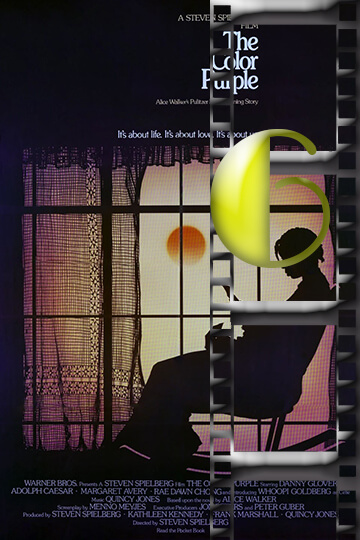
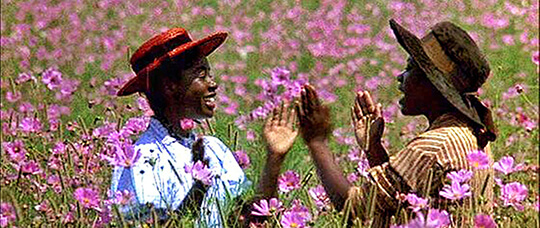
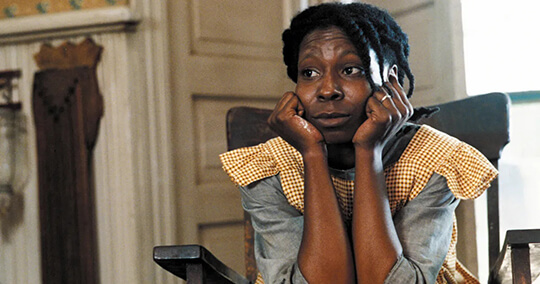
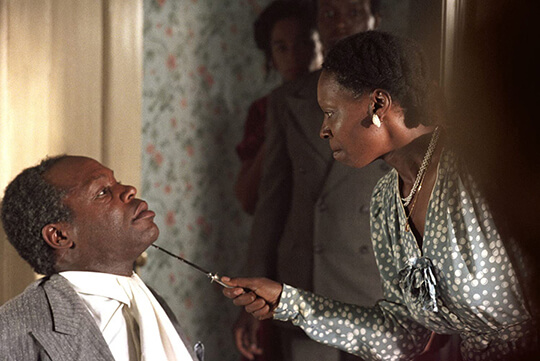
Steven Spielberg’s 1985 adaptation of Alice Walker’s novel “The Color Purple” remains one of cinema’s most polarizing depictions of Black American life. Nearly four decades after its release, this film demands a complex reassessment that acknowledges both its groundbreaking achievements and its problematic limitations through the lens of contemporary film criticism and evolving cultural consciousness. When “The Color Purple” premiered, it generated immediate controversy within Black communities. The film earned a total of eleven Academy Award nominations, positioning it as one of the most nominated films for Oscars in history up to that point. Mainstream critics largely praised Spielberg’s direction, Quincy Jones’s musical score, and the powerful performances of Whoopi Goldberg, Oprah Winfrey, and Danny Glover. At the time, Roger Ebert gave it four stars, saying “not the story of her suffering but of her victory.” However, several Black intellectuals and critics, including the prominent writer Ishmael Reed and the Coalition Against Black Exploitation, denounced the film for depicting negative stereotypes. They argued that Spielberg’s adaptation reduced complex Black characters to familiar stereotypes: the abusive, violent Black male, the hardened but victimized Black woman, and the magical negro figure who brings wisdom and salvation. The complaint was the film’s portrayal of Black men as violent and predatory, while white characters were presented as saviors and benefactors. The NAACP and other groups protested the film, saying its imagery perpetuated racist stereotypes that Hollywood had been selling for decades. These critics were not so much against stories about domestic violence or exploring real problems in Black communities, but rather how these stories were being told and by whom. On a purely cinematic level, “The Color Purple” is the embodiment of Spielberg’s technical sorcery. The film has visual storytelling magic, showcasing an impressive ability to musically underpin the story and film in general, and some stunning visuals, particularly color symbolism and natural lighting. The purple flowers, while only in the beginning and the end, were a potent symbol of beauty surviving trauma. Cinematographer Allen Daviau creates intimate, almost painterly compositions that evoke both the harsh realities of rural Georgia and scenes of transcendent beauty. The acting, particularly by the women, remains riveting. Whoopi Goldberg’s Celie is nuanced but brutally honest, narrating a woman’s odyssey from silence to self-actualization. Sofia is complex and multifaceted in Oprah Winfrey’s hands, refusing to devolve into a flat type of ‘strong Black woman.’ Margaret Avery’s Shug Avery is a marvel who contains a different kind of sensuality alongside a spiritual allure. Quincy Jones’ score appropriately intertwines gospel, blues, and orchestral textures to create a rich emotional fabric that is vital to many of the dramatic high points in the film. The music is not performed nor intended in an appropriative or exploitative tone. Rather, it is a celebration of the place, the musical traditions of the characters, and their communities. Seeing “The Color Purple” with the critical eye of the current moment stripped bare both its visionary elements and its significant blind spots. Black women’s lives were not at the forefront of Hollywood movies in 1985, so this film was groundbreaking in its focus on Celie’s journey toward self-actualization. The film’s frankness in dealing with domestic violence, sexual abuse, and women’s relationships was risky for its time. Yet viewers today, with the advantage of decades of discussion about representation and the male gaze, can more readily spot the film’s problems. Spielberg’s direction, while technically accomplished, too frequently feels like an outsider’s take on Black Southern life. The film’s treatment of violence sometimes veers into exploitation, lingering on brutality in a way that’s voyeuristic rather than instructive. The portrayal of Black masculinity remains particularly problematic. While the book provides more backstory for figures like Mister (Albert), the film reduces most Black male characters to abusers or absences. This reinforces harmful stereotypes about Black men with real-world consequences for how Black families and communities are perceived and treated. In today’s cultural climate, “The Color Purple” would likely face even more severe scrutiny. Contemporary audiences are more attuned to concerns about who gets to tell which stories and how marginalized people are represented onscreen. The fact that the filmmaker is a white male directing a film about the life of a Black woman would certainly raise alarm bells about authentic representation. Since the #MeToo movement, our approach to viewing representations of sexual violence has shifted. The film’s perspective on these structures was novel in 1985, but viewers today might take issue with some of the representations, which at times are gratuitous or exploitative. Certainly, it is important to acknowledge that the film attends to the issues of trauma, but I think there may be criticism of how much it lacks contextual normative knowledge by not establishing the structural racisms and economic exploitations that motivate the traumas. At the same time, many of the film’s contributions, such as the representation of Black women’s resistance, reconceptualizations of spirituality and sexuality, but ultimately, an emphasis on healing and empowerment – will likely continue to appeal to many viewers. Despite its flaws, “The Color Purple” would likely still find an audience today, though perhaps a more divided one. The movie’s themes of survival, sisterhood, and self-discovery remain universal and powerful. Younger audiences new to the film will perhaps be moved by its emotional directness and the intensity of its performances but more critical of its representation choices. The influence of the film on the Black cinema that came after it cannot be overstated. It opened the way to more diversified storytelling but also launched the careers of several Black actors and filmmakers. Its commercial success at the box office proved that movies featuring Black women could be both critically acclaimed and commercially successful. “The Color Purple” is a complex artifact of 1980s Hollywood’s attempt to tackle serious social issues. While it must be credited with bringing Alice Walker’s worthwhile story to a wider audience and with its technical achievement, it also serves to remind us about the importance of authentic representation on screen. The film succeeds as a showcase for outstanding performances and as a visually stunning piece of cinema. However, it fails to be able to transcend the limits of its time and its director’s viewpoint. Today’s viewers can appreciate its historical position while accepting its flaws, a problematic position which can allow us to learn from its shortcomings as well as its accomplishments. In the end, “The Color Purple” is still worth watching, not as a perfect film, but as an important one that started necessary conversations about being seen, authenticity, and the power of storytelling on how we see ourselves and others.
OUR RATING – A REASSESSED 6