
WHAT’S IT ABOUT
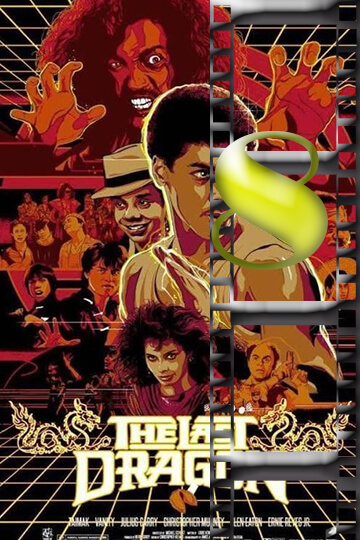
Leroy Green (Taimak), a young martial artist living in New York City, trains tirelessly to attain the same level of mastery as the great Bruce Lee. One night, his life changes forever when he rescues television personality Laura Charles (Vanity) from evil businessman Eddie Arkadian (Chris Murney). Impressed by Leroy’s bravery, Laura falls for Leroy — but to keep her safe, he will have to defeat a gang leader named Sho’nuff (Julius J. Carry III), the self-styled Shogun of Harlem.
MOVIESinMO REVIEW
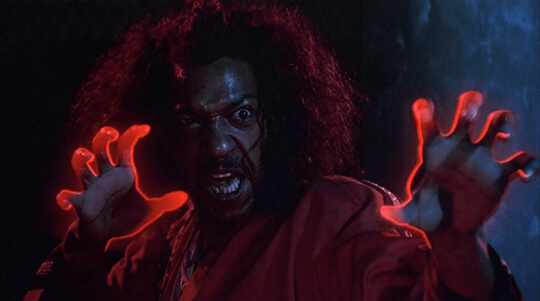
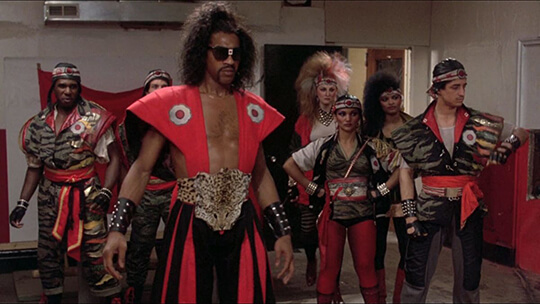
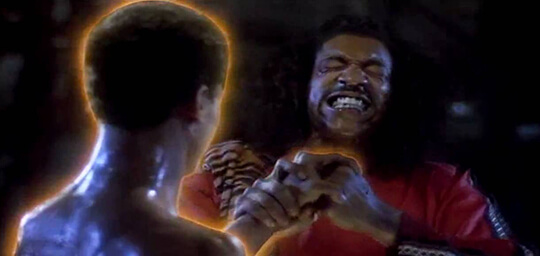
When “The Last Dragon” spin-kicked into theaters in 1985, it was an odd cultural hybrid – a Black-led martial arts film produced by Motown Records founder Berry Gordy that mixed kung fu aesthetics with urban intelligence. Today, four decades later, this cult favorite deserves a reexamination through both historical and contemporary eyes. Does this colorful mix of Eastern mysticism, ’80s pop culture, and Black heroism remain viable today? Let’s see.”The Last Dragon” follows the exploits of Leroy Green (Taimak), a Harlem-based young African-American martial artist who yearns to attain the highest level of martial arts skill – the otherworldly “glow.” His mission is foiled by the villainous Sho’nuff, the self-proclaimed “Shogun of Harlem” (Julius Carry), and Eddie Arkadian (Christopher Murney), an exploitative music video director who has an obsession with video host Laura Charles (Vanity). What ensues is a rousing tale of self-discovery wrapped in a comic book-like presentation that gives laughter and unexpectedly poignant moments. Upon its release, “The Last Dragon” received mixed reviews from mainstream critics, who wrote it off as cheesy, over-the-top, and formulaic. The New York Times called it “an overdressed, overproduced kung-fu melodrama.” White critics overlooked the significance of the film as being one of the first martial arts pictures with a Black star and instead viewed it as merely a Bruce Lee knockoff with a funk soundtrack. The Black press was kinder. Whereas one admits its camp appeal, publications like Jet magazine acclaimed the film for presenting a wholesome Black male hero who was nice, respectable, and heroic – a much-needed break from the last ten years of blaxploitation fare. The film’s box office success ($33 million on a $10 million budget) proved there was actually an audience hungry for this one-of-a-kind cultural fusion. What mainstream media critics missed was the subversive brilliance of the film. In an age where Black protagonists on mainstream movie screens were often confined to sidekicks or stereotypes, “The Last Dragon” unflinchingly placed a Black martial arts master in the starring role on his own esoteric quest. The film’s conscious syncretism of Black and Asian influences – at times awkward but never insincere – was a premature form of cross-cultural veneration that anticipated its moment by decades. From a more progressive critical perspective, “The Last Dragon” is noteworthy for what it gets right and what it gets wrong. How martial arts culture was approached within this film would today be criticized. Leroy’s following of Bruce Lee-look martial arts and Eastern spirituality in some places crosses the line of cultural appropriateness with the mannerisms and speaking patterns he adopted. His name is often invoked as “Bruce Leroy,” highlighting the imitative nature of his name. But there’s genuine admiration in the way the film does these things – Leroy’s journey is not parody, but sincere. The Sho’nuff character would evoke mixed reactions nowadays. Julius Carry’s scene-stealing turn as the over-the-top villain is uncontainably campy fun, but his hammy acting and catchphrases (“Who’s the master?”) may be interpreted as caricature. But there is also something transgressive about his character – in creating his own martial arts persona rather than aping Asian role models, Sho’nuff is a sort of cultural hybrid. Worse is the Chinese characters in the film, who are represented as mysterious, exotic, wise men – two-dimensional caricatures rather than fully developed characters. Orientalist tropes of fortune cookies and the “glow” mysticism would be fingered today. Yet, “The Last Dragon” is an uplifting tale of Black agency. Leroy’s commitment to self-discipline, respect, and self-betterment is nothing like the stereotypical depictions of young Black men in the popular culture of the 1980s.The Harlem of the movie is prosperous and diverse, and Black characters range across socioeconomic lines. Laura Charles presents a vision of Black female success unprecedented for the era – an independent, assertive media figure uncharacterized by her relationship with men. What remains of “The Last Dragon” is its cheerful, unapologetic mixing of otherwise distinct cultural modes. It anticipated the cross-cultural borrowing that would later define hip-hop culture, in which the borrowing of Asian martial arts visual aesthetics became commonplace. The legacy of the film can be traced from as far as the Wu-Tang Clan’s love of martial arts to the visual choices in more recent fare like “Into the Spider-Verse.” To modern audiences, especially those who came of age on the irony-drenched cross-culturalism of the internet age, “The Last Dragon” offers an unapologetically earnest interpretation of genre-mashing. Its naivety can be a touch too much to handle, but there’s something endearing about its unfettered belief in heroism and self-betterment. Modern audiences would be drawn to “The Last Dragon” on multiple fronts. For ’80s die-hards, the film nails it with its synth score, neon hues, and pre-CGI practical effects. Younger audiences might appreciate its rags-to-riches tale and high-octane action and see its cultural relevance. The film’s pacing might feel glacial to viewers accustomed to action sequences in modern films, and some of the dialogue will sound undeniably old-fashioned. But the appeal of its actors – particularly Taimak and Julius Carry – transcends the decades. The film’s corny, sincere lack of irony makes it lovable even as its references become increasingly esoteric. “The Last Dragon” occupies a unique place in film history – an innocent, hopeful celebration of Black heroism prettied up in the guise of martial arts film. Although some elements have not aged as well as others, its uncompromising message of self-sufficiency and personal growth remains powerful. Contemporary audiences will wince at some of the stereotypes and cultural simplification, but good-spirited energy and genuinely progressive elements of the film serve to counteract these issues. What still keeps “The Last Dragon” worth watching in 2025 is precisely what made it exceptional back in 1985 – it was not afraid to imagine Black protagonists at the forefront of a quest typically reserved for white or Asian heroes. It created a world in which a Harlem-born young Black man could find enlightenment through inner strength and self-discipline, in which love could flower without exploitation, and in which the good guy would triumph by merit rather than through violence alone. In an era of endless remakes and IP exploitation, the genuine originality of “The Last Dragon” is revitalizing. It’s a film that, in spite of its shortcomings, captured an instant of cultural potential that still resonates. And when Leroy finally gets his “glow” in the climactic final showdown in the film, it’s a genuinely thrilling moment of Black heroism that transcends its cheesy ’80s origins. Sho’nuff, for that, it is worth honoring.
OUR RATING – A BERRY GORDY 8